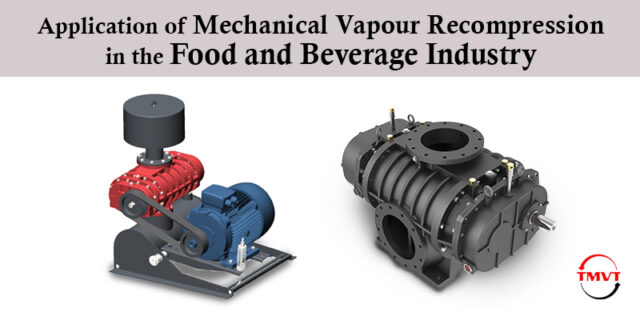
The food and beverage sectors are extremely energy-intensive, with manufacturing processes (especially heating and evaporation) accounting for a large share of energy use. Mechanical vapour recompression (MVR) offers a way to reuse latent heat rather than discard it, dramatically improving energy efficiency. In an MVR evaporator, the process vapor is mechanically compressed and recycled as a heat source. This can cut evaporation energy needs by up to 90% versus conventional steam processes.
How Mechanical Vapour Recompression (MVR) Works
MVR systems are essentially closed-loop heat pumps. The key components include:
Evaporator
The vessel where the liquid (juice, milk, wastewater, etc.) is boiled to generate vapor.
Roots blower (positive-displacement compressor)
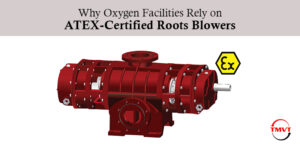
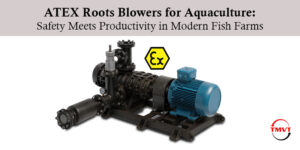
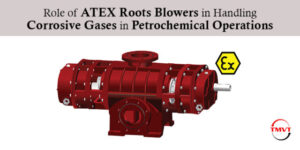
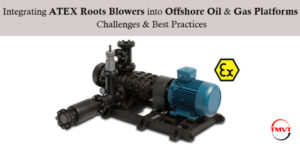
A rotary lobed blower (often a 2- or 3-lobe Roots-type machine) that draws in the process vapor from the evaporator and compresses it to a higher pressure and temperature.
Heat exchanger (condenser)
The compressed vapor condenses on heat-exchanger surfaces, transferring its latent heat back to the feed or preheater.
In operation, the evaporator heats the product until it boils. The vapor rises to the Roots blower, which “pulls in and compresses the evaporator’s vapor, raising its temperature”. The hot compressed vapor is then routed through a heat exchanger or the boiling chamber itself, where it condenses. The released heat reheats the incoming feed liquid. Because the vapor is reused, no fresh steam is needed (after initial startup). This cycle continues automatically: each recompression loop generates just enough hot vapor to sustain the next evaporation step, yielding a self-sustaining process.
Applications in the Food & Beverage Industry
MVR is widely used wherever evaporation or distillation is part of food processing. Its ability to concentrate fluids efficiently makes it a fit for many Food & Beverage segments:
Fruit Juice Concentration
Juice producers use evaporators to remove water from juices (apple, grape, orange, tomato, etc.), both to preserve flavour and reduce costs. MVR-equipped evaporators significantly cut the steam required. A study of a juice plant showed that retrofitting to MVR reduced annual steam consumption by over 70%, saving hundreds of euros per year. In practice, many factories now combine MVR with aromatic recovery: high-energy vapor is recompressed to preserve delicate flavours, yielding concentrated juice with better quality. (Food-industry MVR systems are often used to concentrate tomato or fruit juices.)
Dairy and Milk Powder
Evaporating water from milk (to make skim milk powder or whey powder) is extremely energy-intensive. New Zealand’s dairy sector leads in MVR use: over 100 MVR blowers are installed on milk evaporators nationwide. Compared to multi-effect steam evaporators, MVR greatly reduces fuel needs and improves product quality. In fact, modern milk plants routinely run with three MVR evaporators in parallel, allowing continuous 30-day production runs between cleanings. MVR systems are now standard in greenfield milk powder facilities, enabling zero or near-zero liquid waste and much higher energy utilization.
Non-Alcoholic Beverages
Other drinks like concentrated syrups, teas, coffee extracts, etc. Similarly benefit from MVR. Wherever a liquid is being concentrated, MVR can replace boiler steam. For soft drink or nectar manufacture, MVR evaporators preheat and concentrate the syrup, slashing steam costs. One example is the concentration of liquid sweeteners (like corn syrup or fructose) in beverage ingredients specialized evaporators reclaim the vapor heat internally.
Starch and Sweeteners
Corn wet-milling and sugar refining involve massive evaporation steps. MVR was pioneered in the corn industry, by compressing and recycling the process vapor, plants can halve or better their energy bills. Today, MVR evaporators handle streams like corn syrup, dextrose, glucose, and fructose, achieving higher solids and lower waste. Fewer effects are needed, and the high-temperature vapor recovery means less fuel. Overall, MVR integration in sugar and starch plants yields much lower operating costs and smaller equipment than equivalent steam-only systems.
Brewing and Distillation
Breweries and distilleries generate steam-rich vapours) that can be recompressed. For instance, a whisky distillery installed MVR blowers to capture still vapor heat. The recovered heat boiled the next batch of wash, cutting energy use by nearly half. Many modern breweries capture their brewhouse vapours similarly. MVR is also used on spent grain or wash streams to recover latent heat. In short, alcoholic beverage production can embed MVR to turn waste heat into reboiler energy, reducing reliance on boilers and cooling towers.
Wastewater and Zero-Liquid-Discharge (ZLD)
Treating and reducing effluent is a growing need. MVR evaporators are ideal for concentrating brewery, winery, or other food-processing waste streams. By evaporating industrial wastewater, plants can reuse nearly 100% of the water. With MVR, almost no fresh steam is needed for ZLD, the vapor from boiling the effluent is recompressed and reused. For example, heavy-organic effluents can be processed in multi-effect MVR systems to achieve zero discharge, slashing disposal costs. Industry guides note that MVR systems “require almost zero steam and cooling water during steady operation” and fit any evaporator type.
In summary, mechanical vapor recompression is found across virtually all Food & Beverage sectors from fruit-juice concentrate plants to dairy powder factories, from syrup and sugar refineries to breweries and wastewater ZLD systems. Any process that boils off water (or solvent) can leverage MVR to reclaim that thermal energy.
Benefits of Mechanical Vapour Recompression Systems (MVR) in the Food & Beverage Industry
Mechanical Vapour Recompression is a technology that has been adopted by the food and beverage industry because of its efficiency in recovering and reusing process heat. Here are some of the main benefits that have driven its adoption in the industry.
Significant Energy Savings
MVR Systems can reduce energy use by up to 90 when compared with traditional steam-based Evaporators. These systems are highly cost-effective because they use vapor to heat the system, rather than steam or fuel.
Lower operating costs
Because MVR relies upon electricity instead of continuous steam generation, operation costs are greatly decreased. Facilities that use MVR report shorter ROI periods – typically between two to three years – especially in energy-intensive processes such as juice, dairy and starch concentrate.
Lower Carbon Emissions
MVR systems reduce CO2 emissions by reducing the reliance on fossil-fuel boilers. This helps facilities to meet corporate sustainability goals and environmental compliance standards. Some installations have achieved 50 or more in emission reductions.
Water conservation
In the evaporative process, MVR systems reuse and recover almost all of the water vapor produced, reducing fresh water consumption and wastewater discharge. This is particularly valuable for plants that aim for zero-liquid discharge (ZLD)..
Improved product quality
MVR allows gentle steam evaporation to occur at lower temperatures. This preserves flavours, colors, and nutrients of sensitive products such as fruit juices, milk, or extracts. This process minimizes thermal degradation, resulting in a better product and less cleaning.
Compact Design and Scalable
Modern systems can be customized to fit both small and large operations. They are ideal for upgrading or adding to new facilities because of their small footprint, and the ability to scale up with production needs.
Low Maintenance and High Uptime
With fewer moving pieces and no requirement for high-pressure Steam systems, MVR installations generally experience less maintenance costs as well as longer service intervals. The mechanical simplicity of MVR setups translates into more predictable performance, and fewer unexpected shut-downs.
Why TMVT’s Roots-Blower MVR Systems
TMVT’s solutions use robust Roots-type blowers as the compressor in MVR systems. This choice brings several advantages for food processors:
High Efficiency & Energy Savings
Roots blowers provide a smooth, pulse-free flow of vapor, which improves heat transfer stability. TMVT’s blowers are optimized for efficiency; their positive-displacement action minimizes slippage and energy loss. In practice, TMVT notes that their Roots blowers deliver “high efficiency with low energy consumption”. By contrast to less efficient compressors or steam ejectors, a well-designed Roots blower allows an MVR system to run almost entirely on electrical power, eliminating the constant boiler demand.
Durability and Reliability
MVR evaporators often operate continuously under tough conditions (high pressure/temperature and corrosive vapours). TMVT’s Roots blowers are built with heavy-duty construction for industrial use. As stated on their site, these blowers offer “reliable performance” and are “built to withstand demanding industrial environments”. The robust rotors and housing resist wear and fouling, giving long service life even with carryover or entrained solids. Low vibration design further reduces mechanical strain. Users benefit from the dependable operation: roots blowers sustain constant load without surging, unlike some high-speed turbo units.
Adaptability and Low Maintenance
Roots blowers handle a wide range of flow rates and pressures without phase changes or lubrication issues. TMVT’s technology allows flexibility in process conditions; many units can be fitted with variable-speed drives or inlet guide vanes for turndown. The simple design (few moving parts) makes maintenance easy. TMVT highlights that their blowers require “low maintenance” and have low noise. In practice, once installed, a TMVT Roots blower-based MVR system can often run for years with minimal upkeep.
Tailored Solutions
TMVT offers multiple series (twin-lobe, three-lobe) to match the exact vapor volumes and pressures of a given evaporator. Whether a small juice plant or a large dairy, TMVT can size the blower for optimal load. Its experience means each system is engineered for the client’s fluid (vapor characteristics, required compression ratio, etc.). In short, TMVT’s Roots-blower MVR packages combine rugged construction with energy-optimized design, delivering a high-performance evaporator.
Conclusion
Mechanical vapour recompression has proven its worth across the food and beverage industry. By recapturing latent heat, MVR systems (especially when using durable Roots blowers) achieve massive energy and cost savings. Applications range from fruit juice and dairy concentration to brewing/distillation and wastewater recycling. TMVT’s MVR solutions, built around robust Roots-type blowers, offer the reliability and efficiency that food plants demand. These systems not only cut operating expenses, but also reduce greenhouse gas emissions and water use.
For more information on how mechanical vapour recompression can optimize your process, see TMVT’s product page on MVR systems Mechanical Vapour Recovery Solutions. Their team can help design Roots blower tailored to your food or beverage application – unlocking both environmental and economic benefits.