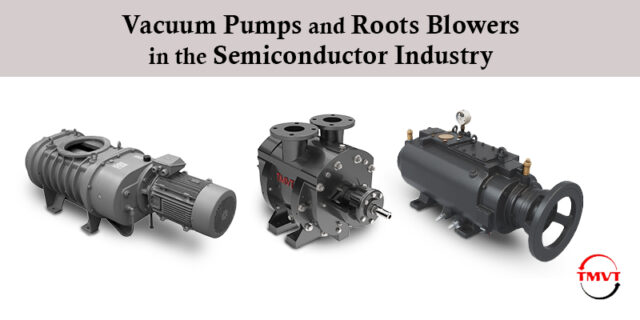
Semiconductor fabrication relies on precise vacuum environments to ensure high-quality chips. Vacuum pumps remove gases to create clean, controlled low-pressure conditions for processes like crystal growth, deposition, etching, wafer handling, and vacuum sintering. TMVT a leading Indian manufacturer of vacuum pumps and blowers supplies oil-free dry screw and liquid-ring vacuum pumps along with high-capacity roots-type blowers worldwide to meet these exacting needs. Modern fabs demand continuous 24/7 operation with flows of thousands of cubic meters per hour and vacuum levels typically in the 100–400 mbar range. This means vacuum systems must be highly reliable, oil-free and contamination-free, as even minor leaks or hydrocarbons can ruin semiconductor layers. In practice, fabs use a combination of vacuum technologies: a primary roughing pump (dry or liquid) for coarse vacuum, backed by a mechanical booster (roots blower) to reach mid-range vacuum, often followed by finer pumps if needed.
Dry and Liquid Ring Vacuum Pumps for Semiconductor Processes
Dry Screw Vacuum Pumps
These pumps use two intermeshing rotors turning in opposite directions to trap and compress gases. In semiconductors, dry screw pumps are valued for oil-free, clean operation, there is no oil in the pumping chamber, so the exhaust is free of hydrocarbon contaminants. TMVT’s dry screw series (e.g. VP, PW models) feature compact, robust designs with mechanical seals and variable pitch rotors for efficient gas handling. Industry sources note that screw pumps offer high pumping speeds, excellent energy efficiency and minimal maintenance. For example, such pumps can continuously evacuate chambers without oil carryover, making them ideal for ultra clean processes like CVD/PVD deposition or ion implantation, where any oil vapor would degrade device quality.
Liquid Ring Vacuum Pumps
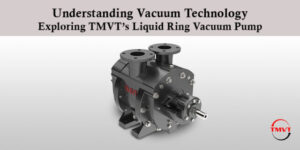
Liquid-ring pumps use a rotating liquid to form a seal against the casing. As the impeller spins, the liquid ring traps and compresses gas. This design handles moist, corrosive or condensable gases very well. TMVT’s liquid ring pumps (LRV/LRK series) achieve rough vacuum levels up to ~50 mmHg abs. per stage with water at 30 °C, and even deeper vacuums when special seal fluids or multi-stage arrangements are used. The liquid seal acts as both the working fluid and sound damper, so these pumps run quietly and vibration free, and can tolerate condensable vapours or entrained liquids without damage. In fact, the only moving part is the impeller, there is no metal-on-metal contact so wear is nearly zero. Liquid-ring pumps can also double as oil-free compressors (delivering an oil-free discharge) and offer long service life with minimal upkeep. This makes them well-suited for wet-process steps in fabs where large vapor loads or moisture are present.
Key features of these pumps include oil-free gas handling (preventing contamination), large vapor capacity (liquid-ring units condense or sweep out moisture), and robust construction for continuous use. TMVT’s pumps are engineered to meet semiconductor specifications. for example, LRV/LRK pumps can be constructed from cast iron or stainless steel depending on the gas corrosiveness, and they support open or closed liquid circulation systems for process integration. Together, dry screw and liquid ring pumps cover the needs for contamination-sensitive evacuation (dry pumps) and heavy condensable/vapor loads (liquid pumps) in wafer fabs.
Roots Blowers (Mechanical Boosters) in Semiconductor Production
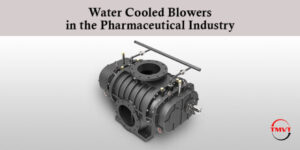
Roots-type blowers are positive-displacement, dry running pumps that use rotating lobes to move gas. They do not compress internally, so they function as boosters to lower pressure when paired with a primary pump. Roots blowers excel at moving very high gas flows at moderate vacuum: industry data shows a single-stage roots pump can deliver 2 to 8 times higher the pumping speed of its backing pump. In practical terms, this means a roots blower can evacuate a large chamber much faster than a single pump alone, which is crucial in high-volume semiconductor fabrication.
Roots blowers come in twin-lobe and three-lobe designs. TMVT’s Twin Lobe Series (MTLK, ETP, MP) uses two intermeshing lobes to boost pressure. These units handle discharge pressures up to about 1.0–2.2 kg/cm² (14–31 psi) in single- or double-stage form, and can operate down to roughly 600 mbar absolute on the vacuum side. All rotors and casings are machined to tight tolerances, and optional acoustic hoods can reduce noise by ~10–12 db. Such blowers are splash lubricated for long life and are rigorously tested for capacity and vibration.
TMVT’s Three-Lobe (Tri-Lobe) Series (3MTL) represents an advanced roots design. By using three twisted lobes instead of two, the tri-lobe blower significantly smooths out the pulsation in the outlet flow. In practice this yields much lower discharge pressure variation, which translates to less vibration and ~20% longer bearing life. The three-lobe geometry also cuts acoustic noise (about a 5 db reduction). Importantly, TMVT’s tri-lobe blowers separate the oil chamber from the gas chamber, so the displaced air is completely oil-free. They cover huge flow ranges (5 to 60,000 m³/h) with discharge pressures up to 1 bar and vacuum down to ~0.5 bar abs.
In a vacuum system, roots blowers are often staged after a primary pump. For example, a dry screw or liquid pump may rough out a chamber to ~1–10 mbar, then a roots booster further reduces pressure to the required level. By combining a roughing pump and a roots booster, fabs can achieve vacuums roughly ten times lower than with the roughing pump alone. This staged approach also allows the heavy lifting to be done by the booster, while the backing pump covers the base pressure. Because roots blower operate contactless and require no seal fluids, they add capacity without contaminating the vacuum line.
Key Advantages of Roots Boosters in Semiconductors:
Roots blowers provide instantaneous high pumping speed for large chambers, speed up pump down cycles, and maintain stable vacuum during fast gas loads. Their dry, positive-displacement design is inherently contamination-free. TMVT’s high-precision roots blowers (twin- or tri-lobe) deliver these benefits while fitting into tight cleanroom specs. In practice, they are widely used to accelerate processes like PECVD, LPCVD and etching.
System Integration and Performance Specifications
A complete semiconductor vacuum system integrates pumps, boosters, valves and controls to meet process requirements. Typical specifications include required ultimate vacuum, pumping speed, gas throughput, and allowable trace contamination. TMVT’s liquid-ring pumps can reach ~50 mbar (single stage) and ~40 mbar (two-stage) with water seals; using cascade stages or special fluids can lower this further. Dry screw pumps can achieve much lower pressures (often in the 10⁻²–10⁻³ mbar range) and are suited for very clean processes. Roots blowers then lift these baselines: TMVT’s tri-lobe units can pull down to about 0.5 bar abs (500 mbar) without help; when paired with a backing pump they reach deep vacuum rapidly.
Performance specs are also tuned to flow and power. For instance, three-lobe blowers consume roughly 5–10% less power than equivalent two-lobe models under similar loads, due to smoother flow. All TMVT blowers use heavy-duty bearings and gears to handle wide operating ranges. In electronics fabs, central vacuum systems often serve multiple tools and notes that typical fabs may require flows of 2,000–8,000 m³/h. Accordingly, TMVT offers pump and blower families sized up to tens of thousands m³/h.
In practice, vacuum pumps for semiconductors are installed in utility rooms away from clean production areas to avoid any potential contamination. Intelligent controls and redundancies ensure that house vacuum never fails. TMVT vacuum systems can be integrated with valves and controllers to match throughput demands. For example, a controller may modulate a roots booster to maintain constant pressure as etch gases are pulsed in and out.
Applications and Advantages in Semiconductor Processes
Vacuum pumps and blowers from TMVT find roles throughout the wafer fab.
Crystal growth and epitaxy
requires low-pressure inert environments (often ~10⁻³ mbar) to grow silicon or compound crystals, relying on clean dry pumps for initial pull-down.
Thin-film deposition (CVD/PVD)
Demands precise vacuum control during gas-phase deposition of layers. Here liquid-ring pumps handle any gas by-products while dry pumps or boosters handle the base vacuum.
Plasma etching
involves reactive gases; roots boosters quickly evacuate the chamber between process steps to save cycle time.
Wafer handling and pick-and-place
use house vacuum for vacuum chucks and robots; dry vacuum pumps provide steady, oil-free flow for pick-and-place tooling.
Vacuum abatement
post-etch scrubbing uses liquid-ring pumps to process acid vapours. In all cases, clean dry output is mandatory.
The advantages of TMVT’s solutions include:
Oil-Free Operation
Both dry screw and roots blower run oil-free (liquid-ring pumps use clean water or compatible fluids). This guarantees that no oil vapor contaminates sensitive wafer environments.
High Pumping Speed and Capacity
As noted by industry sources, roots blowers can achieve 2 to 8 times higher speed of a single-stage pump, moving vast gas volumes to quickly evacuate equipment. TMVT offers blowers up to 60,000 m³/h to match ultra-large fab requirements.
Low Maintenance & Long Life
TMVT pumps use simple, robust designs. Liquid-ring units have only one moving part, virtually eliminating wear. Dry screw pumps have few internal parts and use durable mechanical seals. All blowers are splash-lubricated and tested to industry standards. The end result is minimal downtime – crucial in 24/7 fab operations.
Noise and Vibration Control
Semiconductor fabs are noise-sensitive. Liquid-ring pumps inherently dampen sound via the liquid seal. TMVT’s blowers can be fitted with acoustic enclosures to cut noise by ~10 dB, and tri-lobe designs further reduce pulsation by ~5
Energy Efficiency
Smooth-flow roots blowers and variable-speed drives help lower power consumption. For example, tri-lobe blowers reduce pressure pulsations, saving energy. TMVT also offers motor and drive options to optimize power use.
Flexibility and Customization
TMVT can configure pumps with various materials (cast iron, SS) and accessories to fit a process. For corrosive or high-temp applications, special coatings or sealants are available. They can also supply complete packaged vacuum systems with controls and gauges tailored to semiconductor use.
Conclusion
In summary, choosing the right vacuum components is crucial for semiconductor yield and productivity. TMVT’s decade-plus experience in vacuum technology means customers get expertise, ISO-certified quality and global service. Our vacuum pumps and roots blowers are engineered for the demanding specifications of chip fabs: high speed, high purity and high reliability. By combining TMVT’s dry screw, liquid ring and roots blower technologies, semiconductor manufacturers can achieve the precise vacuum levels and contamination-free conditions that advanced chip processes require – ultimately maximizing throughput and minimizing defect rates