The efficacy of large-scale industrial material handling hinges on the performance of the air source. For engineers and process designers specializing in pneumatic conveying, the challenges presented by traditional air technologies, notably high energy consumption, frequent maintenance cycles, and the persistent risk of oil contamination often define operational bottlenecks. High-speed, gearless turbo blowers, utilizing advanced airfoil bearing technology, represent a fundamental shift in fluid dynamics application, moving the system from merely adequate material transfer to optimized, precision throughput.
As a leading global industrial manufacturer, TMVT provides solutions engineered to redefine these industry standards, offering verifiable energy savings of up to 30%. This analysis details how modern gearless turbo blower architecture addresses the critical requirements of advanced pneumatic conveying systems, ensuring precision flow dynamics, guaranteeing oil-free air purity, and delivering an optimized Total Cost of Ownership across global operations.
The Engineering Imperative: Precision Control for Conveying Dynamics
In pneumatic conveying, air velocity is the most critical factor, dictating both the material transfer efficiency and the integrity of the bulk solids. Process engineers must constantly balance the demands of two primary modes – dilute phase and dense phase conveying.
Dilute phase conveying is characterized by high air velocities, typically ranging between 700 and 1,000 meters per minute, where materials are suspended fully within the air stream. This mode is often suitable for free-flowing materials and longer distances. In contrast, dense phase conveying is utilized for fragile, abrasive, or cohesive materials such as pharmaceuticals, catalysts, or heavy powders, where the material is transported in plugs or waves at low velocity, resulting in a high solids-to-air ratio, often 100:1 or more.
VFD-Enabled Management of Minimum Transport Velocity
A core engineering challenge is preventing line blockages, which occur when air velocity drops below the minimum required transport threshold necessary to keep particles suspended. For reliable dilute phase transfer, the minimum conveying velocity (which can range from 10 to 16 meters per second for fine to coarse materials) often requires an additional 20% buffer for minimum pick-up velocity.
Maintaining this threshold requires a precise and dynamic air flow source. The VFD-controlled, high-speed turbo blower utilizes an optimally customized Variable Frequency Drive linked to a Permanent Magnet Synchronous Motor. This configuration provides the dynamic turndown ratio essential for modulating air flow in real-time.
The ability to precisely adjust air flow allows operators to fine-tune the solids loading ratio dynamically. This is crucial when material input changes or when the system must switch between conveying modes without the wasteful over-pressurization common in fixed-volume systems. This precision ensures system stability, which is the necessary prerequisite for preventing the velocity instability that frequently precipitates blockages and system downtime.
Mitigating Material Attrition and Pipe Wear
High velocities, while necessary for the dilute phase, introduce significant kinetic energy that causes material degradation and fines generation. This is particularly problematic for friable or brittle materials. The precision flow control afforded by the VFD allows engineers to operate closer to the actual, optimized minimum conveying velocity. This prevents excessive acceleration, reducing particle impact energy at elbows and bends, thus protecting material integrity and minimizing damage to the pipeline itself. The broad operational capacity of TMVT Turbo Blowers ranging from 300 to 18,000 M³/hr with pressures up to 0.8 Kg/cm² in normal condition and up to 1 Kg/cm² in special cases, ensures that the system can be optimally sized for specific bulk densities and conveying distances, avoiding the unnecessary energy consumption and high-velocity risks associated with oversized components.
Dynamic Control Requirements for Pneumatic Conveying Modes:
| Conveying Mode | Typical Velocity Range | Mass Loading Ratio (SLR) | Material Risk Profile | Blower Control Requirement |
| Dilute Phase | High (700 – 1,000 m/min) | Low (up to 15:1) | High Attrition/Abrasion Risk | Precise VFD control to prevent velocity spikes and maintain minimum transport velocity |
| Dense Phase | Low (Plug/Wave movement) | High (100:1 or more) | Friable/Abrasive Materials | Stable, high-pressure output with flow modulation to manage plug formation and maintain low-velocity operation |
| Minimum Pick-Up Velocity | 10-16 m/s + 20% Buffer | N/A | Line Blockage Risk | Rapid response from VFD/motor system to handle sudden material feed or pressure transients |
The Airfoil Architecture: Reliability and Energy Efficiency
The functional superiority of the high-speed turbo blower in pneumatic conveying is fundamentally derived from its gearless, frictionless architecture, which contrasts sharply with traditional positive displacement or geared centrifugal systems.
Gearless Design and Frictionless Operation
The core innovation is the non-contact Air Bearing, which is lubricated purely by air buoyancy. Derived from aviation turbine technology, this design eliminates all physical friction, which in turn eliminates wear and tear. This results in a semi-permanent service life and drastically reduced maintenance requirement. The design eliminates the need for oil, seals, lubrication systems, gearbox inspections, and alignment procedures required by conventional blowers. Routine care is minimized, typically consisting only of inlet filter monitoring.
This simplification of mechanical reliability offers a significant advantage in global operations. The inherent reliance of geared systems on a complex inventory of specialized spare parts (e.g., oil pumps, seals, specialized bearings) makes them vulnerable to global supply chain disruptions and logistical bottlenecks, leading to costly stockouts and unpredictable downtime. By eliminating these high-wear components, the airfoil technology transforms reliability into a strategic asset, significantly reducing operational vulnerability and securing higher uptime for 24/7 industrial settings.
Maximizing Isentropic Efficiency via Permanent Magnet Motors
TMVT utilizes the Latest Energy Efficient Permanent Magnet Synchronous Motor to drive the high-precision aerodynamic impeller. This is critical to efficiency. The P-M motor’s rotor has a built-in permanent magnet, which means power is required only to rotate the shaft and not for the energy-intensive magnetization of the rotor. Coupled with the direct-drive system, which eliminates transmission losses, this architecture results in verifiable energy savings of up to 45% compared to less efficient conventional technologies.
This efficiency advantage is vital in pneumatic conveying, where power consumption directly impacts the Specific Energy Consumption per ton of material moved. For industries transitioning away from older, less efficient technologies, this level of energy saving is substantially greater than the 10% to 35% typically cited for standard centrifugal upgrades.
Integrated Solution for Global Deployment
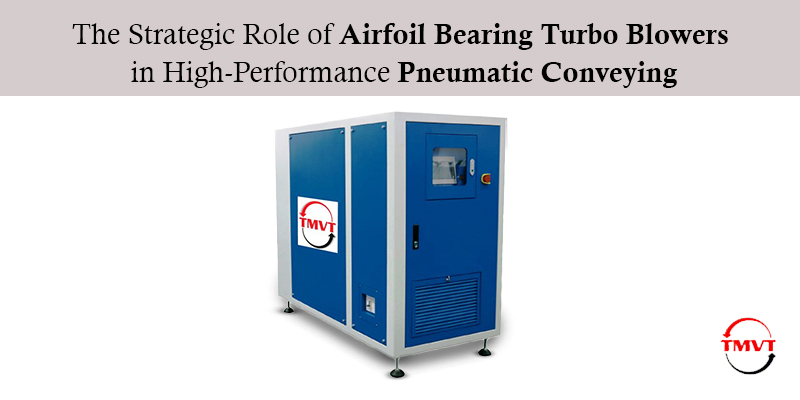
Addressing international logistical pain points, the airfoil bearing turbo blower is built as a complete system in a sound-proof enclosure. The gearless, compact design results in low vibration and noise and requires “no need for extra lifting devices, special foundations, or time-consuming alignment procedures”. This plug-and-play capability drastically cuts down on initial project lead times, reduces reliance on specialized site preparation, and minimizes the civil engineering costs associated with traditional heavy machinery installation.
TMVT Technical Features and Conveying Application Benefits:
| TMVT Feature | Technical Mechanism | Benefit for Pneumatic Conveying Performance |
| Non-contact Air Bearing | Air buoyancy replaces oil/gears | Zero oil contamination (ISO Class 0); Near-zero maintenance and spare parts inventory |
| Permanent Magnet Synchronous Motor (P-M Motor) | Synchronous operation, no slip | Up to 30% energy savings; Consistent high torque across variable speeds |
| Capacity up to 18,000 M³/Hr; Pressure up to 0.8 Kg/cm² in normal condition and up to 1 Kg/cm² in special cases | High-precision Direct-coupled Aerodynamic Impeller | Wide operational envelope, suitable for diverse bulk densities and long pipeline requirements |
| Customized Variable Frequency Drive (VFD) | Dynamic rotation speed control | Precise regulation of volumetric flow; Optimized Solid Loading Ratio (SLR) for attrition control |
| Sound-proof Enclosure Package | Integrated compact design | Extremely low noise/vibration; Eliminates need for special foundation and complex installation |
The Zero-Risk Mandate: ISO Class 0 Air Purity
For sectors handling sensitive materials including Food and Beverage, Pharmaceutical, and Specialty Chemical manufacturing, air quality is a non-negotiable component of operational integrity and regulatory compliance. In these processes, compressed air often contacts the final product, meaning there is zero tolerance for contamination.
Achieving Purity at the Source
The global standard for air purity is governed by ISO 8573-1 Class 0, which defines the acceptable limits for particulates, moisture, and, critically total oil content. Conventional blowers must be paired with extensive downstream filtration and treatment systems to scrub oil aerosol from the output air, adding significant capital cost, pressure drop, and ongoing energy load to the system.
The application of non-contact Air Bearings eliminates the need for oil entirely. Since the mechanical assembly is inherently oil free grease free and seal free the turbo blower inherently delivers Class 0 air quality at the source. This strategic benefit bypasses the complex costly and energy intensive filtration process simplifying system design. To further ensure absolute purity the system is equipped with a high-performance inlet air filter of 1-micron capacity which actively prevents maximum dust particle contamination. This provides unparalleled protection against batch contamination and regulatory non-compliance thereby integrating compliance assurance directly into the conveyance technology.
Operational Intelligence: PLC and Predictive Maintenance
Modern industrial air systems require integrated controls that do more than merely switch the machine on and off, they require operational intelligence to maximize productivity and efficiency. TMVT integrates a sophisticated Programmable Logic Controller (PLC) and a user-friendly touch screen Human Machine Interface into the standard turbo blower package.
Real-Time Performance Monitoring
The PLC continuously monitors and displays critical operational parameters. This includes pressure, temperature, air flow, motor RPM, and, significantly, motor power consumed. This comprehensive data collection moves monitoring beyond simple status checks into a powerful analytical tool. This continuous stream of performance data is the backbone of an Industry 4.0 maintenance strategy, enabling predictive maintenance protocols.
By utilizing this data, engineers can detect minor issues before they escalate into major failures. For example, the system can instantly flag unusual pressure drops, which are often the precursors to air leaks or impending line blockages. More critically the continuous tracking of air flow and consumed motor power allows facilities to calculate and actively manage their Specific Energy Consumption SEC the precise energy required to convey a unit of material. This provides a verifiable Key Performance Indicator KPI for continuous efficiency audits and process optimization. This high level of real time diagnostics and control ensures maximized equipment life cycles and minimized production downtime. Furthermore, various electronic interlocks ensure the machine safety if any unusual parameter change occurs effectively protecting the asset against operational anomalies.
Conclusion: The Total Economic Value Proposition
While the advanced engineering inherent in airfoil bearing turbo blowers may necessitate a higher initial capital investment compared to older, more rudimentary technologies, the true metric of value in industrial engineering is the Total Cost of Ownership.
The gearless, frictionless architecture directly eliminates the recurring and substantial costs associated with traditional systems: frequent oil changes, filter replacement, gearbox maintenance, specialized labour, and the logistical burden of maintaining a complex spare parts inventory. Furthermore, the exceptional operational efficiency, resulting in energy savings of up to 45%, delivers a rapid and favourable Return on Investment purely through reduced utility costs.
Lifecycle Economics and Operational Resilience:
| Cost/Risk Factor | Airfoil Bearing Turbo Blower | Traditional Geared Blowers (Comparative) | Impact on Total Cost of Ownership (TCO) |
| Energy Consumption | Up to 30% Reduction | Baseline (Higher Power Draw) | Major long-term savings; low specific energy consumption (SEC) |
| Maintenance Labour & Parts | Near-Zero: No oil, gears, or alignment needed | High: Scheduled oil changes, filter replacement, gearbox/bearing overhauls | Significant reduction in labour, maintenance budgets, and spare parts inventory |
| Risk of Contamination | Zero (Inherent ISO Class 0) | High (Requires intensive filtration) | Mitigation of product loss and regulatory fines; protection of material purity |
| Installation Complexity | Low: No special foundation or alignment required | Moderate-to-High: Requires specialized foundation and rigorous alignment | Reduced initial project costs and faster commissioning time |
| Downtime | Extremely Low (Predictive maintenance via PLC) | Moderate (Prone to wear-related failures, long lead times for specialized spares) | Maximized operational output and reliability (24/7 capacity) |
The convergence of precision VFD flow control for maximizing throughput and minimizing attrition, guaranteed ISO Class 0 air purity, and the foundational reliability of frictionless mechanics positions the airfoil bearing turbo blower as an essential strategic asset. This technology not only ensures compliance and product quality but fundamentally lowers the specific energy consumed per unit of material conveyed, making it the superior choice for optimizing pneumatic conveying systems globally.
Optimize your pneumatic conveying system for guaranteed oil-free air and maximum TCO reduction. Start a technical dialogue with TMVT’s global experts and calculate your potential 20-30% energy savings today.