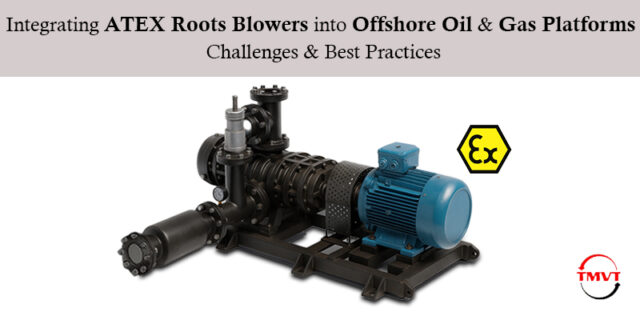
Offshore oil and gas platforms rank among the most hazardous industrial environments. Confined spaces, flammable hydrocarbons, and harsh marine conditions create a high-risk setting where any spark or leak can lead to disaster. In this context, ATEX-certified roots blowers play a critical role in safety and operations. Unlike standard industrial blowers, ATEX units are purpose-built to prevent ignition of explosive gases, making them mandatory for offshore use. In this blog, we explore how to successfully integrate ATEX roots blowers into offshore oil & gas platforms.
Why Offshore Platforms Demand ATEX-Certified Blowers
Offshore platforms operate in hazardous, explosive atmospheres by nature. Even a minor gas leak in a closed module can accumulate and ignite if equipment isn’t explosion-proof. For this reason, regulatory standards require that any blower handling hydrocarbon gas or operating in classified areas must be ATEX-certified to ensure it cannot be an ignition source. ATEX is a European directive that ensures machinery like roots blowers are designed so they avoid sparks or hot surfaces that could ignite flammable gases.
Moreover, offshore platforms present unique conditions – confined modules, high densities of equipment, and continuous processing of hydrocarbons. Blowers are often used to move explosive gases in these tight spaces, so one must assume an ignitable mixture could be present at any time. ATEX roots blowers for hazardous offshore environments give operators peace of mind that even in worst-case scenarios, the blower won’t trigger an explosion or have an hazardous gas leak. Without an ATEX certification, a blower simply cannot be installed on an oil rig, as explosion-proof equipment is absolutely mandatory by industry standards and law.
Applications of Roots Blowers in Offshore Oil & Gas
Roots blowers are positive-displacement machines known for delivering constant airflow at a given speed, making them workhorses in oil & gas facilities. On offshore platforms, ATEX roots blowers fulfil several critical applications:
- Flare Gas Recovery: Offshore rigs often burn off excess hydrocarbon gases via flare systems. Instead of wasting all that energy, roots blowers can capture low-pressure flare gas and boost it for recovery or more efficient combustion. An ATEX-certified blower safely handles the mixed, potentially corrosive flare gas and delivers it to the flare stack without risking ignition. The blower’s oil-free design is crucial here, no oil enters the gas stream, preventing any contamination or fires in the flare line.
- Pneumatic Conveying of Drilling Materials: Drilling operations generate cuttings and use bulk materials (like barite, cement) that often need to be moved or stored. Roots blowers serve as the air source for pneumatic conveying systems on rigs, transporting drill cuttings from shakers to disposal units or moving bulk powder from supply vessels into storage silos. The blower provides a high-volume air stream to carry these solids through piping. Using an ATEX-certified roots blower in this process is important because drill cuttings can be coated in oil or contain flammable gases entrained from the well.
- Gas Boosting on Platforms: In offshore production, there are many low-pressure gas streams that require boosting to higher pressure for use or export. For example, a roots blower can take associated gas coming off a separator and boost it to supply fuel gas for power generators or to send gas to a central processing facility. These gas compression blowers for hazardous areas excel at moving large volumes at moderate differentials.
- Wastewater Treatment Aeration: Even offshore platforms have to treat wastewater to meet environmental discharge standards. Compact bioreactors or sewage treatment units on rigs rely on blowers to supply air for aerobic digestion. Roots blowers provide aeration air to these wastewater treatment systems, enabling bacteria to break down contaminants. An ATEX roots blower is preferred because hydrogen sulphide or other flammable biogases can develop in wastewater tanks. .
Notably, both twin-lobe and three-lobe roots blowers find uses on offshore installations. Twin-lobe (two-lobe) blowers are simpler and can handle moderate flows and pressures , while three-lobe designs handle very large flow rates with smoother output. Depending on the application whether a compact twin-lobe unit for a small rig wastewater plant or a heavy-duty tri-lobe for flare gas recovery – engineers choose the appropriate type. The key is that any blower on an oil rig must be certified explosion-proof (ATEX) and built to withstand marine conditions.
Challenges of Integrating Blowers in Offshore
Deploying a roots blower on an offshore oil rig is not as straightforward as a typical onshore installation. The offshore environment imposes unique challenges that engineers and operators must address during integration:
- Corrosive Marine Environment: Offshore platforms are surrounded by salt water, and the air itself is full of salt spray and humidity. This harsh marine environment leads to aggressive corrosion of equipment. A standard cast iron blower housing, for instance, can rust rapidly without proper protection. Materials and coatings become critical components may need special marine-grade epoxy coatings or use of stainless steel for certain parts to resist salt corrosion.
- Vibration and Structural Stress: Offshore platforms constantly move and vibrate from wave action, drilling activity, heavy machinery, and even wind. Installing a rotating machine like a roots blower in this setting requires careful attention to vibration isolation and structural support. Vibration can come from both the blower and the platform itself. Without proper damping, vibrations can lead to fatigue in piping or misalignment. Best practice is to mount blowers on anti-vibration pads or skid frames and use flexible connectors on pipes. Furthermore, tri-lobe blowers have an advantage here: their smoother flow causes less pulsation and vibration compared to twin-lobe designs.
- Limited Space and Weight Constraints: Equipment often must fit into compact modules or decks with very little clearance. Integrating a blower system offshore means dealing with tight space constraints. the blower, its driver , filters, silencers, and piping all must be as compact as possible. Weight is also a factor; platforms have limits on how much load each deck can carry. This challenge pushes manufacturers to provide space-saving blower skid designs for offshore use. Offshore roots blower integration should involve early planning of layout, ensuring maintenance access is still available despite the cramped quarters. Custom skid packages from the manufacturer can help fit the blower into the available envelope.
- Strict Maintenance Protocols: In the offshore oil & gas industry, maintenance is both critical and difficult. The remote location of a platform means that if a blower fails, getting spare parts or expert service can take days. Thus, reliability is paramount – the blower must run continuously with minimal unplanned downtime. Offshore operators follow strict maintenance and inspection schedules to catch issues early, because an unexpected shutdown could halt essential processes. Training local crew in blower upkeep is also essential, because specialist technicians can’t always be on site. The challenge is to implement a preventative maintenance program offshore that keeps the blower running safely while satisfying rigorous safety rules and minimizing personnel exposure.
- Explosion-Proofing and Compliance: While the blower unit itself might be ATEX-certified, integrating it into an offshore platform’s electrical and control systems comes with challenges. All supporting components like motors, variable frequency drives , control panels, instrumentation must also meet hazardous area requirements. Routing of cables and conduit must preserve the explosion-proof integrity. There may be additional certification steps if the blower is part of a larger skid. Ensuring compliance with not just ATEX but also offshore standards can be complex.
Best Practices for Offshore Blower Integration
Successfully integrating an ATEX blower on an offshore platform requires careful planning and execution. Based on industry experience, here are some best practices for offshore blower installation to overcome the above challenges:
- Select the Right Blower Type (Twin vs. Three-Lobe): Choosing between a twin-lobe or three-lobe roots blower is an important early decision. Three-lobe blowers are generally preferred offshore because their design yields steadier, pulse-free airflow with less vibration and noise. They also tend to put less stress on bearings, meaning longer intervals between overhauls. Twin-lobe blowers, on the other hand, can sometimes achieve higher single-stage pressure or come in more compact sizes for a given duty. Best practice is to match the blower to the application’s needs: if smooth operation and low noise are paramount , go with a tri-lobe. If space is extremely tight or the required pressure is at the top end of a tri-lobe’s capability, a twin-lobe might be suitable.
- Use Corrosion-Resistant Materials & Coatings: To combat the marine atmosphere, specify corrosion protection from the start. Materials and coatings should be chosen based on worst-case conditions . For example, insist on an epoxy marine coating for cast iron blower casings, or consider blowers constructed from stainless steel or with internal anti-corrosion linings if the gas is sour. During installation, use appropriate gasket materials and sealants that can withstand the marine environment and hydrocarbon exposure.
- Ensure Proper Installation and Vibration Isolation: How the blower is installed on the platform will directly impact its performance and longevity. Best practices for offshore blower mounting include using a rigid, flat baseplate that is securely bolted to the deck. Between the skid and deck, vibration isolators or pads should be used to damp vibrations traveling in both directions. All piping connected to the blower (intake and discharge lines) should have flexible couplings or expansion joints to accommodate movement and prevent transmitting stress to the blower casing
- Implement Predictive Maintenance & Monitoring: Given the difficulty of emergency repairs offshore, a predictive approach to maintenance is ideal. Equip the blower system with monitoring sensors such as vibration sensors, temperature probes (on bearings and oil), and possibly pressure/flow sensors to monitor performance. These can tie into the platform’s control system to alert operators of any anomaly
- Provide Training and Follow Safety Protocols: Even the best equipment can be misused if operators aren’t properly trained. Ensure that platform technicians and engineers are trained in the specifics of the roots blower package and its hazardous-area handling procedures. This includes understanding how to isolate and depressurize the blower before maintenance, confirm that no flammable gas is present prior to opening any part of the blower, and following the manufacturer’s maintenance guidelines to the letter.
How TMVT Supports Offshore Oil & Gas Integration
When it comes to ATEX roots blower offshore oil & gas applications, TMVT is a trusted expert with over a decade of proven industry experience (in fact, TMVT’s roots blower heritage spans 50+ years. As a leading manufacturer of twin-lobe and three-lobe roots blowers, TMVT understands the demands of offshore platforms and has engineered its products and services to meet those challenges:
- Certified Explosion-Proof Blowers: TMVT offers a full range of ATEX-certified blowers for oil rigs and petrochemical environments. Both our twin-lobe and tri-lobe models are built to exceed ATEX 2014/34/EU requirements, meaning they are safe for Zone 1 hazardous areas by design. This gives offshore engineers confidence that a TMVT blower can be placed on their platform with complete safety compliance from day one.
- Robust Design for Harsh Environments: TMVT roots blowers are engineered for durability, which is exactly what the offshore marine environment demands. Key components are made from heavy-duty materials like cast iron or carbon steel, and all casings are stress-relieved to prevent distortion under continuous operation. Our three-lobe blowers inherently produce less vibration and noise, a benefit proven by about 20% lower bearing loads and ~5 dB noise reduction compared to two-lobe designs. The result is a blower that can withstand the continuous, demanding service on an oil platform reliable gas compression with minimal wear even in tough conditions.
- Customization to Fit Your Platform: We recognize that each offshore project has unique constraints. TMVT’s engineering team works closely with clients to tailor blower packages to specific site requirements. Whether it’s designing a compact skid that fits into a tight corner of a platform or selecting a special motor configuration, our experts ensure the blower integrates smoothly.
- Global Support and After-Sales Service: Installing the right blower is only half the battle but keeping it running is equally critical. TMVT prides itself on comprehensive after-sales support worldwide. Offshore oil & gas operators can rely on our support network for spare parts, field service, and technical assistance whenever need. We know downtime is costly, so we maintain inventory of critical spare parts and can dispatch service engineers at short notice. This global support is a key reason many oil & gas companies choose TMVT as their blower partner.
- Proven Performance and Safety: Perhaps most importantly, TMVT has a track record of delivering safe, reliable performance in hazardous environments. Our blowers are used in refineries, petrochemical plants, and yes, offshore rigs around the world. Each unit undergoes full performance testing (flow, pressure, vibration, noise, etc.) before shipment to guarantee it meets specifications. We also include all the quality and test documentation needed for regulatory compliance. With certifications like ISO 9001 and a strict safety focus built into our design process, TMVT ensures that our ATEX blowers not only perform efficiently but also uphold the highest safety standards.
Conclusion
In the high-stakes world of offshore oil and gas, integrating the right equipment can make all the difference. ATEX-certified roots blowers have proven to be essential components for many offshore processes from managing flare gas and boosting fuel gas, to keeping wastewater treatment and pneumatic systems running safely. We’ve discussed how these blowers, when properly integrated, mitigate explosion risks while delivering the air and gas movement needed on a platform. By understanding the challenges and following best practices, operators can ensure their offshore roots blower integration is both safe and successful.
Ultimately, offshore environments demand equipment that is robust, reliable, and above all, safe. ATEX blowers for hazardous offshore environments provide that peace of mind, and choosing a proven manufacturer further ensures long-term performance. TMVT, as a top manufacturer of explosion-proof twin and three-lobe roots blowers, has the expertise to support your offshore projects from conception to operation. If you’re looking to enhance safety and efficiency on your platform, we’re here to help. Explore TMVT’s Three Lobe Roots Blower and Twin Lobe Roots Blower for safe, reliable offshore performance. Let us help you integrate the ideal ATEX blower solution to keep your oil & gas operations running smoothly and securely.