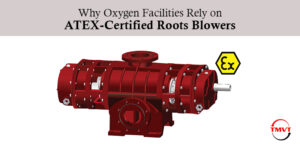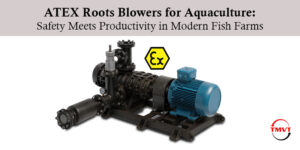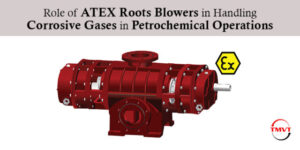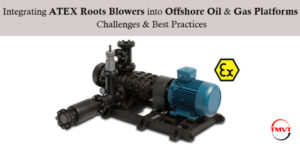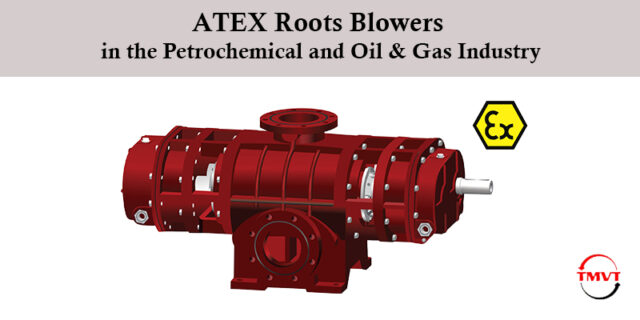
Industrial facilities operating within the oil, gas and petrochemical sectors often contain explosive gases and vapours which pose a significant fire hazard, so equipment used within such environments must adhere to stringent safety standards in order to avoid sparking an incident. ATEX certification is a European directive ensuring that machinery such as roots blowers is designed to avoid sparks or hot surfaces that could ignite explosive gases and spark. Roots blowers are positive-displacement compressors designed to move large volumes of gas by trapping it between spinning lobes and their casing. At TMVT, we manufacture ATEX-certified oil-free twin and tri lobe roots blowers designed for hazardous areas to safely transport natural gas, hydrogen, flare gas and other hydrocarbons found in refineries and chemical plants.
Understanding ATEX Certification
An ATEX-certified blower is specifically manufactured and tested to withstand hazardous Zone 1 or Zone 2 areas where explosive gases may be present. As part of this certification process, stringent controls and tests are implemented during manufacturing in order to avoid any ignition source for possible combustion sources within its vicinity. Fan motors and electrical components must be housed in explosion-proof enclosures; bearings should be shielded and internal clearances designed to avoid sparking. All are addressed by the ATEX 2014/34/EU directive for equipment intended for flammable environments. Compliance can be demonstrated with a certificate, typically covering specific gas groups and temperature classes. ATEX roots blowers offer proven safety, eliminating hot spots and sparks even in case of malfunction, providing maximum protection for workers and plant assets alike.
Roots Blower Design: Twin-Lobe vs. Three-Lobe
Roots blowers consist of two or three intermeshing lobed rotors inside a precision casing. Each revolution traps and transfers fixed pockets of gas from the inlet to the outlet, creating a nearly pulsation-free flow. Three-lobe blowers have three symmetrically arranged lobes on each rotor, while twin-lobe blowers have two. A three-lobe design inherently smooths the flow: adding the third lobe reduces pressure fluctuations and vibration compared to a two-lobe machine. In fact, TMVT’s three-lobe units exhibit about 20% lower bearing loads and roughly 5 dB less noise than equivalent twin-lobe blowers. The result is quieter, more efficient operation and longer life for gears and bearings (increasing maintenance intervals).
Flow Capacity
TMVT three-lobe roots blowers span very high flow rates (typically 5–60,000 m³/h) with discharge pressures up to about 1 bar (gauge) and vacuums to –0.5 bar. Twin-lobe models cover single-stage pressures up to ~1 kg/cm² (~14.2 psi) and dual-stage up to 2.2 kg/cm², with vacuum service to 600 mbar abs. This broad range lets engineers select the right blower size for process air, flare gas, or other flammable gas duties.
Oil-Free Delivery
In all ATEX-certified units, the oil-lubricated bearings and timing gears are isolated in a separate oil chamber. This ensures 100% oil-free discharge gas, which is critical when handling combustible gases or feeding gas to burners or compressors. The dry design also eliminates any lubrication-related ignition risk.
Low Vibration
The tri-lobe rotor profile yields steadier airflow with minimal pulsation. TMVT’s customers report up to 20% longer bearing life on tri-lobe models due to the reduced side loads. Even twin-lobe blowers incorporate precision balancing and acoustical hoods: an optional sound-insulating enclosure can cut noise by 10–12 dB at 1 m distance, improving site comfort without sacrificing performance.
Robust Construction
All TMVT roots blowers are machined from cast iron or carbon steel and stress-relieved after rough machining. This pre-machining stress relief prevents warping at high operating temperatures. Mating surfaces are machined to tight tolerances for optimum sealing and rotor clearances. Drive and driven bearings are splash-lubricated with premium oils, ensuring reliable, heavy-duty operation.
Rigorous Testing
Every blower is individually tested on performance benches to meet international standards (like API 618/ISO 1217 or IS-5456). During factory testing, flow rate, power draw, temperature rise, noise, and vibration are measured and recorded. This quality control guarantees that each unit will perform as specified in the field, which is crucial for continuous processes in oil & gas plants where downtime is costly.
In summary, the combination of twin- and tri-lobe designs gives TMVT flexibility for different oil & gas needs. Operators can choose a compact twin-lobe unit for lower flows and pressures, or a three-lobe blower for smoother high-volume service. All models are built to exceed ATEX “explosion-proof” criteria, ensuring safe handling of any flammable or inert gas in petrochemical settings.
Applications in Petrochemical and Oil & Gas Processes
Roots blowers are workhorses in the chemical, petrochemical, and oil & gas industries because they can handle many kinds of gases – even reactive or contaminated ones – safely and efficiently. Here are key oil & gas applications:
Gas Compression and Transfer
ATEX roots blowers convey and boost hydrocarbon gases between process units. For example, they can pressurize natural gas or methane from low-pressure separators to pipeline pressure, or deliver hydrogen and nitrogen for catalytic reactors. These blowers excel at large volumetric flow at relatively low differential pressure, ideal for “gas movers” in refineries and gas plants.
Flare and Vent Gas Handling
Many refineries and gas processing plants recover or combust waste gases to avoid emissions. ATEX-certified blowers handle the corrosive, mixed composition gases (like flare gas, sour gas or coke oven gas) by delivering them safely to combustion stacks or recycle systems. Their oil-free design prevents ignition and contaminant carryover in the waste stream.
Chemical Feed and Purge Services
Roots blowers are used to convey inerting or purging gases (such as nitrogen) in tank farms, reactors, and catalyst beds. They also supply air or fuel gas to burners and heaters. Since the blowers are explosion-proof, they can pump flammable process gases (propane, ethylene, etc.) without risk, enabling heating or desorption steps in processes like reforming or hydrocracking.
Aeration and Vacuum
In refinery wastewater treatment or process air blowers, roots machines supply oxygen for biological reactors and purge hazardous spaces. Conversely, in vacuum distillation units, they provide rough-vacuum back sweep. ATEX models ensure that any explosive vapours in these processes are moved without igniting.
Drying and Regenerative Loops
Some units use regenerative dryers to remove moisture or VOCs from air/gas streams. These blowers circulate heated air/gas through adsorption beds. The corrosion-resistant, ATEX-rated construction means they can safely circulate gas mixtures that may contain traces of solvents or explosive components.
Pipeline and Subsea Boosting
In onshore and offshore gas pipelines, tri-lobe blowers can act as gas boosters for gas-lift systems or to pressurize subsea lines. The compliance with ATEX (and often IECEx) means these machines can be deployed on platforms and drilling rigs where explosion-proof gear is mandatory.
In all these cases, the ability to move flammable or corrosive gas without ignition is the core requirement. As one industry guide notes, roots blowers safely transport inert, corrosive and explosive gases – including hydrogen, chlorine, hydrocarbons and mixtures thereof – under demanding conditions. By choosing an ATEX-certified blower, plant engineers ensure compliance and protect personnel.
Technical Highlights of TMVT ATEX Roots Blowers
TMVT’s ATEX roots blowers combine advanced engineering with global quality standards. A few technical highlights include:
Wide Flow and Pressure Range
Models handle from a few hundred to tens of thousands of cubic meters per hour. Tri lobe blowers cover high-flow duties (5–60,000 m³/h at up to 1 bar), while twin-lobe blowers cover mid-range flows with higher pressure capability (single-stage up to ~1 kg/cm²).
Oil-free Sealing
The blower’s oil bath is isolated, so discharge is completely oil-free. This feature is crucial for gas processing and metering systems where lubricants can foul catalysts or contaminate fuel streams.
Explosion-proof Motors
Motors and electrical parts are certified for Zone 1/2 use. For example, the built-in Ex d motor housings prevent any spark from escaping. All wiring and junction boxes meet ATEX/IECEx requirements.
Temperature Handling
Blowers are designed to handle ambient and gas temperatures typical of oil & gas plants. Special gaskets and insulation ensure that even under fault conditions, surfaces remain below safe limits.
Noise and Vibration Control
Even though roots blowers are positive-displacement machines, their noise can be significant. TMVT offers acoustic enclosures and dynamic balancing. In tests, these measures reduce noise by over 10 dB and keep vibration to minimal levels.
Efficient Operation
The tri-lobe design reduces internal leakage and improves volumetric efficiency compared to twin-lobe units. This yields better power consumption per volume of gas moved. High-efficiency operation is especially important in continuous oil & gas processes for energy savings.
Compliance and Testing
Besides ATEX, all blowers comply with relevant industrial codes. TMVT performs full acceptance testing on every unit, with documentation. Customers in oil & gas know they are getting a blower that meets or exceeds the specifications.
In practical terms, a client can trust that a TMVT ATEX blower will not only fit the required profile for a process, but also handle the specific gas type and hazard level without trouble.
Why Choose TMVT’s ATEX Roots Blowers
TMVT is a leading global manufacturer of roots blowers with decades of experience in industrial gas handling. Customers in oil, gas and chemical sectors rely on TMVT for engineered solutions that meet the highest safety and quality standards. Some reasons to choose TMVT’s ATEX blowers:
Proven Expertise
TMVT has been supplying roots blowers for over 50 years. The company holds international certifications (ISO 9001:2015 for quality, 14001 for environment, 45001 for safety, plus Conformité European marking). This demonstrates a commitment to quality and safety in every product.
Customization
TMVT’s engineering team can tailor blower packages (baseplate, drive, etc.) to specific site requirements. Whether it’s a module for an offshore platform or a skid-mounted unit for a refinery, TMVT can accommodate it.
Global Support
With a worldwide network, TMVT provides after-sales service, spare parts and field support anywhere the blowers operate. This global presence ensures quick response to any maintenance or retrofit needs in oil & gas plants.
Value and Reliability
TMVT blowers are engineered for long service life. As noted in technical specs, features like stress-relieved casings and industrial-grade gears mean these units run continuously for years with minimal wear. Lower downtime translates to lower total cost of ownership.
Safety Focus
Because ATEX compliance is fundamental, TMVT designs eliminate potential ignition sources as a rule. The blowers pass rigorous in-house and third-party tests. They are suitable for Zone 1/2 installations by design, giving plant engineers confidence to operate at rated capacities without extra precautions.
Industry Trust
Engineers in top refineries, petrochemical complexes, and LNG plants trust ATEX roots blowers for their operations. These applications often require not just performance, but also authoritative documentation of safety – something TMVT provides with each blower.
In oil & gas industry projects, choosing the right equipment can make a critical difference in safety and uptime. TMVT’s ATEX-certified roots blowers offer a complete solution for hazardous-area gas handling. They ensure compliance with international explosion-protection standards and deliver the performance needed for processes such as fuel gas boosting, vent gas recovery, pneumatic conveying of hydrocarbons, or process air supply. By combining technical excellence (as evidenced by features like low pulsation and full compliance testing) with global quality assurance, TMVT blowers help companies meet both operational and regulatory goals.
Conclusion
ATEX-certified roots blowers are essential for the petrochemical and oil & gas industries whenever large volumes of flammable, toxic or corrosive gases must be moved safely. TMVT’s family of explosion-proof twin and tri lobe blowers is engineered specifically for these conditions. Their rugged construction, extensive testing and full ATEX Zone 1 compliance provide peace of mind, while the efficient, oil-free operation keeps processes running smoothly. Contact TMVT to discuss how an ATEX roots blower can be applied to your next critical service from refinery flare recovery to offshore gas compression with guaranteed safety and performance