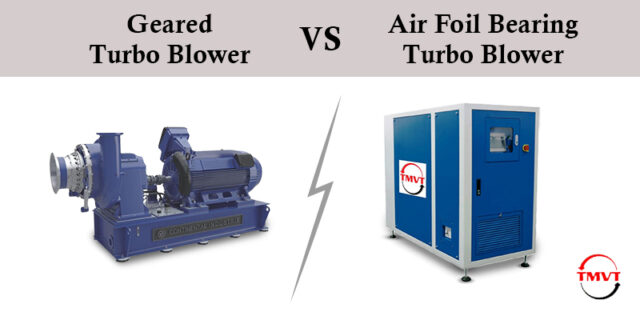
The right turbo blower is vital for industries like manufacturing, wastewater treatment or power generation. Two of the most popular options for high-performance are geared turbo blowers and air foil bearing turbo blowers. Both are single-stage centrifugal blower, however they differ greatly in the design and operating. In this article we will examine the differences between the geared and air foil bearing (gearless) turbo blowers, in depth, examining their operating principles and energy efficiency, maintenance requirements and the suitability of each for different applications. When you know the difference between the two, facility managers, engineers as well as environmental experts and industrial owners are able to make an informed choice which maximizes performance and energy savings as well as long-term reliability.
Understanding Geared Turbo Blowers
Geared turbo blowers (often known as integrally-geared single-stage turbo blowers) make use of a Gear Box to connect a standard speed motor to an impeller that is high-speed. In this type of design, the induction motor (typically 1,500-3,000 RPM) runs the drive shaft which is connected to the driven / Impeller shaft through a speed-increasing gearbox that runs the impeller at extremely high speeds (often around 30,000 RPM). It “steps up” the rotational speed to allow the impeller to produce the required pressurized airflow as well as pressure. The main features of turbo blowers geared include:
Robust Gear Drive
The precision of the gearbox lies at the centre to the entire system and allows high flow rates and greater pressure outputs. Geared blowers are able to handle extremely large airflow capacities in fact, fully geared blowers provide some of the best flows among turbo blowers. They are frequently utilized in large municipal or industrial factories where high-volume air flow is required.
Pressurised Lubrication System
Designs with gears typically employ oil-lubricated bearings within the gearbox and shaft. The Pressurised Lubrication System ensures that the oil reaches to rotating parts in machine and keep them in functioning mode.
Impellers and Control Features
Geared blowers have variable inlet guide vanes and diffuser vanes to aid in controlling the flow and pressure while operating at a set motor speed. Modern units can also be equipped with Variable Frequency Drives (VFDs) that operate on the motor, but historically the flow control was based on mechanical adjustments.
Size and installation:
Turbo blowers with a gearbox generally heavier and bigger than air foil blowers because of the oil sump, gearbox and cooling needs. They may require a solid foundation and a careful alignment during installation. But their design is tested and solid and has a steady performance in a wide range of industries.
The Vibration and Noise
Because of the advances in engineering that geared blowers are able to run at minimal vibration and noise levels considering their dimensions. But, the mechanical mesh is prone to introducing a distinct “whine,” and vibration isolation mounts, also known as sound enclosures are commonly used to provide peace of mind. Manufacturers emphasize features such as low noise emissions and a low level of vibrations as selling points for modern-day geared blowers.
In short it is a geared turbo-blower that utilizes the mechanical drivetrain to reach the highest speeds of impellers. It is highly regarded by its large flow capacity as well as its robust design and well-proven technology however it also has more moving parts, oil-based lubrication and a little more complicated maintenance than gearless systems.
Understanding Air Foil Bearing (Gearless) Turbo Blowers
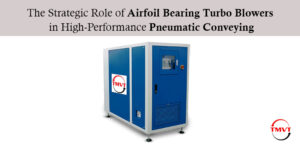
Air foil bearing turbo blowers are the latest generation of high-speed blowers that are gearless. Instead of gearboxes these models use a Direct-coupled, high-speed motor as well as specialized air foil bearings that support the shaft. They are often referred to as turbo blowers with no gears and turbines with air-bearing lubrication they eliminate any contact points with lubrication by using air as a bearing medium. Here’s how they operate and the main features they have:
Direct Drive High-Speed Motor
Air foil turbo blowers are powered by a permanent magnet-synchronous motor (PMSM) that can be rotated at extremely fast speeds without the need for a gearbox. The impeller is installed directly to the motor shaft which means there are no transmission losses caused by gears. The speed is controlled using a variable frequency drive (VFD), allowing exact adjustment of blower output through modulation of the motor’s frequency. This direct drive, high-speed method results in a high energy efficiency and quick control of airflow as well as pressure.
Air foil bearings (Oil-Free)
Instead of traditional bearings, the shaft rests on an air cushion. Air foil bearings make use of thin metal foils and the force in air-films to stabilize the shaft while in operation. If the air blower operates running at speed and the shaft “floats” on air with no contact between metal and metal and drastically reduces friction. There is no lubricating oil required in any way which means no oil replacements and none of the maintenance associated with the bearing. This design is oil-free and will not only reduce the cost of maintenance but also ensures pure, non-contaminant air output that is ideal for wastewater aeration, or in the food processing where oil residues aren’t desirable.
Energy Efficiency
By removing the gearbox, and utilizing high-efficiency motors Air foil blowers can achieve an extremely high efficiency overall. There are no friction losses, and PMSM motors typically reach more than 95 percent motor efficiency. This results in lower energy use for the same airflow as compared to the older technology. In reality, air foil turbo blowers have been recognized to reduce energy consumption by 20-40% in comparison to conventional lobe or multistage blowers. Additionally, they are competitive with geared blowers and offer greater turn-down capability. Operators also gain from the broad range of flow control, without sacrificing efficiency when working with partial loads.
Compact and light-weight design
Gearless turbo blowers generally come with a compact skid-mounted unit. Without a massive oil pumps, gearboxes, or huge baseplates the entire unit is significantly smaller and usually does not require particular foundation and alignment when installing. The footprint is tiny which means it can be placed in an area for flooring – an important benefit in crowded buildings and retrofitting work. Many of the units are air-cooled, and sound-encased to make installation.
Quiet Low-Vibration Operation
Operating on air frictionless bearings means that these blowers work with minimal vibration and extremely smooth rotation. There is no mechanical contact during normal operation and this minimizes vibration and noise considerably. Air foil bearing blowers generate less noise that geared blowers usually around 70-85 dBA. This is a significant improvement in working environment comfort. It is appreciated in offices or in residential areas close to industrial sites.
Key Differences Between Geared and Air Foil Bearing Turbo Blowers
Both air foil and geared turbines that are bearings can be utilized to provide pressurized air effectively However, their different construction result in different performance features. In this Article, we’ll compare both techniques in relation to a number of critical aspects:
| Air Foil Turbo Blowers | Geared Turbo Blowers | |
Components and Design | Air foil blowers employ the direct-drive motor that does not have a gear. This means that air foil blowers are mechanically simpler and totally oil-free. | Geared blowers utilize the combination of a motor, gearbox, and impeller assembly. Geared blowers are more prone to wear and tear due to the additional parts that require attention. |
Energy Efficiency
| With the permanent magnet high-speed Motor directly driving the impeller, there’s no loss in transmission or mechanical friction caused by gears.- Gearless design is able to maximize the input power to create airflow. In addition, the ability to change the speed of air foil blowers allows users adjust the performance required, which avoids wasteful throttles. | Geared blowers can be extremely efficient, but some energy is lost through the mesh of the gear and friction between the bearings. – The gear-driven blowers may also utilize VFDs as well as inlet vanes to provide control, but they will not be able to maintain their peak efficiency over the entire flow area as air foil models. |
Capabilities of Flow and Pressure
| Air foil bearing turbo blowers are usually employed for low-pressure air supply (commonly with a pressure of ~0.6 bar, but there are models as high as ~1.0-1.2 bar) that covers the majority of requirements for aeration and processing air. The flow capacity of these blowers can be about 30,000-40,000 m3/hr with one unit. For small-sized plants or systems one air foil blower is usually sufficient for large-scale installations. | Geared turbo blowers have been traditionally used to handle extremely large flow or high-pressure applications. They can generate pressures on the range to 1.5-2.5 bars (g) with single stage configurations and can handle huge flows. extremely large ones may require a number of gearless units or prefer the use of a geared blower. |
Maintenance Requirements | Air foil bearing blowers are nearly maintenance-free—no oil, no contact wear, and fewer components to service. Routine care mainly involves cleaning inlet filters and monitoring motor performance. Air foil blowers demand significantly less time and cost to maintain, resulting in reduced downtime and lower lifecycle expenses. | Geared blowers require regular upkeep, including oil changes, filter replacements, gearbox inspections, and occasional alignment. Over time, gears and bearings may need overhauls. Benefits from more Periodic Checks and regular maintenance is required to keep the machine running. |
Reliability and Longevity | Air foil bearing blowers, have also demonstrated strong reliability—particularly in clean, controlled environments. With no gears or oil, they have fewer failure points and lower risk of mechanical issues. While they require clean intake air and controlled start-stop cycles, a well-maintained unit can run continuously for years with minimal downtime. | Geared turbo blowers are proven and durable, with many systems operating for decades. Their rugged design tolerates moderate dust and vibration, thanks to sturdy, oil-lubricated metal bearings. |
Noise and Vibration
| Air foil bearing turbo blowers operate with lower noise and vibration levels than geared blowers, thanks to their gearless design and smooth air bearing support. This makes them ideal for meeting workplace noise standards. | Geared blowers have improved with better dampening and precision gears, they still produce some high-frequency sound from the gearbox. |
Cost Aspects | Air foil bearing turbo blowers typically have a higher upfront cost due to their advanced motor and bearing technology. However, the total cost of ownership often favours air foil blowers. Their energy efficiency and minimal maintenance—no oil, fewer service needs—translate into significant long-term savings. Facilities can also benefit from lower electricity bills and potential energy rebatesOften offer better lifecycle value | In contrast, geared blowers often cost less initially, using standard motors and components. While geared blowers are durable, they involve ongoing costs for oil, parts, and slightly higher power consumption. Geared models may suit tighter budgets or demanding performance needs. |
Application Suitability | Air foil bearing blowers are ideal for those seeking maximum energy efficiency, low maintenance, and compact design. This makes them popular in modern facilities aiming to reduce downtime and boost sustainability. | Geared turbo blowers suit applications requiring very high flow rates or pressure in a single unit, as they handle greater loads and operate reliably in harsher conditions (e.g., dusty or hot environments with proper filtration). |
Both blower types serve similar applications—wastewater aeration, combustion air, pneumatic conveying, and low-pressure industrial processes. The choice depends on priorities. Many plants now combine both using geared blowers for base-load demand and air foil types for flexible, energy-efficient operations.
Conclusion
Both air foil bearing (gearless) and geared turbo blowers offer unique advantages and are integral to efficient industrial air systems. Understanding their differences helps engineers and decision-makers select the right blower technology for each application, balancing factors like energy efficiency, maintenance, and performance requirements.
As a trusted provider of high-speed turbo blower solutions, TMVT brings deep expertise in both gearless and geared technologies. We ensure clients receive the optimal solution tailored to their operational needs. By partnering with an industry leader like TMVT, businesses can confidently implement high-performance turbo blowers that deliver long-term reliability, energy savings, and superior results.