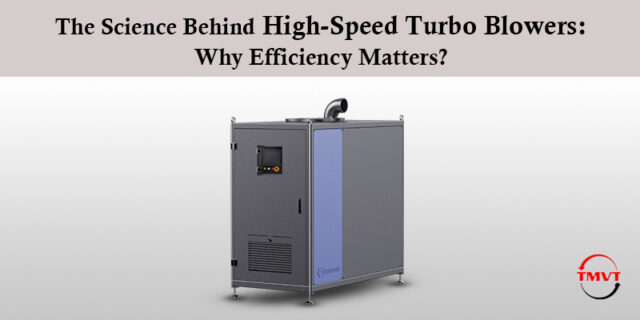
Energy efficiency is the single most critical factor for modern industrial plants looking to reduce operational costs. Many facilities still rely on outdated aeration systems that consume excessive electricity and require frequent maintenance. The introduction of High Speed Turbo Blowers has transformed this landscape by offering a solution that drastically cuts energy usage while improving reliability. This article explores the engineering science behind these advanced machines and explains exactly why upgrading to turbo technology is a smart investment for your business.
How Turbo Blowers Work?
- So, at the outset, let’s understand the workings of turbo blowers.
Fundamentally, a turbo blower functions on a combination of aerodynamics and mechanical precision that helps generate airflow.
Some basic principles of these blowers include the following.
- Compression and Expansion: Turbo blowers compress air or gas as it flows across the system. While increasing the air’s pressure and velocity, it creates high-speed streams that various applications require.
- Impeller Dynamics: The impeller is a rotating disk with blades that drive the compression process. While spinning at a high velocity, the impeller accelerates the surrounding air radially outward, thus converting rotational energy into kinetic energy.
Key Parts of High Velocity Air Machines and Their Roles
Turbo blowers are composed of various parts that make up for their efficiency.
- Impeller Design: The impeller’s thoughtful design, including its shape, size, and material is optimized to deliver the expected levels of efficiency. They have advanced designs that include curved blades to reduce air resistance and lightweight alloys to minimize energy consumption.
- Motor and Drive: Modern blowers have variable-speed drives (VSDs) that ensure precision control over airflow and pressure.
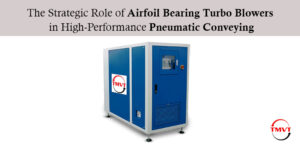
- Bearings: High-speed turbo blowers usually have air-foil bearings that eliminate the need for lubrication, and ensure zero friction, and quieter operations.
Aerodynamics
And there we are! While the design and components undoubtedly play a crucial role, one cannot discount the role aerodynamics plays in driving blower efficiency.
- Reducing Drag: Experts use computational fluid dynamics (CFD) to design blowers that minimize internal drag, paving the way to smooth airflow paths, preventing turbulence, and enhancing efficiency.
- Pressure vs. Velocity: Turbo blowers specialize in converting velocity energy into pressure energy for crucial processes like aeration in wastewater treatment.
Innovation that Drives Efficiency
High-speed turbo blowers deliver the desired levels of efficiency due to;
- Smart Controls: They are equipped with advanced sensors that monitor and adjust operations in real-time, optimizing performance and efficiency.
- Heat Recovery: Processes generate varying amounts of heat. High-speed turbo blowers have heat recovery mechanisms that capture the heat produced during operations so that it can be used for other processes.
- Direct Drive Systems: Additionally, high-speed blowers are also equipped with direct drive systems that eliminate energy losses related to gear systems.
- RPM: Under a magnetic synchronized motor, the RPM reaches up to 400,000.
Where are High-Speed Turbo Blowers Used?
As a result of the efficiency and constant airflow that they deliver, high-speed turbo blowers are used across various applications, including the following.
- Wastewater treatment
- Power generation (cooling systems, gas turbines, etc.)
- Industrial processes (chemical and petrochemical industries)
- Food and beverage
- Mining and cement production
- Semiconductors and electronics manufacturing
- Fermentation
- desulphurization
Innovation that Drives Efficiency. Efficiency that Contributes to Progress!
Apparently, high speed blowers might seem like machines that support a particular process. However, like every machine, they contribute to efficient operations, enabling industries to maintain precision in the associated process.
As for the efficiency of high-speed blowers, it is their innovative design, precision engineering, and advanced aerodynamics that prove instrumental.
Of course, one cannot discount the role of manufacturers in this.
Some of the best in the business, including TMVT, ensure thoughtful designs that serve the diverse airflow needs of various processes.
So, if you’ve been looking to transform the efficiency of your industrial processes with top-tier high velocity air machines, choose TMVT.
Explore our product page and email us at tmvtmumbai@tmvt.com to connect with our experts and discuss your industrial process requirements.