Vacuum technology is essential in modern sugar manufacturing. In sugar refineries, juices are concentrated and crystallized under vacuum to efficiently remove water at low temperatures.
For example, refined sugar is formed in vacuum pans (evaporative crystallizers) where steam and non-condensable gases are continuously drawn off. As one industry guide explains, a liquid-ring vacuum pump “draws off vapor, air and other non-condensable” to assist in the evaporation and crystallization process.
By maintaining reduced pressure, vacuum pumps lower the boiling point of sugar syrup, allowing evaporation and crystal formation at cooler temperatures. This reduces energy use and prevents caramelization of the sugar, improving product quality and yield.
VACUUM EVAPORATION IN SUGAR PRODUCTION
In a sugar plant, multi‑effect evaporators remove water from cane or beet juice in stages. Each effect uses steam and vacuum to concentrate the syrup. Vacuum pumps create the necessary low pressure so that the juice boils at well below 100 °C.This low‑temperature evaporation saves energy and preserves sugar colour and purity.
For example, replacing older steam‑jet (water‑ejector) systems with liquid‑ring vacuum pumps can cut water and energy use dramatically.
One case study reports the new vacuum system used only one‑third the water of older ejectors and saved roughly 30% on energy. Because the boiling point is lower under vacuum, less steam is required per unit of evaporated water.
The result is higher throughput and lower fuel costs. In practice, this means a sugar mill can concentrate more juice on the same steam load.
Lower boiling point:
Vacuum allows evaporation at reduced temperature, saving steam energy.
Reduced sugar degradation:
Cooler boiling minimizes caramelization and sugar inversion, improving color and taste.
Higher throughput:
Effective vacuum speeds up evaporation rates.
VACUUM CRYSTALLIZATION IN SUGAR PROCESSING
After evaporation, the concentrated syrup enters vacuum pans to form sugar crystals.
In these pans, vacuum pumps continually draw off steam and air so that supersaturated syrup can boil and crystallize. By controlling the vacuum, mills produce consistent crystal sizes and high purity.
According to TMVT (a vacuum technology leader), a uniform vacuum helps produce “more uniform sugar crystallization,” yielding sugar with better colour and quality at lower cost.
Lower boiling temperatures also reduce inversion of sucrose, preserving yield. In effect, vacuum crystallization is a gentle, energy-efficient way to harvest sugar crystals from syrup.
Uniform crystals:
Constant vacuum and temperature lead to even nucleation and growth.
Improved sugar colour:
Gentle boiling under vacuum prevents burning or decomposition.
Cost savings:
More of the sugar remains in crystal form (less in molasses), and energy use is minimized by lower boil temperatures.
Vacuum crystallization thus directly boosts product quality. As a TMVT reference notes, vacuum pans are “evaporative crystallizers” by design, and they rely on pumps to continually remove vapours. In summary, effective vacuum pumping in crystallizers gives sugar producers cooler, cleaner, and more uniform crystallization than open-air methods.
TYPES OF VACUUM PUMPS USED IN SUGAR INDUSTRIES
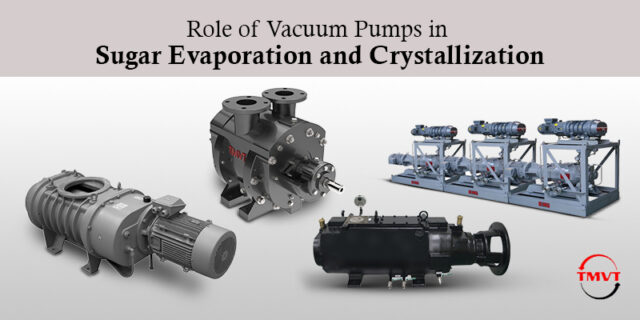
Sugar mills commonly use several vacuum pump technologies, each with its own strengths. The most important types in evaporation and crystallization are liquid-ring (water-ring) pumps, dry screw pumps.
(Mechanical vacuum boosters are also used to enhance vacuum depth.) All these pumps can be found in sugar plants, often chosen to match the process conditions.
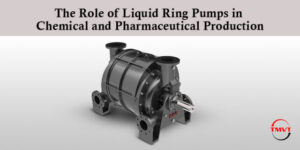
Liquid-Ring (Water-Ring) Vacuum Pumps
Liquid-ring pumps are the workhorses of sugar evacuation systems. They use water (or another seal fluid) to form a rotating ring that seals the pump chambers.
This design tolerates large amounts of water vapor and even condensate in the suction gas, making them ideal for sugar evaporation and filtration.
TMVT emphasizes that liquid-ring pumps are “best for handling wet environments and vapor-heavy applications. In practice, a sugar evaporator can produce wet steam laden with sugar solids, and a water-ring pump can handle this without damage.
Advantages:
- Moisture tolerance: Can ingest hot water and syrup carryover without harm.
- Robust and simple: Few moving parts, no metal-metal contact, yielding “wear-free performance”.
- Low maintenance: No internal lubrication needed, so maintenance is minimal (often just seal water treatment).
- High capacity: When used as condensers, liquid-ring pumps condense the vapor internally, effectively boosting their suction capacity.
- Energy and water efficient: Modern designs recover vacuum rapidly. One vendor notes their liquid-ring system recovers vacuum in minutes and saves 30% energy over older pumps. They also use only about one-third the seal water of traditional steam ejectors.
These advantages make liquid-ring pumps ideal for evaporators and crystallizers. In fact, TMVT explicitly states that such pumps assist the evaporation and crystallization stages in sugar refining. Many sugar mills worldwide rely on large liquid-ring units to maintain the deep vacuum needed for multiple-effect evaporators and vacuum pans.
DRY SCREW VACUUM PUMPS
Dry screw vacuum pumps use two intermeshing rotors to pump gas without any seal fluid. Because they are oil-free, they are attractive in food and beverage processes (including sugar) where oil contamination is undesirable.
TMVT describes dry-screw pumps as “advanced technology for clean, oil-free operations”.In a sugar plant, a dry screw pump can provide strong vacuum for processes like packaging, CO₂ recovery (from carbonation), or as a backing pump downstream of a liquid-ring pump.
Advantages:
- Oil-free operation: No oil in the process gas, eliminating contamination risk. This is crucial if the vacuum system is connected to sensitive areas (e.g. packaging).
- High throughput: Capable of continuous duty, they maintain vacuum even under heavy loads.
- Lower maintenance than oil pumps: While bearings and seals must be maintained, there is no oil change or separator to service.
- Energy savings: Modern dry screw designs often use variable speed drives to match pumping to demand, reducing power use at part load.
- Dry operation: Since no liquid ring is used, there’s no need to treat or dispose of seal water.
These pumps complement liquid-ring stages in some sugar applications, especially where an extremely clean vacuum is required. However, because they cannot tolerate liquid slugs well, they are typically placed after condensers or boosters.
MECHANICAL VACUUM BOOSTERS
Mechanical boosters (also called liquid-ring boosters or vacuum amplifiers) are not pumps by themselves but enhance the overall vacuum system. They are often installed between a primary pump and the process.
As TMVT notes, boosters are “ideal for enhancing vacuum efficiency”. In sugar plants, a booster will take the wet, low-pressure vapours from an evaporator and further compress them into the primary vacuum pump’s inlet.
This lowers the suction pressure in the evaporator and allows the system to maintain a stronger vacuum with the same pump.
Advantages:
- Increased capacity: Boosters multiply the effective suction of the main pump, often doubling its capacity by adding a second compression stage.
- Robust design: Built for harsh conditions like moisture and particulates, with stainless internals in many models.
- Modular: Multiple boosters can be ganged to boost vacuum in multiple evaporator bodies.
In practice, using mechanical boosters in tandem with liquid-ring pumps is standard in high-output sugar evaporators and vacuum pan trains. This configuration squeezes extra performance out of each pump, enabling deeper vacuum at lower cost.
BENEFITS OF USING VACUUM PUMPS IN SUGAR INDUSTRY
Using vacuum pumps strategically in evaporation and crystallization yields clear performance gains. Below are key benefits realized in sugar processing:
Energy Savings:
By boiling sugar juice under vacuum, mills use far less steam than at atmospheric pressure. Modern vacuum systems (liquid-ring pumps plus boosters) recover vacuum in minutes and cut energy use dramatically. Estimates show up to 30% savings versus older methods. Also, since pumps can condense steam internally, less cooling water is needed, further reducing utilities. Overall, plants report lower fuel costs per ton of sugar when vacuum is optimized.
Water Savings:
Liquid-ring pumps recirculate a portion of their seal water internally, using much less fresh water than traditional ejectors. TMVT, for example, highlights that its pumps “are more efficient in water usage” than competitors. Likewise, our vacuum systems are built for energy‑efficient operation.
Improved Product Quality:
Cooler boiling under vacuum means less sugar breakdown. As one source notes, vacuum crystallization leads to “more uniform sugar crystallization” with “better colour” and purer sugar. In practice, this translates to higher market value and less off‑spec product.
Increased Uptime:
Modern vacuum pumps (especially liquid-ring and dry screw) are designed to run continuously with minimal maintenance. They have no metal-to-metal contact and often just one moving part, which greatly extends life. For example, TMVT lists “30+ years” design life for its liquid‑ring compressors. Maintenance is largely limited to checking seals and bearings, so sugar plants can run longer campaigns between shutdowns.
Reliability under Duress:
Sugar processes can introduce slugs of condensate or solids into a vacuum line. Liquid-ring pumps in particular can handle these upsets without shutting down. As TMVT points out, their pumps “can handle carryover & process upsets without interruption”. This robustness avoids costly interruptions.
Lower Capital Costs:
Because vacuum pumps can serve as condensers and boost capacity, smaller motors and piping suffice. As one engineer notes, in a wet vacuum system the liquid ring pump “serves as a secondary condenser”, meaning the pump handles much of the condensation duty. The result is that the pump’s effective capacity far exceeds its nominal rating, allowing a smaller unit to do the same work. This reduces initial equipment cost and space requirements.
Taken together, these factors mean that vacuum pump systems not only save energy but also boost productivity. A well‑designed vacuum system allows a sugar mill to extract more sugar per ton of juice, with less downtime and lower operating cost. As TMVT summarizes, choosing a quality vacuum pump manufacturer leads to “increasing the productivity and efficiency” of the industry.
CHOOSING THE RIGHT VACUUM PUMP FOR YOUR SUGAR MILL
Selecting the best vacuum pump (or combination of pumps) depends on your process needs. Key considerations include required vacuum level, vapor flow (kg/hour), gas composition, and allowable maintenance. In general:
- For Evaporation and Pan Vacuum: Liquid-ring pumps are often the first choice. They work well with wet vapor and occasional solids. Look for features like internal water recirculation (to minimize seal water use) and robust construction.
- For Dry, Oil-Free Applications: Dry-screw pumps are favoured. They are ideal if the vacuum line must remain oil-free (for example, in product-handling areas). They typically need a pre-condenser to remove bulk steam first.
- For High Vacuum: If you need deep vacuum (e.g. for final crystallization cooling), an oil-sealed rotary pump or specialized booster may be required. Modern oil-sealed pumps run cool and with minimal oil carryover, but any oil usage must be carefully managed.
- For Efficiency: Consider integrated systems. Some manufacturers offer custom vacuum packages: a liquid-ring pump with a dry-booster, for instance, tailored to sugar pans. Matching pump curves to the evaporator load (and operating in their best efficiency range) yields maximum savings.
- After-Sales Support: Vacuum pumps are long-lived, so choose a supplier with good service support. Quick access to replacement seals, bearings, and technicians can minimize downtime during overhauls.
CONCLUSIONS
Sugar manufacturers who invest in high-quality vacuum systems and maintain them properly gain a competitive edge. They experience fewer production interruptions, longer equipment lifespans, and ultimately deliver superior products to market.
Smart sugar producers’ partner with vacuum technology experts who understand the unique challenges of their industry. TMVT brings decades of specialized experience in designing, manufacturing, and maintaining vacuum systems specifically engineered for sugar processing applications.
Don’t leave your vacuum system performance to chance. Reach out to TMVT today for a consultation on how our tailored vacuum solutions can transform your sugar production process. Our team will analyze your specific requirements and recommend the perfect vacuum system that balances performance, efficiency, and reliability.
Ready to take your sugar production to the next level? Visit our product page to explore our complete range of industrial vacuum pumps designed specifically for the sugar industry.