Why ATEX-Certified Blowers are Essential for Zero Liquid Discharge (ZLD) Systems
Zero Liquid Discharge (ZLD) systems are advanced wastewater treatment processes that aim to eliminate all liquid waste, recovering nearly 100% of the water for reuse. In a typical ZLD setup, wastewater is first treated or filtered, then fed into evaporators to boil off water. The concentrated brine from the evaporator is finally sent to a crystallizer or spray dryer to produce solid salts. Industries such as chemicals, pharmaceuticals, textiles, and power generation increasingly adopt ZLD to meet strict environmental regulations and sustainability goals.
How ZLD processes create explosive hazards
Several stages of the ZLD process create the conditions for an explosive atmosphere, which requires an ignition source to ignite. However, these processes inherently create explosive atmospheres if not managed correctly. For example:
- Vacuum Evaporation/Distillation: Concentrating industrial effluent can vaporize flammable solvents or volatile organic compounds (VOCs) contained in the waste stream. If a blower or equipment sparks or overheats, it could ignite these vapours.
- Spray Drying: Turning the evaporator concentrate into powder generates a cloud of fine combustible dust. As one engineering study notes, the over-riding explosion hazard in spray drying is a dust explosion from the fine particulate material formed in the dryer and bag filters.
- Biogas/Anaerobic Gas Handling: Some ZLD plants include anaerobic treatment that produces methane-rich biogas. Methane and other flammable gases (e.g. H₂S) present an explosion risk if any ignition source is nearby.
Each of these hazards underscores why blowers in ZLD plants must be explosion-proof. In a normal blower, internal heat, electrical faults, static discharge or friction could ignite flammable gas or dust. An uncertified blower in a ZLD unit could thus become the ignition source of a devastating blast.
Explosion Hazards in ZLD Processes
- Flammable Vapours: ZLD evaporators often concentrate organic-laden wastewater. Flammable solvents (like alcohols, hydrocarbons or VOCs) can vaporize. In fact, a GEA technical brochure explains that when MVR is used to compress organic vapours (e.g. ethanol), the compressor must be explosion-proof and typically rated for ATEX Zone 1. This means any blower used to move these vapours needs full ATEX certification.
- Combustible Dust: Final drying of solids (via spray dryers or crystallizers) produces fine dust clouds. The AstraZeneca/IChemE report on spray drying hazards confirms that handling these powders creates a dominant dust explosion risk in the dryer and collection equipment. Even a small spark or hot surface can ignite airborne dust in a ZLD crystallizer.
- Flammable Gases: Many ZLD systems recover or vent gases (biogas, hydrogen, methane). For instance, wastewater from oil & gas or mining can contain methane or H₂S, both highly explosive. TMVT note that volatile substances like methane or benzene in wastewater have fire/explosion potential and must be kept away from ignition sources. Blowers handling these gases must thus be rated for the appropriate ATEX gas zone.
In summary, any stage of ZLD that boils off liquids or handles dusty solids can create a hazardous atmosphere. This requires all rotating equipment especially blowers to be designed so they cannot ignite the environment around them.
ATEX-Certified Blowers: Safeguarding ZLD Plants
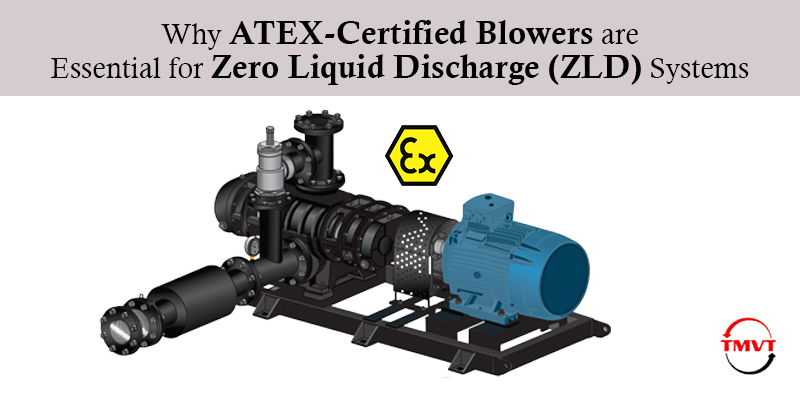
ATEX is a stringent European safety directive for equipment in explosive atmospheres. An ATEX-certified blower is built and tested to ensure it never becomes an ignition source under normal or fault conditions. Key design features include:
- Spark-free construction: Critical components like rotors, couplings and shafts are made of non-sparking materials or treated to prevent friction sparks.
- Explosion-proof motors and enclosures: All electrical parts (motor windings, connections, etc.) are contained in flameproof housings. These enclosures can withstand an internal explosion without letting flames escape. As TMVT notes, ATEX roots blowers have their motors housed in explosion-proof enclosures so that no electric spark can ignite the surroundings.
- Thermal and static controls: ATEX blowers are engineered to limit temperature rise (hot surfaces can ignite gases) and to dissipate static electricity. Designs often include grounding measures or mechanical seals to keep static charges from building up.
- Zone-specific certification: ATEX equipment is rated for specific hazardous zones (e.g. Zone 1 for gas, Zone 21 or 22 for dust). A blower certified for Zone 1 Gas, for instance, guarantees it can safely operate in environments where explosive vapours are likely
Together, these features mean an ATEX blower actively prevents ignition. It effectively contains any sparks or hot particles internally. As industry experts put it, ATEX-certified blowers are designed to avoid creating ignitions in potentially explosive areas. Even in a malfunction, ATEX roots blowers will eliminate hot spots and sparks, ensuring they will not trigger an explosion.
Technical Advantages of TMVT’s Tri-Lobe ATEX Blowers
For Zero Liquid Discharge applications, TMVT’s range of ATEX-certified three-lobe roots blowers offers both safety and performance. Key technical highlights from TMVT’s product lines include:
- Wide capacity range: TMVT’s new 3MTL series covers flows from 5 to 60,000 m³/h, with discharge pressures up to ~1 bar and vacuum down to –0.5 bar. This lets engineers size a blower precisely for a given ZLD evaporator or compressor stage, whether the plant is small or very large.
- Tri-lobe rotor design: Unlike two-lobe blowers, the three-lobe configuration produces a smoother, nearly pulse-free This significantly reduces internal pressure spikes. TMVT reports that three-lobe units have about 20% lower bearing loads and ~5 dB less noise than equivalent two-lobe designs. For ZLD systems, smoother flow means steadier compression of vapor (or air), lower vibration, and longer equipment life. In practice, customers see longer maintenance intervals and quieter operation thanks to the tri-lobe design.
- Oil-free operation: The 3MTL blowers have a completely separated oil chamber. This means the discharge gas is 100% oil-free. In hazardous duties, oil-free delivery is critical – no oil mist enters the vent stream, and there’s no risk of oil decomposition igniting in the blower. TMVT emphasizes that with this design the blower ensures 100% oil-free discharge gas, which is vital when handling any flammable vapours or feeding waste gases to burners.
- Reduced pulsation and wear: By smoothing the flow, the tri-lobe geometry lighter loads bearings and timing gears, yielding a longer service life. Users note up to 20% longer bearing life. Stable airflow also boosts the efficiency of MVR evaporators – roots blowers compress vapor more reliably and use less horsepower than less efficient compressors.
- Robust construction: TMVT blowers are precision-machined from cast iron or steel, stress-relieved, and balanced. This yields heavy-duty reliability for continuous ZLD operation. Tight clearances are maintained even under high vacuum/pressure, and optional cooling or instrumentation can be added. Low intrinsic vibration and optional sound enclosures keep the system stable.
These technical strengths make TMVT’s ATEX blowers ideal for the rigors of ZLD plants. They can continuously handle large volumes of moist vapor, dust-laden exhaust, or corrosive gases without compromising safety.
Benefits of ATEX-Certified Blowers in ZLD Applications
Choosing ATEX-certified roots blowers for a ZLD plant brings broader benefits beyond explosion safety:
- Regulatory compliance: Many industries are legally required to use ATEX rated equipment in hazardous zones. Using ATEX blowers ensures the plant meets local and international safety standards (CE, IECEx, etc.), avoiding costly fines or shutdowns.
- Operational reliability: ATEX blowers are built to stricter quality and testing protocols. For example, TMVT tests each blower on a performance bench (flow, noise, vibration) and certifies it for API/ISO standards. This rigorous QA means the blower will perform as specified, crucial for continuous ZLD processes where downtime is very costly.
- Explosion risk reduction: The primary benefit is safety. An ATEX-rated blower mitigates the very hazard the ZLD plant is trying to eliminate. In practice, this protection translates to massive cost savings by avoiding fires or explosions. An ATEX blower minimize the risk of ignition and contains any possible internal fault.
- Long-term economics: Though ATEX blowers can have a higher upfront cost, the lifecycle savings are huge. Avoiding a single accident (or even minor fire) pays for itself. Plus, ATEX blowers often have a robust design (oil-free, low vibration) that lowers maintenance and energy costs over time. TMVT notes that their ATEX units exceed explosion-proof criteria, giving plant managers peace of mind.
TMVT’s ATEX Blowers Solving ZLD Challenges
TMVT, a leading Roots Blower manufacturer in India, specializes in ATEX-certified tri-lobe roots blowers for global customers. Here’s how TMVT’s blowers address common ZLD needs:
- Safe Vapor Compression (MVR): In MVR evaporators, roots blowers recompress hot vapor for reuse. TMVT blowers handle this continuously at high temperature and moderate pressure. The oil-free design means vapours stay uncontaminated, and the ATEX rating prevents ignition even with organic vapours present. TMVT highlights that using efficient roots blowers in MVR allows plants to recover nearly all thermal energy from the vapours, making ZLD processes energy-efficient as well as safe.
- Inerting and Gas Purging: Some ZLD systems introduce inert gas (nitrogen) to blanketing tanks or purge volatile streams. TMVT’s blowers can deliver inert gas under pressure or suction, and being ATEX-rated they remain safe even if the gas stream carries traces of flammables.
- Handling Flare and Emissions: In ZLD variants that burn off or capture waste gases, TMVT ATEX blowers can move hot, mixed-composition gases to flare stacks or scrubbers. Their oil-free, high-volume operation ensures that flammable gas is sent safely to the burner without any oil carried over.
- Global Support: TMVT provides complete packages, including drive motors, baseplates, and instrumentation, all compliant with ATEX. As a full solution, the blower can be certified for the exact hazardous zone of the plant. TMVT’s in-house R&D and testing ensure that even custom materials maintain ATEX compliance.
In all these cases, choosing a TMVT ATEX-certified blower means solving the core problem like move large volumes of gas or vapor in a ZLD plant without risking an explosion. The result is a safer workplace and more robust ZLD operation.
Conclusion
Zero Liquid Discharge plants represent a major advance in industrial water reuse, but they pose unique safety challenges. ATEX-certified roots blowers are not optional in ZLD – they are essential equipment. By design, ATEX blowers eliminate sparks, hot surfaces, and other ignition sources in environments rich with flammable vapors or dust. In practice, this means the plant can safely concentrate and dry hazardous effluents without fear of a catastrophic explosion.
TMVT’s ATEX-rated three-lobe roots blowers are built to meet this need. They combine high efficiency and reliability (wide flow range, low pulsation, oil-free delivery) with full explosion-proof engineering. For industries in India and around the world implementing ZLD, using TMVT’s ATEX-certified blowers ensures compliance with global safety standards and uninterrupted operation.

TMVT Team
Serving as the Editorial Lead at TMVT, I am a digital content expert passionate about manufacturing innovation and industrial efficiency, committed to delivering high-quality updates and technical guides on machinery trends for our global client base.