Explosion-Proof Air and Gas Handling: Why Biogas Facilities Choose ATEX Roots Blowers
Biogas plants produce a flammable, moisture-laden gas that demands special handling. Raw biogas contains roughly 60% methane and 35% CO₂, along with water vapor and often traces of hydrogen sulphide (H₂S). These components make biogas highly combustible and corrosive. Any electrical spark, hot surface or oil mist can ignite it. For this reason, biogas facilities worldwide insist on explosion-proof ATEX-certified blowers. ATEX is a European safety standard requiring equipment to eliminate ignition sources in hazardous atmospheres. In practice, ATEX-certified Roots blowers use rugged enclosures, special motor designs and wide clearances so that even in a worst-case gas leak, the blower itself cannot spark an explosion.
Roles of Roots blowers in biogas facilities
Roots-type blowers play key roles in biogas processing. They move and compress the gas throughout the plant with a steady, constant flow. They also boost pressure to meet downstream needs for instance raising biogas pressure for pipeline injection or for fuelling cogeneration engines. Roots blowers can even mix biogas with air for controlled flaring or blend gases during upgrading. In aerobic stages (like wastewater aeration), blowers supply oxygen to microbes. In every case, large volume flow at low-to-moderate pressure is required, and Roots blowers excel at that. In digestion tanks they help circulate gas and oxygen; in upgrading they provide air streams to CO₂/H₂S scrubbers; and for grid injection they compress the methane-rich gas gently for pipelines.
- Gas transport: Roots blowers convey biogas from digesters or collection headers to processing units. Their high-volume flow moves gas even at low inlet pressures.
- Pressure boosting: After initial generation, biogas often needs higher pressure (e.g. for engine CHP units or pipeline injection). Roots blowers compress the gas in positive-displacement stages to reach the required pressure.
- Mixing and aeration: In purification or flaring, blowers mix biogas with air or steam. They also drive aeration in any associated wastewater tanks (as in anaerobic sludge processing). Importantly, an ATEX blower is used here because H₂S and other flammable biogases can build up during treatment.
Because biogas handling involves flammable vapours and liquids, selecting the right blower is critical. An ATEX-certified Roots blower is engineered to meet those challenges.
Why ATEX Certification Matters for Biogas Blowers
- Explosion protection: Biogas is an explosive hazard. ATEX roots blowers are designed so that no internal part can ignite the gas. All electrical components are in flameproof enclosures and have mechanical seals, and even the housing and bearings are rated to keep surface temperatures below ignition limits. In other words, an ATEX blower can safely run even in a methane-rich atmosphere. Regulations mandate that any blower handling hydrocarbon gas in a plant must be explosion-proof, so ATEX certification isn’t optional.
- No ignition sources: In practice, ATEX certification means roots blowers have features like inert gas purges or intrinsic safety in controls, special drive couplings, and strict clearance tolerances. These measures remove all sparks or hot spots. Many designs also use oil-free compression a critical safety feature. Because lubricating oil is completely isolated from the gas path, there’s no oil mist that could ignite. In fact, TMVT’s tri-lobe blowers physically separate the oil chamber from the gas chamber, ensuring the discharged biogas is entirely oil-free. This oil-free operation is itself a safety benefit – entrained oil could otherwise become an ignition source or foul downstream equipment.
- Corrosion resistance: Raw biogas often contains H₂S and moisture, which form acidic compounds that corrode metal. A blower in a biogas plant must resist that. In practice, ATEX-certified blowers for biogas use special materials and coatings. For example, critical parts may be lined or coated with Teflon/epoxy, and rotors might be stainless steel or otherwise treated against acid attack. This means the blowers last much longer even in wet, sulphurous gas.
- Oil-free delivery: As mentioned, an oil-free design is crucial for biogas. Any oil carryover would foul catalysts or engines downstream and also pose fire risks. ATEX-certified Roots blowers achieve this by using separate oil chambers – bearings and gears are lubricated but isolated from the gas. TMVT’s tri-lobe blowers, for instance, ensure that all lubricated components are in their own sealed oil sump. Advanced seals or piston rings prevent any lubricant from reaching the gas side. The result is 100% oil-free biogas out of the blower – a major advantage for sensitive downstream equipment.
- Steady, efficient flow: Roots blowers are positive-displacement machines, so they deliver a constant flow at fixed speed. This stable flow is valuable in a digester or upgrading unit, where pressure and flow swings must be minimized. The three-lobe design in particular (used by TMVT) smooths out pulsations compared to older two-lobe blowers. Less pulsation means steadier pressure, lower vibration, and more uniform gas flow for reactors or compressors. In fact, we note that three-lobe blowers achieve about 20% longer bearing life and reduce noise by ~5 dB versus twin-lobe models.
- Reliability & low maintenance: Biogas facilities need blowers that run 24/7 with minimal downtime. Roots blowers have a simple, rugged construction & few moving parts, and all wear is non-contact. TMVT’s blowers are built tough large cast-iron or steel casings, precision-machined internals, and oil baths keep gears and bearings happy. In practice, this means many years of service before overhaul. For biogas plants, that translates to fewer shutdowns and lower total cost of ownership.
In short, ATEX-certified Roots blowers bring five key benefits to biogas plants from explosion-proof safety to corrosion resistance, oil-free output, consistent high flow, and dependable uptime. They are truly the workhorses of gas handling in anaerobic digestion and upgrading.
How TMVT’s ATEX Roots Blowers Solve Biogas Challenges
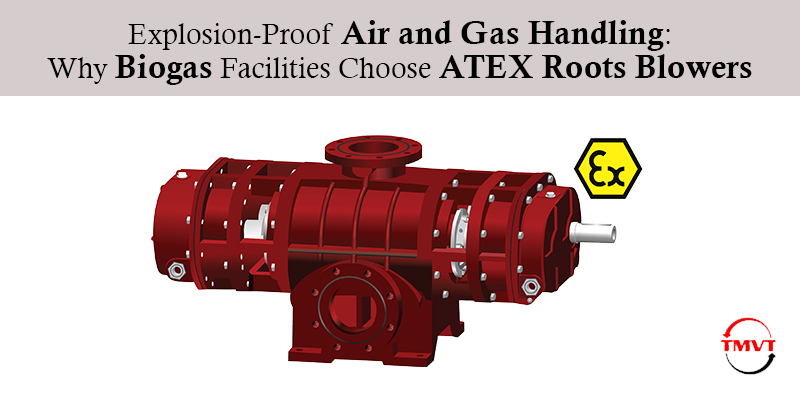
As a leading Indian manufacturer of ATEX-certified blowers, TMVT designs its tri-lobe roots blowers specifically for harsh gas service. The new 3MTL series covers 5 to 60,000 m³/h of flow, up to 1 bar discharge pressure. This vast range means a single product line can serve everything from small farm digesters to large biomethane plants.
- Ultra-stable flow: TMVT’s tri-lobe rotors inherently reduce discharge pulsation. The result is an extremely smooth output flow. In data from TMVT, this design yields much lower discharge pressure variation, translating to less vibration and about 20% longer bearing life. Stable flow and low vibration are huge advantages for biogas systems, as they prolong equipment life and simplify control.
- Oil-free gas path: The TMVT design keeps oil completely out of the gas. Our oil chamber is separated from main chamber; hence air is oil free. This, along with advanced seals on the shaft, means no lubricant can contaminate the biogas. In essence, TMVT blowers deliver clean, oil-free biogas straight out of the unit
- Reduced maintenance: With their simple internal design, TMVT Roots blowers are easy to service. Fewer parts, no internal compression, and splash lubrication all help. TMVT specifically highlights that the blower’s construction is simple and hence easy maintenance. For plant operators, this means faster routine checks and less downtime.
- High efficiency: TMVT notes that the tri-lobe geometry causes less back flow and a more stable air flow rate, this increases volumetric efficiency. Biogas blowers often see variable pressures, and less back-flow means more of the gas is effectively moved. Also, smoother lobes cut noise by ~5 dB, which is important for pump rooms. All together, the blowers’ efficiency and quiet operation help cut energy costs on long runs.
- Worldwide explosion-proof certification: TMVT backs its designs with full ATEX compliance. Their blowers are built to meet ATEX 2014/34/EU standards for Zone 1 areas. In fact, TMVT explicitly states it offers ATEX blowers safe for Zone 1 hazardous areas by design. This means a TMVT blower can be confidently installed in any European or global biogas plant without extra modification. In effect, biogas customers get a plug-and-play explosion-proof blower that ticks all safety boxes.
- Custom fit: Finally, TMVT’s engineering team can tailor each blower package to the plant’s needs. This includes choosing cast material, coatings, and accessories. For example, if the biogas has very high H₂S, TMVT can specify corrosion-resistant linings on the casing. Or if a project needs a compact skid, TMVT can adjust the blower layout. This flexibility means the blower handles the actual gas conditions on site. In short, TMVT ATEX blowers aren’t just off-the-shelf pieces they’re built for the exact challenge of each biogas plant, be it manure digestion, landfill methane, or wastewater biogas.
Conclusion
Biogas facilities face unique safety and operational demands. The combination of a flammable, corrosive gas and the need for reliable, constant airflow makes equipment choice critical. ATEX-certified Roots blowers answer this challenge by eliminate ignition risk while providing robust, oil-free performance for large gas volumes. TMVT’s tri-lobe blowers, in particular, are tailored to biogas applications. They cover the full range of flows and pressures, reduce pulsations by design, and keep the biogas stream clean. By installing TMVT’s ATEX-rated Roots blowers, a biogas plant gains peace of mind. These units safeguard against explosions, stand up to H₂S and moisture, and deliver stable gas flows day after day.
As India’s leading manufacturer of ATEX roots blowers with global reach, TMVT brings decades of experience to every project. Our solutions ensure that biogas plants operate safely and efficiently, turning waste gas into energy without compromise. If your facility handles biogas or biomethane, an ATEX-certified TMVT Roots blower can be a pivotal part of your system – enhancing performance, uptime, and above all, safety.

TMVT Team
Serving as the Editorial Lead at TMVT, I am a digital content expert passionate about manufacturing innovation and industrial efficiency, committed to delivering high-quality updates and technical guides on machinery trends for our global client base.