
How does a Liquid Ring Vacuum Pump differ from other types of vacuum pumps?
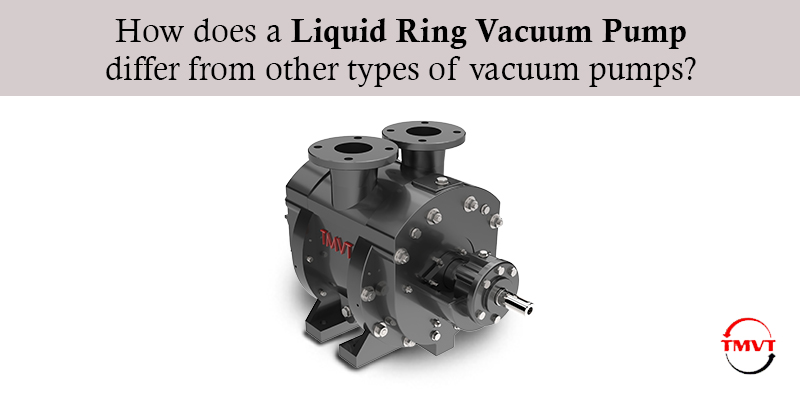
Industrial vacuum selection is a strategic choice that dictates the reliability of your entire manufacturing line. For process engineers and facility owners, the liquid ring vacuum pump stands as a uniquely robust solution compared to rotary vane or dry screw alternatives. TMVT is a premier manufacturer from India with decades of experience and specialize in high-performance liquid ring systems designed for the rigors of global industrial applications.
While many technologies rely on high-precision metal contact or complex oil lubrication, the TMVT liquid ring pump uses a rotating ring of service liquid to perform compression. This fundamental difference in the sealing medium provides the operational advantages that distinguish our technology from other industrial counterparts.
Mechanical Distinction – Simplicity and Internal Clearance
The most prominent difference between a liquid ring vacuum pump and a dry screw or rotary vane system is the number of moving parts. A dry screw pump requires two interlocking rotors spinning at high speeds with tight clearances. Rotary vane pumps rely on sliding vanes that rub against the internal housing and require constant oil lubrication.
TMVT design is defined by elegant simplicity. The only moving part is a multi-bladed impeller mounted on a shaft. This impeller is positioned eccentrically within a cylindrical casing. Because the impeller never touches the casing or other stationary parts, mechanical wear is negligible. This non-contact design significantly extends the operational lifespan and reduces the frequency of major overhauls.
Table 1 – Mechanical Architecture Comparison

Liquid Handling and Moisture Tolerance
A defining differentiator of liquid ring technology is its resilience in wet process conditions prevalent in chemical and pharmaceutical sectors. While moisture causes oil emulsification and mechanical seizure in rotary vane pumps or rotor corrosion in dry screw systems, liquid ring vacuum pumps flourish. Because they utilize service liquid for sealing, incoming moisture is simply incorporated into the ring and discharged. This robust design manages large vapor loads and liquid slugs without internal damage, eliminating the need for the complex inlet filtration mandatory for sensitive dry or oil-sealed technologies.
Condensing Effect – A Thermodynamic Advantage
Liquid ring systems offer an internal condensing effect that other vacuum technologies lack. When saturated gas enters the pump, it meets the cool service liquid. This liquid acts as a direct-contact condenser and causes much of the incoming vapor to transition into the liquid phase.
This phase change reduces the gas volume that the impeller must mechanically compress. As gas volume decreases, the effective pumping speed of the unit increases beyond its dry-air rating. This allows liquid ring pump to handle high vapor loads more efficiently than dry screw or rotary vane pumps, which must mechanically compress the entire vapor volume.
Isothermal Operation – Thermal Management and Safety
Heat dissipation during compression is where liquid ring pumps diverge most from other technologies. Dry screw pumps and reciprocating compressors operate on adiabatic principles where gas temperature rises dramatically. Discharge temperatures in dry screw pumps can reach 450⁰F (232⁰C), which can trigger chemical polymerization or ignite explosive gas mixtures.
Liquid ring vacuum pump operates almost isothermally. The service liquid acts as a thermal buffer and absorbs the heat generated during compression. This heat is carried away by the discharged liquid, which can be cooled and recirculated. This keeps gas discharge temperatures low, typically within 10⁰F to 20⁰F of the service liquid.
Table 2: Thermal and Safety Profile Comparison

Minimal Maintenance and Mechanical Reliability
The Total Cost of Ownership is a critical metric for plant owners. Liquid ring pumps provide a clear advantage in simplicity and reliability. Liquid ring pumps feature no timing gears to synchronize and no multiple rotors to align. While reciprocating piston pumps require regular replacement of rings and valves, the liquid ring design is inherently low-friction.
Because the impeller does not touch the casing, internal components do not experience the wear found in sliding or interlocking parts. Liquid ring pump can often operate for several years without internal part replacements. Additionally, there is no internal lubrication in the pumping chamber. This provides an oil-free vacuum and ensures your process gas remains uncontaminated.
Internal Lubrication and Contamination
A major maintenance hurdle for oil-sealed pumps (like rotary vane or piston pumps) is the management of the lubricating oil. The oil must be periodically filtered and changed to remove contaminants absorbed from the process gas. If the process gas is corrosive or reactive, it can degrade the oil rapidly, leading to frequent maintenance and the cost of disposing of contaminated lubricants.
Liquid ring pump requires absolutely no internal lubrication in the pumping chamber. The service liquid whether it is water, oil, or a process-compatible fluid serves the dual purpose of sealing and cooling but does not act as a traditional lubricant that can be degraded by mechanical friction. This leads to an oil-free vacuum, ensuring that the process gas remains uncontaminated and the environmental impact of used oil disposal is virtually eliminated.
Contaminant Tolerance and Robustness
Industrial processes are rarely clean. Vacuum pumps are often exposed to dust, particulates, or fibrous materials. In scroll or screw pumps, even small debris can score rotors or cause seizure due to tight clearances.
Liquid ring pumps are engineered for dirty applications. The continuous flushing action of the service liquid acts as a self-cleaning mechanism. As the ring rotates, it captures particulates and flushes them out the discharge port. This makes the pump tolerant of harsh environments in mining or paper industries.
Table 3 – Operational Performance Benchmarks

Core Technical Differentiators
The technical differences between liquid ring vacuum pumps and other leading technologies rest on four pillars.
-
Sealing Medium and Contamination Control
The liquid ring itself provides the seal. In most systems, this is water, which is inexpensive, non-toxic, and acts as a cleaning agent. In contrast, rotary vane pumps use oil, which carries the risk of back streaming, where oil molecules migrate back into the vacuum chamber and contaminate the process. For cleanroom, pharmaceutical, or food applications, the water-sealed or oil-free nature of the TMVT pump is a decisive advantage.
-
Moisture and Liquid Tolerance
This is perhaps the most significant functional difference. Liquid ring pumps handle moisture as part of their design. Other pumps, such as dry scroll or standard rotary vane types, are highly sensitive to moisture; even high humidity can lead to internal corrosion or seal failure.
-
Moving Parts and Maintenance Complexity
The simplicity of the design centred on a single rotating impeller, contrasts with the multi-component, high-precision assemblies found in screw, claw, and piston pumps. Fewer moving parts mean fewer failure points, simpler spare parts inventory, and a much lower requirement for specialized technical labour during routine servicing.
-
Typical Use and Operational Environment
Liquid ring pumps are the heavy-duty workhorses of the vacuum world. They are ideally suited for rugged industrial environments where the process is dirty, hot, or wet. Other pumps like rotary vane or dry scroll systems are more suited for clean, dry laboratory environments or high-tech manufacturing where vacuum levels are deep and the gas stream is highly controlled.
Common Applications Across Global Industries
The technical differences described above have led to the adoption of TMVT liquid ring vacuum pumps across a wide spectrum of industrial sectors. TMVT supplies these machines globally, serving both public sector giants and private sector innovators.
- Chemical and Pharmaceutical Industry: TMVT pumps are indispensable for distillation, crystallization, drying, and solvent recovery. Their ability to handle corrosive gases and provide oil-free vacuum is critical for maintaining product purity.
- Power Generation: In power plants, these pumps are used for condenser evacuation, fly ash conveying, and pump priming. They help maintain the vacuum necessary for steam turbines to operate at peak efficiency.
- Food and Beverage Industry: Used extensively for deaeration of mineral water, vacuum packaging, bottling, and the deodorization of edible oils. The lack of oil contamination ensures compliance with food safety regulations.
- Mining and Minerals: TMVT pumps drive the vacuum filtration systems used to dewater mineral concentrates. Their robustness against abrasive particles and liquid carryover makes them the preferred choice for this rugged industry.
- Pulp and Paper Industry: Crucial for the dehydration of paper webs and paper coating processes. The pumps handle the high moisture and fibre content of the process gas with ease.
- Refineries and Petrochemicals: Employed for flare gas recovery and vacuum distillation of crude oil. The isothermal compression provides an extra layer of safety when handling hydrocarbon vapours.
Why TMVT – The Choice for Global Engineering
TMVT Industries Pvt. Ltd. is a leading manufacturer from India with a global supply chain. We are founded on engineering precision and customer service.
A Legacy of Excellence
TMVT is part of the T. Maneklal group, which has been an industrial leader since 1948. This history gives us a deep understanding of pump dynamics. Under the guidance of our management, we invest in technically oriented facilities in Ahmedabad to meet global benchmarks.
Unwavering Quality
our commitment to quality is reflected in international certifications. We are an ISO 9001.2015, ISO 14001.2015, and ISO 45001.2018 certified company. Our products carry CE and ATEX certifications for safety in international markets.
Tailor-Made Solutions
We provide customized engineering solutions. We work with engineers to select the appropriate material of construction, circulation system, and pump series to match your specific process requirements.
Conclusion
The differences between a liquid ring vacuum pump and other types are rooted in mechanical and thermodynamic principles. While other technologies struggle with moisture and maintenance, the TMVT liquid ring vacuum pump excels by embracing wet processes and maintaining cool isothermal compression.
If your process demands high reliability in harsh or hazardous conditions, the liquid ring vacuum pump is the superior solution. TMVT provides high-performance systems that drive productivity in the modern industrial era.
Optimize Your Process with TMVT
Upgrade to a vacuum system engineered for the toughest industrial duties. Contact our global engineering support team today for a technical consultation or a quote.
- Visit our website – https://tmvt.com/
- Head Office in Mumbai, India | +91 (0) 22- 22830060 / 68
- Manufacturing Plant in Ahmedabad, India | +91 (0) 79-40084283
TMVT Industries Pvt. Ltd. – Your Partner in Global Industrial Vacuum Excellence.

TMVT Team
Serving as the Editorial Lead at TMVT, I am a digital content expert passionate about manufacturing innovation and industrial efficiency, committed to delivering high-quality updates and technical guides on machinery trends for our global client base.