The-Strategic-Role-of-Airfoil-Bearing-Turbo-Blowers-in-High-Performance-Pneumatic-Conveying-1.jpg

November 24, 20250

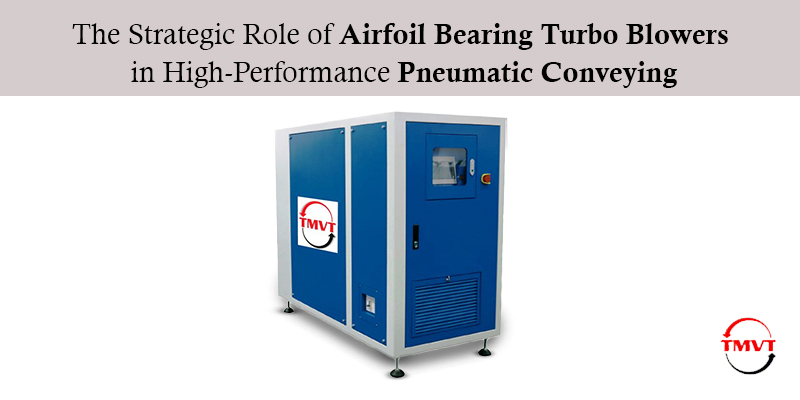
The efficacy of large-scale industrial material handling hinges on the performance of the air source. For engineers and process designers specializing in pneumatic conveying, the challenges presented by traditional air technologies, notably high energy consumption, frequent maintenance cycles, and the persistent risk of oil contamination often define operational bottlenecks. High-speed, gearless turbo blowers, utilizing advanced airfoil bearing technology, represent a fundamental shift in fluid dynamics application, moving the system from merely adequate material transfer to optimized, precision throughput.

As a leading global industrial manufacturer, TMVT provides solutions engineered to redefine these industry standards, offering verifiable energy savings of up to 30%. This analysis details how modern gearless turbo blower architecture addresses the critical requirements of advanced pneumatic conveying systems, ensuring precision flow dynamics, guaranteeing oil-free air purity, and delivering an optimized Total Cost of Ownership across global operations.

The Engineering Imperative: Precision Control for Conveying Dynamics

In pneumatic conveying, air velocity is the most critical factor, dictating both the material transfer efficiency and the integrity of the bulk solids. Process engineers must constantly balance the demands of two primary modes – dilute phase and dense phase conveying.

Dilute phase conveying is characterized by high air velocities, typically ranging between 700 and 1,000 meters per minute, where materials are suspended fully within the air stream. This mode is often suitable for free-flowing materials and longer distances. In contrast, dense phase conveying is utilized for fragile, abrasive, or cohesive materials such as pharmaceuticals, catalysts, or heavy powders, where the material is transported in plugs or waves at low velocity, resulting in a high solids-to-air ratio, often 100:1 or more.

VFD-Enabled Management of Minimum Transport Velocity

A core engineering challenge is preventing line blockages, which occur when air velocity drops below the minimum required transport threshold necessary to keep particles suspended. For reliable dilute phase transfer, the minimum conveying velocity (which can range from 10 to 16 meters per second for fine to coarse materials) often requires an additional 20% buffer for minimum pick-up velocity.

Maintaining this threshold requires a precise and dynamic air flow source. The VFD-controlled, high-speed turbo blower utilizes an optimally customized Variable Frequency Drive linked to a Permanent Magnet Synchronous Motor. This configuration provides the dynamic turndown ratio essential for modulating air flow in real-time.

The ability to precisely adjust air flow allows operators to fine-tune the solids loading ratio dynamically. This is crucial when material input changes or when the system must switch between conveying modes without the wasteful over-pressurization common in fixed-volume systems. This precision ensures system stability, which is the necessary prerequisite for preventing the velocity instability that frequently precipitates blockages and system downtime.

Mitigating Material Attrition and Pipe Wear

High velocities, while necessary for the dilute phase, introduce significant kinetic energy that causes material degradation and fines generation. This is particularly problematic for friable or brittle materials. The precision flow control afforded by the VFD allows engineers to operate closer to the actual, optimized minimum conveying velocity. This prevents excessive acceleration, reducing particle impact energy at elbows and bends, thus protecting material integrity and minimizing damage to the pipeline itself. The broad operational capacity of TMVT Turbo Blowers ranging from 300 to 18,000 M³/hr with pressures up to 0.8 Kg/cm²  in normal condition and up to 1 Kg/cm² in special cases, ensures that the system can be optimally sized for specific bulk densities and conveying distances, avoiding the unnecessary energy consumption and high-velocity risks associated with oversized components.

Dynamic Control Requirements for Pneumatic Conveying Modes:

Conveying Mode Typical Velocity Range Mass Loading Ratio (SLR) Material Risk Profile Blower Control Requirement
Dilute Phase High (700 – 1,000 m/min) Low (up to 15:1) High Attrition/Abrasion Risk Precise VFD control to prevent velocity spikes and maintain minimum transport velocity
Dense Phase Low (Plug/Wave movement) High (100:1 or more) Friable/Abrasive Materials Stable, high-pressure output with flow modulation to manage plug formation and maintain low-velocity operation
Minimum Pick-Up Velocity 10-16 m/s + 20% Buffer N/A Line Blockage Risk Rapid response from VFD/motor system to handle sudden material feed or pressure transients

The Airfoil Architecture: Reliability and Energy Efficiency

The functional superiority of the high-speed turbo blower in pneumatic conveying is fundamentally derived from its gearless, frictionless architecture, which contrasts sharply with traditional positive displacement or geared centrifugal systems.

Gearless Design and Frictionless Operation

The core innovation is the non-contact Air Bearing, which is lubricated purely by air buoyancy. Derived from aviation turbine technology, this design eliminates all physical friction, which in turn eliminates wear and tear. This results in a semi-permanent service life and drastically reduced maintenance requirement. The design eliminates the need for oil, seals, lubrication systems, gearbox inspections, and alignment procedures required by conventional blowers. Routine care is minimized, typically consisting only of inlet filter monitoring.

This simplification of mechanical reliability offers a significant advantage in global operations. The inherent reliance of geared systems on a complex inventory of specialized spare parts (e.g., oil pumps, seals, specialized bearings) makes them vulnerable to global supply chain disruptions and logistical bottlenecks, leading to costly stockouts and unpredictable downtime. By eliminating these high-wear components, the airfoil technology transforms reliability into a strategic asset, significantly reducing operational vulnerability and securing higher uptime for 24/7 industrial settings.

Maximizing Isentropic Efficiency via Permanent Magnet Motors

TMVT utilizes the Latest Energy Efficient Permanent Magnet Synchronous Motor to drive the high-precision aerodynamic impeller. This is critical to efficiency. The P-M motor’s rotor has a built-in permanent magnet, which means power is required only to rotate the shaft and not for the energy-intensive magnetization of the rotor. Coupled with the direct-drive system, which eliminates transmission losses, this architecture results in verifiable energy savings of up to 30% compared to less efficient conventional technologies.

This efficiency advantage is vital in pneumatic conveying, where power consumption directly impacts the Specific Energy Consumption per ton of material moved. For industries transitioning away from older, less efficient technologies, this level of energy saving is substantially greater than the 10% to 35% typically cited for standard centrifugal upgrades.

Integrated Solution for Global Deployment

Addressing international logistical pain points, the airfoil bearing turbo blower is built as a complete system in a sound-proof enclosure. The gearless, compact design results in low vibration and noise and requires “no need for extra lifting devices, special foundations, or time-consuming alignment procedures”. This plug-and-play capability drastically cuts down on initial project lead times, reduces reliance on specialized site preparation, and minimizes the civil engineering costs associated with traditional heavy machinery installation.

TMVT Technical Features and Conveying Application Benefits:

TMVT Feature Technical Mechanism Benefit for Pneumatic Conveying Performance
Non-contact Air Bearing Air buoyancy replaces oil/gears Zero oil contamination (ISO Class 0); Near-zero maintenance and spare parts inventory
Permanent Magnet Synchronous Motor (P-M Motor) Synchronous operation, no slip Up to 30% energy savings; Consistent high torque across variable speeds
Capacity up to 18,000 M³/Hr; Pressure up to 0.8 Kg/cm²  in normal condition and up to 1 Kg/cm² in special cases High-precision Direct-coupled Aerodynamic Impeller Wide operational envelope, suitable for diverse bulk densities and long pipeline requirements
Customized Variable Frequency Drive (VFD) Dynamic rotation speed control Precise regulation of volumetric flow; Optimized Solid Loading Ratio (SLR) for attrition control
Sound-proof Enclosure Package Integrated compact design Extremely low noise/vibration; Eliminates need for special foundation and complex installation

The Zero-Risk Mandate: ISO Class 0 Air Purity

For sectors handling sensitive materials including Food and Beverage, Pharmaceutical, and Specialty Chemical manufacturing, air quality is a non-negotiable component of operational integrity and regulatory compliance. In these processes, compressed air often contacts the final product, meaning there is zero tolerance for contamination.

Achieving Purity at the Source

The global standard for air purity is governed by ISO 8573-1 Class 0, which defines the acceptable limits for particulates, moisture, and, critically total oil content. Conventional blowers must be paired with extensive downstream filtration and treatment systems to scrub oil aerosol from the output air, adding significant capital cost, pressure drop, and ongoing energy load to the system.

The application of non-contact Air Bearings eliminates the need for oil entirely. Since the mechanical assembly is inherently oil free grease free and seal free the turbo blower inherently delivers Class 0 air quality at the source. This strategic benefit bypasses the complex costly and energy intensive filtration process simplifying system design. To further ensure absolute purity the system is equipped with a high-performance inlet air filter of 1-micron capacity which actively prevents maximum dust particle contamination. This provides unparalleled protection against batch contamination and regulatory non-compliance thereby integrating compliance assurance directly into the conveyance technology.

Operational Intelligence: PLC and Predictive Maintenance

Modern industrial air systems require integrated controls that do more than merely switch the machine on and off, they require operational intelligence to maximize productivity and efficiency. TMVT integrates a sophisticated Programmable Logic Controller (PLC) and a user-friendly touch screen Human Machine Interface into the standard turbo blower package.

Real-Time Performance Monitoring

The PLC continuously monitors and displays critical operational parameters. This includes pressure, temperature, air flow, motor RPM, and, significantly, motor power consumed. This comprehensive data collection moves monitoring beyond simple status checks into a powerful analytical tool. This continuous stream of performance data is the backbone of an Industry 4.0 maintenance strategy, enabling predictive maintenance protocols.

By utilizing this data, engineers can detect minor issues before they escalate into major failures. For example, the system can instantly flag unusual pressure drops, which are often the precursors to air leaks or impending line blockages. More critically the continuous tracking of air flow and consumed motor power allows facilities to calculate and actively manage their Specific Energy Consumption SEC the precise energy required to convey a unit of material. This provides a verifiable Key Performance Indicator KPI for continuous efficiency audits and process optimization. This high level of real time diagnostics and control ensures maximized equipment life cycles and minimized production downtime. Furthermore, various electronic interlocks ensure the machine safety if any unusual parameter change occurs effectively protecting the asset against operational anomalies.

Conclusion: The Total Economic Value Proposition

While the advanced engineering inherent in airfoil bearing turbo blowers may necessitate a higher initial capital investment compared to older, more rudimentary technologies, the true metric of value in industrial engineering is the Total Cost of Ownership.

The gearless, frictionless architecture directly eliminates the recurring and substantial costs associated with traditional systems: frequent oil changes, filter replacement, gearbox maintenance, specialized labour, and the logistical burden of maintaining a complex spare parts inventory. Furthermore, the exceptional operational efficiency, resulting in energy savings of up to 30%, delivers a rapid and favourable Return on Investment purely through reduced utility costs.

Lifecycle Economics and Operational Resilience:

Cost/Risk Factor Airfoil Bearing Turbo Blower Traditional Geared Blowers (Comparative) Impact on Total Cost of Ownership (TCO)
Energy Consumption Up to 30% Reduction Baseline (Higher Power Draw) Major long-term savings; low specific energy consumption (SEC)
Maintenance Labour & Parts Near-Zero: No oil, gears, or alignment needed High: Scheduled oil changes, filter replacement, gearbox/bearing overhauls Significant reduction in labour, maintenance budgets, and spare parts inventory
Risk of Contamination Zero (Inherent ISO Class 0) High (Requires intensive filtration) Mitigation of product loss and regulatory fines; protection of material purity
Installation Complexity Low: No special foundation or alignment required Moderate-to-High: Requires specialized foundation and rigorous alignment Reduced initial project costs and faster commissioning time
Downtime Extremely Low (Predictive maintenance via PLC) Moderate (Prone to wear-related failures, long lead times for specialized spares) Maximized operational output and reliability (24/7 capacity)


The convergence of precision VFD flow control for maximizing throughput and minimizing attrition, guaranteed ISO Class 0 air purity, and the foundational reliability of frictionless mechanics positions the airfoil bearing turbo blower as an essential strategic asset. This technology not only ensures compliance and product quality but fundamentally lowers the specific energy consumed per unit of material conveyed, making it the superior choice for optimizing pneumatic conveying systems globally.

Optimize your pneumatic conveying system for guaranteed oil-free air and maximum TCO reduction. Start a technical dialogue with TMVT’s global experts and calculate your potential 20-30% energy savings today.
Why-Oxygen-Facilities-Rely-on-ATEX-Certified-Roots-Blowers.jpg

October 29, 20250

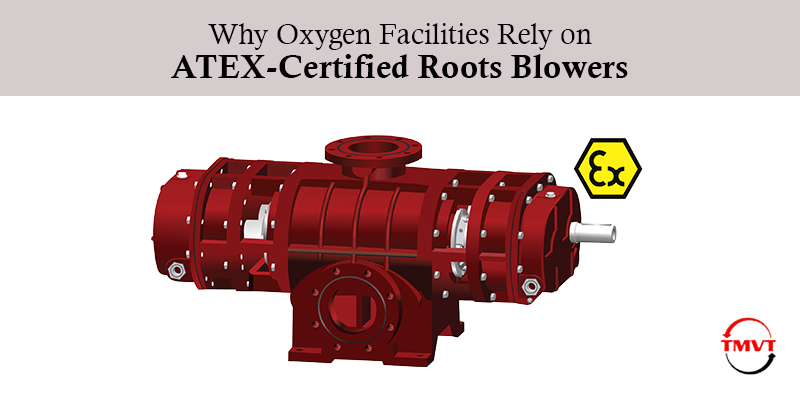
For engineers working with hazardous gases, ATEX certification is a familiar and non-negotiable safety baseline. It provides a crucial framework for preventing ignition in explosive atmospheres. However, when the process gas is oxygen, relying on a standard ATEX certification alone is a dangerous oversimplification. Oxygen is not a fuel, it is a powerful oxidizer that fundamentally rewrites the rules of combustion. In an oxygen-enriched environment, the blower itself, its components, lubricants, and even microscopic contaminants can become the primary fuel in a catastrophic fire.

This article moves beyond the basics of explosion-proofing to provide a detailed engineering analysis of why oxygen service demands a far more rigorous approach. We will deconstruct the unique fire triangle of an oxygen-rich atmosphere, dissect the specific ignition mechanisms inherent to Roots blower operation, and detail the critical design, material, and cleanliness protocols required to ensure true operational safety.

The Oxygen-Enriched Fire Triangle in Hazard Analysis

The classic fire triangle requires a fuel, an oxidizer, and an ignition source. In a typical ATEX application like biogas handling, the process gas is the fuel, and the goal is to prevent the blower from providing an ignition source. In an oxygen facility, this model is inverted.

  • The Oxidizer: The process gas itself is a potent oxidizer. An atmosphere is considered oxygen-enriched when the concentration exceeds 23.5%. In this state, the environment becomes hyper-reactive.
  • The Fuel: With a powerful oxidizer present, materials not normally considered flammable can become highly combustible. This includes the blower’s own components, such as seals, gaskets, and incompatible metals. More critically, trace contaminants like lubricating oils, greases, or solvents become exceptionally dangerous fuels that can ignite with very little energy.
  • The Ignition Source: The sources of ignition in an oxygen system are often subtle and directly related to the mechanical operation of the equipment itself.

The consequence of this altered chemistry is dramatic. In an oxygen-enriched atmosphere, materials ignite at significantly lower temperatures, and once ignited, they burn with far greater speed and intensity. This means a minor energy release that would be harmless in normal air can initiate a devastating fire.

Eliminating Ignition Sources: The Core of an Oxygen-Service Blower Design

An ATEX-certified blower for oxygen service must be engineered to eliminate all potential ignition sources, which go far beyond simple electrical sparks. The most critical risks are mechanical and thermodynamic in nature.

Intrinsic Mechanical and Thermodynamic Hazards

  • Adiabatic Compression: Often called the gas hammer effect, this is one of the most insidious ignition risks. When oxygen is pressurized rapidly in a confined space (like a pipe leading to a fast-opening valve), the work done on the gas converts directly into heat, causing a near-instantaneous temperature spike. This can easily generate enough heat to ignite hydrocarbon contaminants or non-compatible polymer seals, creating a fire with no external spark or flame.
  • Frictional Heating: The high-speed, close-tolerance operation of a Roots blower’s lobes presents a risk of frictional heat. Contact between rotors and the casing, or heat from a failing bearing or gear, can create localized hot spots sufficient for ignition in an oxygen-rich environment.
  • Particle Impact: High-velocity gas can carry tiny contaminants like rust or weld slag. When these particles strike a surface, such as a valve seat or an elbow, their kinetic energy converts to thermal energy, creating a spark hot enough to ignite surrounding materials. This mechanism is a documented cause of major oxygen system fires.

The ATEX Foundation: Electrical and Static Safety

While mechanical risks are paramount, the foundational electrical safety provided by ATEX certification is essential.

  • Spark-Free Design: All electrical components, particularly the motor and instrumentation, must be housed in robust, flameproof enclosures to contain any potential arc or spark and prevent it from reaching the outside atmosphere.
  • Static Electricity Dissipation: The entire blower package must be properly grounded to prevent the build-up and discharge of static electricity, which is a well-known ignition source.

Engineering for Compatibility: Materials, Cleanliness, and Sealing

A truly safe oxygen-service blower is defined by more than its ATEX rating. It is defined by an engineering philosophy that prioritizes material compatibility and absolute cleanliness.

The Mandate for 100% Oil-Free Operation

In a standard industrial blower, a small amount of lubricant carryover might be an acceptable inefficiency. In an oxygen blower, it is a critical failure waiting to happen. Hydrocarbon oils and greases are the perfect first fuel to initiate a fire via the kindling chain, a process where the ignition of a highly flammable contaminant generates enough heat to ignite more robust materials, leading to a cascading system failure.

Therefore, a key feature of any blower intended for oxygen service is a design that guarantees 100% oil-free gas delivery. This is not achieved with filters, but through an engineered design that physically isolates the oil-lubricated bearings and timing gears from the gas compression chamber. This design principle eliminates the most common fuel source from the system entirely.

Material Science is Non-Negotiable

Material selection must be governed by oxygen compatibility. Common industrial materials like carbon steel and aluminium, while strong, can ignite and burn with explosive force in pressurized oxygen. International standards from bodies like the European Industrial Gases Association (EIGA) provide clear guidance on material selection.

  • Metals: Ignition-resistant materials such as copper, bronze, and specific nickel alloys are preferred for wetted components.
  • Non-Metals and Sealing: All non-metallic components, including gaskets and mechanical seals, must be specifically tested and certified for oxygen compatibility, ensuring they have a high auto-ignition temperature and will not become a weak link in the safety chain.

The Rigor of Oxygen Cleaning

Before assembly and shipment, every component of the blower that will come into contact with the process gas must undergo a validated oxygen cleaning procedure. This is a meticulous process designed to remove virtually all organic and inorganic contaminants down to a microscopic level. Where the ATEX certification is designed to eliminate the ignition source, this critical cleaning process is designed to eliminate the fuel. This ensures the blower is delivered free of any residual fuel that could compromise safety.

Why TMVT is the Engineered Choice for Oxygen Facilities

Meeting the extreme demands of oxygen service requires a manufacturing partner who understands these principles at a fundamental level. At TMVT, our Roots blowers are engineered from the ground up with the specific hazards of oxygen in mind.

  • Inherently Safe Oil-Free Design: The cornerstone of our design is the complete physical separation of oil sumps from the gas path. This is not an optional feature, it is integral to our blower architecture, providing an engineered guarantee of 100% oil-free gas delivery and eliminating the primary fuel risk.
  • Precision and Material Integrity: To mitigate the risk of frictional heating, we utilize robust cast iron casings that are stress-relieved after pre-machining. This process prevents thermal warping at operating temperatures, ensuring that critical rotor clearances are maintained and contact is avoided. All components are machined to exceptionally tight tolerances for optimal performance and safety.
  • The Tri-Lobe Advantage: Our three-lobe rotor profile provides a smoother, less pulsating gas flow compared to older twin-lobe designs. This results in significantly lower vibration and mechanical stress on bearings and downstream components, reducing the risk of fatigue failure and increasing operational stability. Our customers report up to 20% longer bearing life on our tri-lobe models, a direct indicator of reduced mechanical load.
  • Certified and Verified Performance: TMVT blowers are built to meet the stringent requirements of the ATEX 2014/34/EU But we go a step further. Every single blower undergoes individual performance testing at our facility before shipment. We measure and document flow rate, power consumption, temperature rise, and vibration levels to guarantee that each unit performs precisely and safely as specified.

Conclusion: Safety Beyond Certification

In conclusion, while ATEX certification is a mandatory starting point, it is insufficient on its own to guarantee safety for Roots blowers in oxygen facilities. True safety is the result of a holistic engineering approach that addresses the unique chemical properties of oxygen. It requires a design that is inherently oil-free, built with meticulously selected materials, manufactured to extreme precision to eliminate mechanical ignition sources, and delivered in a state of validated cleanliness.

Choosing a blower for such a critical application is not merely a procurement decision, it is a partnership in safety. It requires a manufacturer like TMVT, who possesses the deep expertise and engineering discipline to deliver a solution that is not just compliant, but fundamentally safe by design.


ATEX-Roots-Blowers-for-Aquaculture-Safety-Meets-Productivity-in-Modern-Fish-Farms.jpg

October 24, 20250

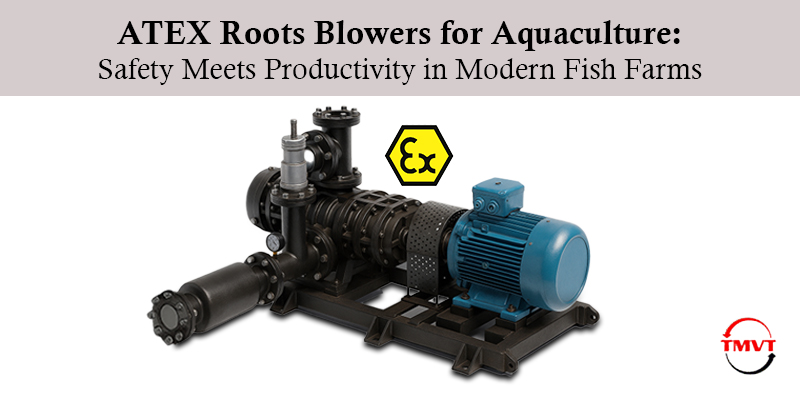
Modern aquaculture is an industry transformed. The push for higher yields and greater sustainability has led to the widespread adoption of intensive farming methods like Recirculating Aquaculture Systems and biofloc technology. At the heart of these systems is the need for powerful, reliable aeration, a task for which the roots blower for fish farming has become the undisputed workhorse. By delivering a constant, high volume of air, these blowers are the engines driving productivity, ensuring high dissolved oxygen levels, and maintaining optimal water quality.

However, as aquaculture operations become more technologically advanced and enclosed, they begin to mirror industrial processes, introducing new and often overlooked safety challenges. The very biological processes that these systems foster can generate hazardous, flammable gases. This intersection of biological productivity and industrial risk is where ATEX certification becomes not just relevant, but essential. An ATEX roots blower in aquaculture is more than just an aeration device; it is a critical piece of safety infrastructure that protects the facility, its personnel, and its valuable stock.

Why Roots Blowers are Essential for Modern Fish Farming

The primary function of an aeration blower in aquaculture is to sustain life and optimize growth. Roots blowers, as positive displacement machines, are uniquely suited for this role, providing a constant and steady volume of air regardless of back-pressure. This consistent performance directly translates to several key productivity advantages.

  • Consistent Dissolved Oxygen Supply: High stocking densities in modern fish farms place an enormous demand on the dissolved oxygen in the water. Roots blowers, connected to diffusers at the bottom of tanks or ponds, ensure a continuous and uniform supply of oxygen throughout the entire water column. This prevents stratification, eliminates low-oxygen dead zones, and reduces stress on the fish, leading to better health, improved growth rates, and higher survival rates.
  • Superior Water Quality: Effective aeration is fundamental to water quality management. The circulation created by a roots blower helps suspend solids for removal and, more importantly, supports the aerobic bacteria that break down harmful waste products like ammonia. This process prevents the buildup of toxic gases and helps maintain a stable, healthy aquatic environment.
  • Energy Efficiency and Reliability: Modern tri-lobe roots blowers are engineered for high efficiency, delivering large air volumes with lower power consumption compared to other aeration methods. Built with robust materials and simple mechanical principles, they are designed for 24/7 operation with minimal maintenance, offering the reliability that is critical for any aquaculture operation.

Flammable Gas Generation in Intensive Aquaculture

While the benefits of intensive aquaculture are clear, the concentration of biological activity in enclosed systems like RAS and biofloc tanks can create potentially hazardous environments. The same microbial processes that treat waste can, under certain conditions, produce flammable biogases.

The primary concern is hydrogen sulphide (H2S), a toxic and flammable gas produced by anaerobic bacteria. These bacteria thrive in oxygen-depleted zones that can form in:

  • Settled Sludge: Pockets of accumulated fish waste and uneaten feed at the bottom of tanks or in sumps can quickly become anaerobic, creating ideal conditions for H2S production.
  • Biofilter Dead Zones: While biofilters are designed to be aerobic, areas with poor mixing or insufficient flow can become anoxic, turning a water treatment component into a potential gas generator.
  • Stagnant Piping: Sections of pipe with low flow can also accumulate organic matter and foster anaerobic conditions.

In these intensive systems, microorganisms can also produce methane (CH4). While typically in smaller quantities, both H2S and CH4 can accumulate in enclosed spaces such as pump rooms, filter buildings, or the headspace above tanks, creating a potentially explosive atmosphere. An ignition source in such an environment could lead to a catastrophic event.

The ATEX Solution: Engineering Safety into Aeration

This is precisely the scenario that ATEX certification is designed to prevent. An ATEX-certified, explosion proof blower for aquaculture farms is engineered to eliminate all potential ignition sources, ensuring it can operate safely even if flammable gases are present.

Key safety features of an ATEX-certified roots blower include:

  • Spark-Free Design: ATEX blowers are constructed with non-sparking materials. Critically, all electrical components, including the motor, are housed in robust, flameproof enclosures that contain any potential electrical spark and prevent it from igniting the surrounding atmosphere.
  • Guaranteed Oil-Free Operation: Oil mist from a standard blower’s lubrication system can act as a fuel source in an explosion. ATEX-certified blowers for these applications must ensure 100% oil-free air delivery. This is achieved through designs that completely isolate the oil-lubricated gears and bearings from the gas path, eliminating a critical element of the fire triangle.
  • Strict Temperature Control: Overheating due to friction or internal compression can create hot surfaces that act as an ignition source. ATEX certification guarantees that the blower’s external and internal surface temperatures will remain safely below the auto-ignition temperature of potential hazardous gases.
  • Static Electricity Dissipation: The entire blower package is designed to be properly grounded, preventing the buildup of static electricity—a common and often overlooked ignition source.

Why TMVT is Premier Choice for ATEX Roots Blower in Aquaculture

At TMVT, we understand that modern aquaculture demands equipment that delivers both peak productivity and uncompromising safety. Our ATEX-certified roots blowers are engineered from the ground up to meet these dual requirements, making them the ideal solution for today’s advanced fish farms.

  • Superior Tri-Lobe Technology: Our 3MTL series blowers feature an advanced three-lobe rotor design. This provides a smoother, less pulsating airflow, which significantly reduces vibration and noise. The benefits are twofold, it creates a less stressful environment for the fish and farm personnel, and the reduced mechanical load extends the life of bearings by up to 20%, ensuring superior reliability.
  • Inherently Safe, 100% Oil-Free Design: The safety of your operation and the purity of your water are paramount. The TMVT design features an oil chamber that is physically separated from the main gas chamber, providing an engineered guarantee of 100% oil-free air. This eliminates the risk of oil contamination in your tanks and removes a potential fuel source from the safety equation.
  • Robust and Precise Construction: TMVT blowers are built for continuous, heavy-duty operation. We use robust cast iron casings that are stress-relieved after pre-machining to prevent warping and ensure dimensional stability at all operating temperatures. All components are machined to extremely tight tolerances, minimizing friction and maximizing efficiency and service life.
  • Certified Safety and Performance: We offer a complete range of blowers that are fully compliant with the ATEX 2014/34/EU directive, providing you with certified and documented explosion-proof protection. Furthermore, every TMVT blower is individually tested at our facility for capacity, power consumption, temperature rise, and vibration levels before shipment, guaranteeing that it will perform to specification from day one.

Conclusion: Integrating Productivity and Peace of Mind

As aquaculture continues to evolve, the line between agriculture and industry blurs. The drive for higher productivity through intensive systems necessitates a more sophisticated approach to operational safety. Choosing an ATEX roots blower for aquaculture is a forward-thinking decision that addresses the real, though often unacknowledged, risks of flammable gas buildup.

By selecting a TMVT aeration blower for your aquaculture operation, you are investing in a solution that is engineered for both maximum productivity and certified safety. Our commitment to quality, precision, and robust design ensures you receive a reliable, efficient, and fundamentally safe machine that provides not only oxygen for your stock, but peace of mind for your entire operation.


Explosion-Proof-Air-and-Gas-Handling-Why-Biogas-Facilities-Choose-ATEX-Roots-Blowers.jpg

September 25, 20250

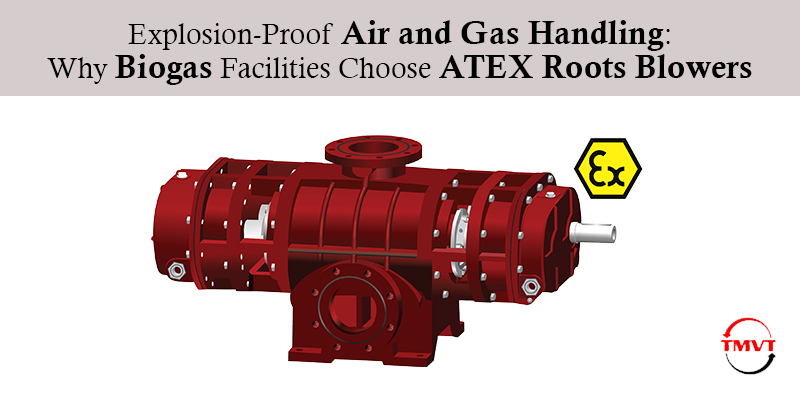
Biogas plants produce a flammable, moisture-laden gas that demands special handling. Raw biogas contains roughly 60% methane and 35% CO₂, along with water vapor and often traces of hydrogen sulphide (H₂S). These components make biogas highly combustible and corrosive. Any electrical spark, hot surface or oil mist can ignite it. For this reason, biogas facilities worldwide insist on explosion-proof ATEX-certified blowers. ATEX is a European safety standard requiring equipment to eliminate ignition sources in hazardous atmospheres. In practice, ATEX-certified Roots blowers use rugged enclosures, special motor designs and wide clearances so that even in a worst-case gas leak, the blower itself cannot spark an explosion.

Roles of Roots blowers in biogas facilities

Roots-type blowers play key roles in biogas processing. They move and compress the gas throughout the plant with a steady, constant flow. They also boost pressure to meet downstream needs for instance raising biogas pressure for pipeline injection or for fuelling cogeneration engines. Roots blowers can even mix biogas with air for controlled flaring or blend gases during upgrading. In aerobic stages (like wastewater aeration), blowers supply oxygen to microbes. In every case, large volume flow at low-to-moderate pressure is required, and Roots blowers excel at that. In digestion tanks they help circulate gas and oxygen; in upgrading they provide air streams to CO₂/H₂S scrubbers; and for grid injection they compress the methane-rich gas gently for pipelines.

  • Gas transport: Roots blowers convey biogas from digesters or collection headers to processing units. Their high-volume flow moves gas even at low inlet pressures.
  • Pressure boosting: After initial generation, biogas often needs higher pressure (e.g. for engine CHP units or pipeline injection). Roots blowers compress the gas in positive-displacement stages to reach the required pressure.
  • Mixing and aeration: In purification or flaring, blowers mix biogas with air or steam. They also drive aeration in any associated wastewater tanks (as in anaerobic sludge processing). Importantly, an ATEX blower is used here because H₂S and other flammable biogases can build up during treatment.

Because biogas handling involves flammable vapours and liquids, selecting the right blower is critical. An ATEX-certified Roots blower is engineered to meet those challenges.

Why ATEX Certification Matters for Biogas Blowers

  • Explosion protection: Biogas is an explosive hazard. ATEX roots blowers are designed so that no internal part can ignite the gas. All electrical components are in flameproof enclosures and have mechanical seals, and even the housing and bearings are rated to keep surface temperatures below ignition limits. In other words, an ATEX blower can safely run even in a methane-rich atmosphere. Regulations mandate that any blower handling hydrocarbon gas in a plant must be explosion-proof, so ATEX certification isn’t optional.
  • No ignition sources: In practice, ATEX certification means roots blowers have features like inert gas purges or intrinsic safety in controls, special drive couplings, and strict clearance tolerances. These measures remove all sparks or hot spots. Many designs also use oil-free compression a critical safety feature. Because lubricating oil is completely isolated from the gas path, there’s no oil mist that could ignite. In fact, TMVT’s tri-lobe blowers physically separate the oil chamber from the gas chamber, ensuring the discharged biogas is entirely oil-free. This oil-free operation is itself a safety benefit – entrained oil could otherwise become an ignition source or foul downstream equipment.
  • Corrosion resistance: Raw biogas often contains H₂S and moisture, which form acidic compounds that corrode metal. A blower in a biogas plant must resist that. In practice, ATEX-certified blowers for biogas use special materials and coatings. For example, critical parts may be lined or coated with Teflon/epoxy, and rotors might be stainless steel or otherwise treated against acid attack. This means the blowers last much longer even in wet, sulphurous gas.
  • Oil-free delivery: As mentioned, an oil-free design is crucial for biogas. Any oil carryover would foul catalysts or engines downstream and also pose fire risks. ATEX-certified Roots blowers achieve this by using separate oil chambers – bearings and gears are lubricated but isolated from the gas. TMVT’s tri-lobe blowers, for instance, ensure that all lubricated components are in their own sealed oil sump. Advanced seals or piston rings prevent any lubricant from reaching the gas side. The result is 100% oil-free biogas out of the blower – a major advantage for sensitive downstream equipment.
  • Steady, efficient flow: Roots blowers are positive-displacement machines, so they deliver a constant flow at fixed speed. This stable flow is valuable in a digester or upgrading unit, where pressure and flow swings must be minimized. The three-lobe design in particular (used by TMVT) smooths out pulsations compared to older two-lobe blowers. Less pulsation means steadier pressure, lower vibration, and more uniform gas flow for reactors or compressors. In fact, we note that three-lobe blowers achieve about 20% longer bearing life and reduce noise by ~5 dB versus twin-lobe models.
  • Reliability & low maintenance: Biogas facilities need blowers that run 24/7 with minimal downtime. Roots blowers have a simple, rugged construction & few moving parts, and all wear is non-contact. TMVT’s blowers are built tough large cast-iron or steel casings, precision-machined internals, and oil baths keep gears and bearings happy. In practice, this means many years of service before overhaul. For biogas plants, that translates to fewer shutdowns and lower total cost of ownership.

In short, ATEX-certified Roots blowers bring five key benefits to biogas plants from explosion-proof safety to corrosion resistance, oil-free output, consistent high flow, and dependable uptime. They are truly the workhorses of gas handling in anaerobic digestion and upgrading.

How TMVT’s ATEX Roots Blowers Solve Biogas Challenges

As a leading Indian manufacturer of ATEX-certified blowers, TMVT designs its tri-lobe roots blowers specifically for harsh gas service. The new 3MTL series covers 5 to 60,000 m³/h of flow, up to 1 bar discharge pressure. This vast range means a single product line can serve everything from small farm digesters to large biomethane plants.

  • Ultra-stable flow: TMVT’s tri-lobe rotors inherently reduce discharge pulsation. The result is an extremely smooth output flow. In data from TMVT, this design yields much lower discharge pressure variation, translating to less vibration and about 20% longer bearing life. Stable flow and low vibration are huge advantages for biogas systems, as they prolong equipment life and simplify control.
  • Oil-free gas path: The TMVT design keeps oil completely out of the gas. Our oil chamber is separated from main chamber; hence air is oil free. This, along with advanced seals on the shaft, means no lubricant can contaminate the biogas. In essence, TMVT blowers deliver clean, oil-free biogas straight out of the unit
  • Reduced maintenance: With their simple internal design, TMVT Roots blowers are easy to service. Fewer parts, no internal compression, and splash lubrication all help. TMVT specifically highlights that the blower’s construction is simple and hence easy maintenance. For plant operators, this means faster routine checks and less downtime.
  • High efficiency: TMVT notes that the tri-lobe geometry causes less back flow and a more stable air flow rate, this increases volumetric efficiency. Biogas blowers often see variable pressures, and less back-flow means more of the gas is effectively moved. Also, smoother lobes cut noise by ~5 dB, which is important for pump rooms. All together, the blowers’ efficiency and quiet operation help cut energy costs on long runs.
  • Worldwide explosion-proof certification: TMVT backs its designs with full ATEX compliance. Their blowers are built to meet ATEX 2014/34/EU standards for Zone 1 areas. In fact, TMVT explicitly states it offers ATEX blowers safe for Zone 1 hazardous areas by design. This means a TMVT blower can be confidently installed in any European or global biogas plant without extra modification. In effect, biogas customers get a plug-and-play explosion-proof blower that ticks all safety boxes.
  • Custom fit: Finally, TMVT’s engineering team can tailor each blower package to the plant’s needs. This includes choosing cast material, coatings, and accessories. For example, if the biogas has very high H₂S, TMVT can specify corrosion-resistant linings on the casing. Or if a project needs a compact skid, TMVT can adjust the blower layout. This flexibility means the blower handles the actual gas conditions on site. In short, TMVT ATEX blowers aren’t just off-the-shelf pieces they’re built for the exact challenge of each biogas plant, be it manure digestion, landfill methane, or wastewater biogas.

Conclusion

Biogas facilities face unique safety and operational demands. The combination of a flammable, corrosive gas and the need for reliable, constant airflow makes equipment choice critical. ATEX-certified Roots blowers answer this challenge by eliminate ignition risk while providing robust, oil-free performance for large gas volumes. TMVT’s tri-lobe blowers, in particular, are tailored to biogas applications. They cover the full range of flows and pressures, reduce pulsations by design, and keep the biogas stream clean. By installing TMVT’s ATEX-rated Roots blowers, a biogas plant gains peace of mind. These units safeguard against explosions, stand up to H₂S and moisture, and deliver stable gas flows day after day.

As India’s leading manufacturer of ATEX roots blowers with global reach, TMVT brings decades of experience to every project. Our solutions ensure that biogas plants operate safely and efficiently, turning waste gas into energy without compromise. If your facility handles biogas or biomethane, an ATEX-certified TMVT Roots blower can be a pivotal part of your system – enhancing performance, uptime, and above all, safety.


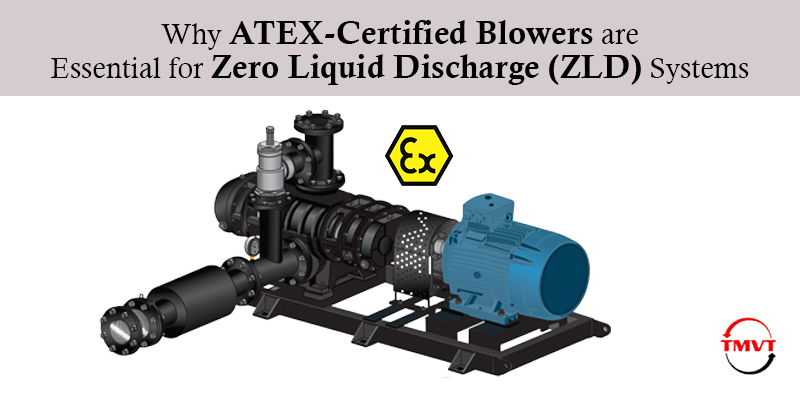
Why-ATEX-Certified-Blowers-are-Essential-for-Zero-Liquid-Discharge-ZLD-Systems.jpg

September 22, 20250

Zero Liquid Discharge (ZLD) systems are advanced wastewater treatment processes that aim to eliminate all liquid waste, recovering nearly 100% of the water for reuse. In a typical ZLD setup, wastewater is first treated or filtered, then fed into evaporators to boil off water. The concentrated brine from the evaporator is finally sent to a crystallizer or spray dryer to produce solid salts. Industries such as chemicals, pharmaceuticals, textiles, and power generation increasingly adopt ZLD to meet strict environmental regulations and sustainability goals.

How ZLD processes create explosive hazards

Several stages of the ZLD process create the conditions for an explosive atmosphere, which requires an ignition source to ignite. However, these processes inherently create explosive atmospheres if not managed correctly. For example:

  • Vacuum Evaporation/Distillation: Concentrating industrial effluent can vaporize flammable solvents or volatile organic compounds (VOCs) contained in the waste stream. If a blower or equipment sparks or overheats, it could ignite these vapours.
  • Spray Drying: Turning the evaporator concentrate into powder generates a cloud of fine combustible dust. As one engineering study notes, the over-riding explosion hazard in spray drying is a dust explosion from the fine particulate material formed in the dryer and bag filters.
  • Biogas/Anaerobic Gas Handling: Some ZLD plants include anaerobic treatment that produces methane-rich biogas. Methane and other flammable gases (e.g. H₂S) present an explosion risk if any ignition source is nearby.

Each of these hazards underscores why blowers in ZLD plants must be explosion-proof. In a normal blower, internal heat, electrical faults, static discharge or friction could ignite flammable gas or dust. An uncertified blower in a ZLD unit could thus become the ignition source of a devastating blast.

Explosion Hazards in ZLD Processes

  • Flammable Vapours: ZLD evaporators often concentrate organic-laden wastewater. Flammable solvents (like alcohols, hydrocarbons or VOCs) can vaporize. In fact, a GEA technical brochure explains that when MVR is used to compress organic vapours (e.g. ethanol), the compressor must be explosion-proof and typically rated for ATEX Zone 1. This means any blower used to move these vapours needs full ATEX certification.
  • Combustible Dust: Final drying of solids (via spray dryers or crystallizers) produces fine dust clouds. The AstraZeneca/IChemE report on spray drying hazards confirms that handling these powders creates a dominant dust explosion risk in the dryer and collection equipment. Even a small spark or hot surface can ignite airborne dust in a ZLD crystallizer.
  • Flammable Gases: Many ZLD systems recover or vent gases (biogas, hydrogen, methane). For instance, wastewater from oil & gas or mining can contain methane or H₂S, both highly explosive. TMVT note that volatile substances like methane or benzene in wastewater have fire/explosion potential and must be kept away from ignition sources. Blowers handling these gases must thus be rated for the appropriate ATEX gas zone.

In summary, any stage of ZLD that boils off liquids or handles dusty solids can create a hazardous atmosphere. This requires all rotating equipment especially blowers to be designed so they cannot ignite the environment around them.

ATEX-Certified Blowers: Safeguarding ZLD Plants

ATEX is a stringent European safety directive for equipment in explosive atmospheres. An ATEX-certified blower is built and tested to ensure it never becomes an ignition source under normal or fault conditions. Key design features include:

  • Spark-free construction: Critical components like rotors, couplings and shafts are made of non-sparking materials or treated to prevent friction sparks.
  • Explosion-proof motors and enclosures: All electrical parts (motor windings, connections, etc.) are contained in flameproof housings. These enclosures can withstand an internal explosion without letting flames escape. As TMVT notes, ATEX roots blowers have their motors housed in explosion-proof enclosures so that no electric spark can ignite the surroundings.
  • Thermal and static controls: ATEX blowers are engineered to limit temperature rise (hot surfaces can ignite gases) and to dissipate static electricity. Designs often include grounding measures or mechanical seals to keep static charges from building up.
  • Zone-specific certification: ATEX equipment is rated for specific hazardous zones (e.g. Zone 1 for gas, Zone 21 or 22 for dust). A blower certified for Zone 1 Gas, for instance, guarantees it can safely operate in environments where explosive vapours are likely

Together, these features mean an ATEX blower actively prevents ignition. It effectively contains any sparks or hot particles internally. As industry experts put it, ATEX-certified blowers are designed to avoid creating ignitions in potentially explosive areas. Even in a malfunction, ATEX roots blowers will eliminate hot spots and sparks, ensuring they will not trigger an explosion.

Technical Advantages of TMVT’s Tri-Lobe ATEX Blowers

For Zero Liquid Discharge applications, TMVT’s range of ATEX-certified three-lobe roots blowers offers both safety and performance. Key technical highlights from TMVT’s product lines include:

  • Wide capacity range: TMVT’s new 3MTL series covers flows from 5 to 60,000 m³/h, with discharge pressures up to ~1 bar and vacuum down to –0.5 bar. This lets engineers size a blower precisely for a given ZLD evaporator or compressor stage, whether the plant is small or very large.
  • Tri-lobe rotor design: Unlike two-lobe blowers, the three-lobe configuration produces a smoother, nearly pulse-free This significantly reduces internal pressure spikes. TMVT reports that three-lobe units have about 20% lower bearing loads and ~5 dB less noise than equivalent two-lobe designs. For ZLD systems, smoother flow means steadier compression of vapor (or air), lower vibration, and longer equipment life. In practice, customers see longer maintenance intervals and quieter operation thanks to the tri-lobe design.
  • Oil-free operation: The 3MTL blowers have a completely separated oil chamber. This means the discharge gas is 100% oil-free. In hazardous duties, oil-free delivery is critical – no oil mist enters the vent stream, and there’s no risk of oil decomposition igniting in the blower. TMVT emphasizes that with this design the blower ensures 100% oil-free discharge gas, which is vital when handling any flammable vapours or feeding waste gases to burners.
  • Reduced pulsation and wear: By smoothing the flow, the tri-lobe geometry lighter loads bearings and timing gears, yielding a longer service life. Users note up to 20% longer bearing life. Stable airflow also boosts the efficiency of MVR evaporators – roots blowers compress vapor more reliably and use less horsepower than less efficient compressors.
  • Robust construction: TMVT blowers are precision-machined from cast iron or steel, stress-relieved, and balanced. This yields heavy-duty reliability for continuous ZLD operation. Tight clearances are maintained even under high vacuum/pressure, and optional cooling or instrumentation can be added. Low intrinsic vibration and optional sound enclosures keep the system stable.

These technical strengths make TMVT’s ATEX blowers ideal for the rigors of ZLD plants. They can continuously handle large volumes of moist vapor, dust-laden exhaust, or corrosive gases without compromising safety.

Benefits of ATEX-Certified Blowers in ZLD Applications

Choosing ATEX-certified roots blowers for a ZLD plant brings broader benefits beyond explosion safety:

  • Regulatory compliance: Many industries are legally required to use ATEX rated equipment in hazardous zones. Using ATEX blowers ensures the plant meets local and international safety standards (CE, IECEx, etc.), avoiding costly fines or shutdowns.
  • Operational reliability: ATEX blowers are built to stricter quality and testing protocols. For example, TMVT tests each blower on a performance bench (flow, noise, vibration) and certifies it for API/ISO standards. This rigorous QA means the blower will perform as specified, crucial for continuous ZLD processes where downtime is very costly.
  • Explosion risk reduction: The primary benefit is safety. An ATEX-rated blower mitigates the very hazard the ZLD plant is trying to eliminate. In practice, this protection translates to massive cost savings by avoiding fires or explosions. An ATEX blower minimize the risk of ignition and contains any possible internal fault.
  • Long-term economics: Though ATEX blowers can have a higher upfront cost, the lifecycle savings are huge. Avoiding a single accident (or even minor fire) pays for itself. Plus, ATEX blowers often have a robust design (oil-free, low vibration) that lowers maintenance and energy costs over time. TMVT notes that their ATEX units exceed explosion-proof criteria, giving plant managers peace of mind.

TMVT’s ATEX Blowers Solving ZLD Challenges

TMVT, a leading Roots Blower manufacturer in India, specializes in ATEX-certified tri-lobe roots blowers for global customers. Here’s how TMVT’s blowers address common ZLD needs:

  • Safe Vapor Compression (MVR): In MVR evaporators, roots blowers recompress hot vapor for reuse. TMVT blowers handle this continuously at high temperature and moderate pressure. The oil-free design means vapours stay uncontaminated, and the ATEX rating prevents ignition even with organic vapours present. TMVT highlights that using efficient roots blowers in MVR allows plants to recover nearly all thermal energy from the vapours, making ZLD processes energy-efficient as well as safe.
  • Inerting and Gas Purging: Some ZLD systems introduce inert gas (nitrogen) to blanketing tanks or purge volatile streams. TMVT’s blowers can deliver inert gas under pressure or suction, and being ATEX-rated they remain safe even if the gas stream carries traces of flammables.
  • Handling Flare and Emissions: In ZLD variants that burn off or capture waste gases, TMVT ATEX blowers can move hot, mixed-composition gases to flare stacks or scrubbers. Their oil-free, high-volume operation ensures that flammable gas is sent safely to the burner without any oil carried over.
  • Global Support: TMVT provides complete packages, including drive motors, baseplates, and instrumentation, all compliant with ATEX. As a full solution, the blower can be certified for the exact hazardous zone of the plant. TMVT’s in-house R&D and testing ensure that even custom materials maintain ATEX compliance.

In all these cases, choosing a TMVT ATEX-certified blower means solving the core problem like move large volumes of gas or vapor in a ZLD plant without risking an explosion. The result is a safer workplace and more robust ZLD operation.

Conclusion

Zero Liquid Discharge plants represent a major advance in industrial water reuse, but they pose unique safety challenges. ATEX-certified roots blowers are not optional in ZLD – they are essential equipment. By design, ATEX blowers eliminate sparks, hot surfaces, and other ignition sources in environments rich with flammable vapors or dust. In practice, this means the plant can safely concentrate and dry hazardous effluents without fear of a catastrophic explosion.

TMVT’s ATEX-rated three-lobe roots blowers are built to meet this need. They combine high efficiency and reliability (wide flow range, low pulsation, oil-free delivery) with full explosion-proof engineering. For industries in India and around the world implementing ZLD, using TMVT’s ATEX-certified blowers ensures compliance with global safety standards and uninterrupted operation.


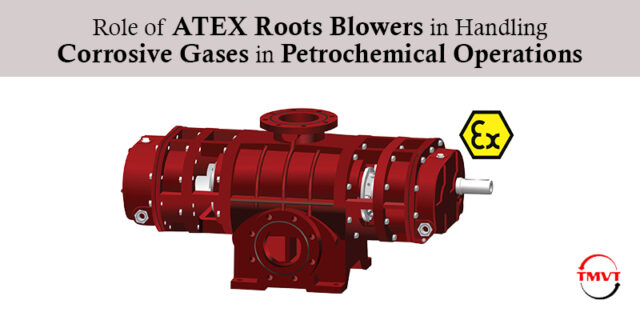
ATEX-Roots-Blowers-in-Handling-Corrosive-Gases-in-Petrochemical-Operations.jpg

September 11, 20250

Industrial petrochemical plants routinely handle gas streams that are corrosive and potentially explosive, including acidic components and alkaline components . These gases attack ordinary blower material like carbon steel or iron can rust and perforate rapidly in acid or alkaline environments. At the same time many of these gases are flammable. A corrosion-induced leak or mechanical failure in a blower can release toxic, flammable gas into a hazardous Zone, risking ignition and a major incident. Thus, corrosion-resistant, ATEX-certified blower designs are essential in petrochemical service.

  • Typical corrosive gases: Petrochemical streams often contain H2S, HCl, SO2, SO3, Cl2, CO2, F2, Nox, NO, NO2, N2O4, COCI2 (Phosgene) being an aggressive species and even ammonia vapours. For example, hydrogen sulphide (from gas wells or sour crude) and chloride-containing gases (from chlorination processes) are common, both can severely corrode metals. The breakdown of acid gases can produce condensate that dramatically accelerates metal attack.
  • Effects on blowers: In a Roots blower, corrosion can thin the casing or rotors, leading to leaks or rotor seizure. Build-up of corrosion products on the lobes can imbalance the rotors or reduce volumetric capacity. Any leak into the atmosphere exposes workers to toxic fumes and creates a Zone 1 explosion risk if ignition sources are present.
  • Safety hazard: Corrosive gases like H2S are also explosive. For example, waste or flare gases containing acid and hydrocarbon vapours are both toxic and combustible, requiring safe handling by blowers. An ATEX-rated blower must thus not only resist corrosion, but also prevent any ignition. Any flaw due to corrosion could compromise its explosion-proof design.

Engineering Challenges and Corrosion Mitigation

Designing blowers for chemically aggressive atmospheres raises several engineering challenges:

  • Material degradation: Standard blower materials can quickly degrade. Acid or alkaline vapours can form rust, pits and cracks on metal surfaces. If moisture is present, corrosion is even faster. Over time this can enlarge clearance gaps or bore holes, increases the amount leakage, puts more load on the gears and bearing which reduces efficiency or causing leaks.
  • Sealing and bearings: Corrosive gases can quickly damage standard lip seals or gaskets, leading to leakage and bearing contamination. To prevent this, TMVT uses a multi-layer sealing system:

1) Gas-side mechanical seals or labyrinth seals that resist acid and moisture attack.

2) Isolated oil chambers with splash-lubricated bearings, ensuring that lubricants never come into direct contact with the gas stream.

3) Protective coatings and corrosion-resistant materials on seal housings to extend service life.

4) Optional purge arrangements (using clean, inert gas) in severe service to keep corrosive vapours away from the bearing chamber.

This design not only prevents leakage of corrosive gases but also protects the bearings, ensuring long-term reliability in ATEX Zone 1 environments.

  • Temperature and condensation: Some acid gases have high dew points. For example, HCl gas condenses into hydrochloric acid on cooler surfaces. Blowdowns and start-ups must manage temperature to avoid acid condensation inside the blower.

To address these, engineers use a combination of design strategies and materials:

  • Corrosion-resistant materials: Key wetted parts (such as rotors, casing, and internal walls) are constructed from or protected with corrosion-resistant alloys and coatings. Depending on the gas composition, TMVT applies solutions such as:

1) 316L Stainless Steel – high resistance to HCl, H₂S, and chloride-rich gases.

2) Nickel Plating – a fine-grained, uniform coating widely used for its superior corrosion resistance.

3) Epoxy and Ceramic Linings – chemical-resistant protective layers applied to internal surfaces to prevent acid or alkali attack.

4) Hard Rubber or Polymer Coatings – effective for certain acidic streams, providing a non-reactive barrier.

By selecting the appropriate combination of alloy and coating, TMVT ensures long-term protection of wetted parts against aggressive petrochemical gases.

  • Smooth internal design: TMVT’s tri-lobe rotor design provides a much smoother airflow compared to two-lobe or irregular impellers. This steady flow minimizes sudden pressure fluctuations, which in turn reduces vibration, mechanical stress, and wear on seals. Additionally, the streamlined internal passages and polished surfaces prevent dead zones where corrosive vapours or liquid condensates might accumulate. By avoiding these stagnant pockets, the blower is less prone to localized corrosion, pitting, or build-up of chemical deposits directly extending equipment life and ensuring safer, more reliable operation in corrosive environments.
  • Isolation of moving parts: TMVT three-lobe units separate the oil chamber from the gas chamber, so the gas never contacts lubricants. This prevents chemical reaction with oil and ensures no oil forms by-products under acid attack.
  • Temperature control: When necessary, blowers can be jacketed or insulated to keep internal metal temperatures above the dew point of acid vapours, avoiding condensation.

Combining these measures means the blower can operate safely in a harsh chemical environment. Proper design reduces corrosion rates, but materials and coatings are the principal line of defence, as discussed next.

Materials and Coatings for Corrosive-Service ATEX Blowers

The choice of construction materials is critical for a Roots blower in corrosive duty. Common approaches include:

  • Stainless steel rotors and casings: Stainless alloys are widely used for acid gas service. Stainless resists acids like HCl, H2S and ammonia. For example, 316L SS has molybdenum to resist chloride attack. TMVT can supply blowers with stainless steel internals or even full stainless casings when needed.
  • High-alloy steels: In extremely corrosive applications, super-alloys or duplex stainless steels may be used for components. These are more exotic and costlier, but sometimes chosen for the severest acids.
  • Ceramic and epoxy linings: Some blowers are lined internally with chemical-resistant coatings. For example, hard rubber, epoxy, or ceramic linings can be applied to the chamber walls and rotors.
  • Nickel plating: Electroplating a few microns of nickel on rotors and internals is another technique. Nickel exhibits excellent corrosion resistance. Industry literature notes that nickel has a fine-grain, protective structure and is widely used in electroforming for its corrosion resistance.
  • Bronze or aluminium bronze: In some cases, copper alloys are used for parts, since copper resists some acids and does not spark. TMVT’s vacuum pump line offers partial-bronze construction for corrosive services. A similar choice can be made for blower casings or impellers in specialized blowers.
  • Coated internals: Apart from full linings, segmented coatings may be applied. For instance, a cast iron housing might be painted with epoxy or ceramic paint. Critical areas receive sprayed or polymer coatings to slow down metal wear.

When selecting materials, TMVT will often ask for the gas composition and specify, for example, a 316L SS rotor set and an epoxy-coated cast housing. The goal is to ensure that every wetted path either is made of a non-corroding alloy or is isolated by a resistant lining.

Design Features of TMVT’s Three-Lobe ATEX Roots Blowers

TMVT’s three-lobe Roots blowers incorporate several design features that make them particularly well-suited for corrosive petrochemical service while meeting ATEX safety standards:

  • Tri-lobe rotor geometry: The three-lobe design gives a very smooth, almost pulsation-free flow. This steadier flow reduces vibration and mechanical stress. In corrosive gas streams, smoother flow means fewer pressure spikes, which lowers peak stresses on casings and seals. TMVT has measured that three-lobe units have about 20% lower bearing loads and about 5 dB less noise than equivalent two-lobe blowers. Lower vibration also means that seals and linings are less likely to be damaged by oscillation
  • Oil-free gas path: All TMVT ATEX blowers, the gas chamber is completely separated from the oil chamber. This ensures 100% oil-free discharge gas. For corrosive gases, its important any lubricant could chemically break down under acid attack, potentially generating carbon residues or seizing up.
  • Robust cast construction: TMVT blowers use a heavy-duty cast housing that is stress-relieved during machining. Stress relief prevents distortions at high temperatures or under pressure. The substantial cast body provides a strong barrier; when needed, TMVT can apply protective lining inside the cast cavity.
  • Explosion-proof Components: Beyond corrosion resistance, TMVT’s ATEX blowers are engineered with explosion-proof motors, enclosures, and electrical fittings, ensuring no ignition sources in hazardous environments. For sealing, TMVT specifies mechanical seals that meet ATEX compliance requirements either individually certified with an Ex marking or covered under the blower’s overall ATEX declaration. Together, these measures ensure the complete assembly is fully compliant with ATEX Zone 1 safety standards.
  • Low heat generation: The tri-lobe profile and precision balancing mean the blower runs cooler and with minimal friction. Lower heat inside the blower means the blowdown stream is less likely to reach temperatures that could ignite or accelerate corrosion.
  • Easy maintenance access: TMVT design emphasizes ease of maintenance. A simple, modular construction means blowers can be opened for inspection or relining
  • Proven performance: Each TMVT blower is run-tested on a performance bench. This factory testing validates that the machine meets specification before shipping. TMVT’s quality control helps ensure that once installed, the blower will perform as required even under demanding conditions.

In summary, the combination of tri-lobe design and robust ATEX-engineering gives TMVT blowers a reliability edge in handling harmful gases. Features like reduced pulsation and 100% oil-free flow directly support corrosion resistance and safety

Maintenance and Inspection Best Practices

Even the most corrosion-resistant blower requires diligent maintenance in harsh service. Regular inspection and upkeep are vital for long-term reliability:

  • Frequent visual checks: Inspect the blower housing and rotors for signs of corrosion, pitting or erosion. Any discoloration, unusual deposits inside the casing can indicate coating breakdown. TMVT blowers often have viewing ports or easy-open covers so an operator can periodically check internal surfaces
  • Recoat or replace linings: If internal linings show wear, they should be reapplied. It’s better to patch a tiny breach than wait for a cascade of corrosion behind it. TMVT recommends using the same corrosion-resistant material as originally used to maintain uniform protection.
  • Bearing and seal service: Even though bearings are in a sealed oil sump, corrosive gas can sometimes infiltrate small leaks. Use corrosion-inhibiting gear oil, and replace oil filters or breathers if installed.

ATEX Zone Compliance and Corrosion Control

ATEX certification is mandatory for blowers operating in gas hazardous areas (Zones 1 in petrochemical plants). For an ATEX Roots blower, this means:

  • No ignition sources: TMVT’s ATEX blowers are designed so that all electrical parts are explosion-proof, and all bearings and gear chambers are fully sealed to prevent sparks. Unlike belt-driven machines which can generate friction, slippage, and static TMVT blowers use a direct drive configuration. This eliminates potential ignition from belts, reduces heat build-up, and ensures safer operation in hazardous petrochemical environments. The overall design also avoids hot surfaces and static accumulation, fully supporting ATEX Zone 1 compliance.
  • Preserved enclosure integrity: The blower casing itself serves as a flame barrier. Corrosion can thin or weaken the casing, potentially breaking its ability to contain an ignition. Thus, corrosion control is directly related to explosion protection. A blown seal or perforation due to corrosion could let gas into the motor housing or into open air, creating a dangerous condition.
  • Temperature classes: ATEX also sets maximum surface temperatures. Corrosion on hot spots can affect temperature sensors or compensating devices. Maintaining clean, corrosion-free surfaces helps ensure the blower doesn’t inadvertently exceed its temperature rating.
  • Zone maintenance: In ATEX Zone 1, equipment is required to be inspected at defined intervals. Part of this is checking that any protective linings or coatings are intact. In practice, a corrosion-resistant blower will more easily remain within compliance over time, because there’s less risk of breach.

In summary, corrosion control and ATEX safety go hand in hand. By using corrosion-resistant materials and coatings, the blower continues to meet ATEX requirements throughout its service life. Conversely, effective corrosion protection reduces unplanned leaks of flammable gas.

Finally, compliance means the blower must have documentation matching its materials and construction. TMVT’s ATEX blowers are supplied with full certification, showing that even with special materials the unit has been tested for Zone 1 use.

Conclusion

Corrosive gas handling is a critical challenge in petrochemical and chemical processing. A standard blower will corrode or fail prematurely when exposed to acid/alkaline vapours By combining advanced materials (316L stainless steel, nickel plating, polymer linings, etc.) with the proven TMVT tri-lobe design, operators get a corrosion-resistant, reliable Roots blower for even the most aggressive gas streams.


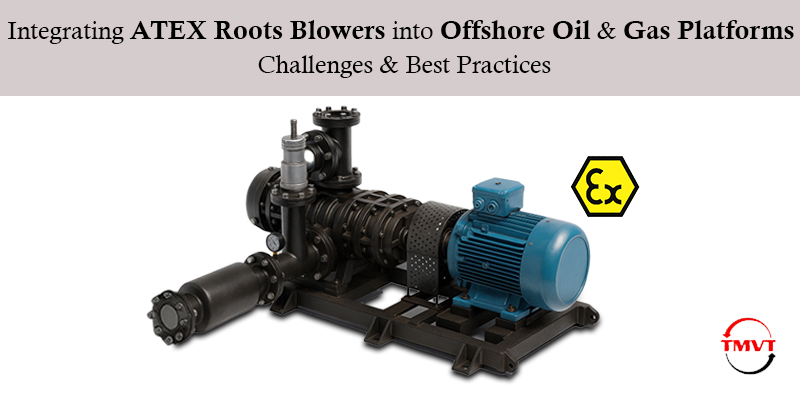
Integrating-ATEX-Roots-Blowers-into-Offshore-Oil-Gas-Platforms-Challenges-Best-Practices.jpg

September 10, 20250

Offshore oil and gas platforms rank among the most hazardous industrial environments. Confined spaces, flammable hydrocarbons, and harsh marine conditions create a high-risk setting where any spark or leak can lead to disaster. In this context, ATEX-certified roots blowers play a critical role in safety and operations. Unlike standard industrial blowers, ATEX units are purpose-built to prevent ignition of explosive gases, making them mandatory for offshore use. In this blog, we explore how to successfully integrate ATEX roots blowers into offshore oil & gas platforms.

Why Offshore Platforms Demand ATEX-Certified Blowers

Offshore platforms operate in hazardous, explosive atmospheres by nature. Even a minor gas leak in a closed module can accumulate and ignite if equipment isn’t explosion-proof. For this reason, regulatory standards require that any blower handling hydrocarbon gas or operating in classified areas must be ATEX-certified to ensure it cannot be an ignition source. ATEX is a European directive that ensures machinery like roots blowers are designed so they avoid sparks or hot surfaces that could ignite flammable gases.

Moreover, offshore platforms present unique conditions – confined modules, high densities of equipment, and continuous processing of hydrocarbons. Blowers are often used to move explosive gases in these tight spaces, so one must assume an ignitable mixture could be present at any time. ATEX roots blowers for hazardous offshore environments give operators peace of mind that even in worst-case scenarios, the blower won’t trigger an explosion or have an hazardous gas leak. Without an ATEX certification, a blower simply cannot be installed on an oil rig, as explosion-proof equipment is absolutely mandatory by industry standards and law.

Applications of Roots Blowers in Offshore Oil & Gas

Roots blowers are positive-displacement machines known for delivering constant airflow at a given speed, making them workhorses in oil & gas facilities. On offshore platforms, ATEX roots blowers fulfil several critical applications:

  • Flare Gas Recovery: Offshore rigs often burn off excess hydrocarbon gases via flare systems. Instead of wasting all that energy, roots blowers can capture low-pressure flare gas and boost it for recovery or more efficient combustion. An ATEX-certified blower safely handles the mixed, potentially corrosive flare gas and delivers it to the flare stack without risking ignition. The blower’s oil-free design is crucial here, no oil enters the gas stream, preventing any contamination or fires in the flare line.
  • Pneumatic Conveying of Drilling Materials: Drilling operations generate cuttings and use bulk materials (like barite, cement) that often need to be moved or stored. Roots blowers serve as the air source for pneumatic conveying systems on rigs, transporting drill cuttings from shakers to disposal units or moving bulk powder from supply vessels into storage silos. The blower provides a high-volume air stream to carry these solids through piping. Using an ATEX-certified roots blower in this process is important because drill cuttings can be coated in oil or contain flammable gases entrained from the well.
  • Gas Boosting on Platforms: In offshore production, there are many low-pressure gas streams that require boosting to higher pressure for use or export. For example, a roots blower can take associated gas coming off a separator and boost it to supply fuel gas for power generators or to send gas to a central processing facility. These gas compression blowers for hazardous areas excel at moving large volumes at moderate differentials.
  • Wastewater Treatment Aeration: Even offshore platforms have to treat wastewater to meet environmental discharge standards. Compact bioreactors or sewage treatment units on rigs rely on blowers to supply air for aerobic digestion. Roots blowers provide aeration air to these wastewater treatment systems, enabling bacteria to break down contaminants. An ATEX roots blower is preferred because hydrogen sulphide or other flammable biogases can develop in wastewater tanks. .

Notably, both twin-lobe and three-lobe roots blowers find uses on offshore installations. Twin-lobe (two-lobe) blowers are simpler and can handle moderate flows and pressures , while three-lobe designs handle very large flow rates with smoother output. Depending on the application whether a compact twin-lobe unit for a small rig wastewater plant or a heavy-duty tri-lobe for flare gas recovery – engineers choose the appropriate type. The key is that any blower on an oil rig must be certified explosion-proof (ATEX) and built to withstand marine conditions.

Challenges of Integrating Blowers in Offshore

Deploying a roots blower on an offshore oil rig is not as straightforward as a typical onshore installation. The offshore environment imposes unique challenges that engineers and operators must address during integration:

  • Corrosive Marine Environment: Offshore platforms are surrounded by salt water, and the air itself is full of salt spray and humidity. This harsh marine environment leads to aggressive corrosion of equipment. A standard cast iron blower housing, for instance, can rust rapidly without proper protection. Materials and coatings become critical components may need special marine-grade epoxy coatings or use of stainless steel for certain parts to resist salt corrosion.
  • Vibration and Structural Stress: Offshore platforms constantly move and vibrate from wave action, drilling activity, heavy machinery, and even wind. Installing a rotating machine like a roots blower in this setting requires careful attention to vibration isolation and structural support. Vibration can come from both the blower and the platform itself. Without proper damping, vibrations can lead to fatigue in piping or misalignment. Best practice is to mount blowers on anti-vibration pads or skid frames and use flexible connectors on pipes. Furthermore, tri-lobe blowers have an advantage here: their smoother flow causes less pulsation and vibration compared to twin-lobe designs.
  • Limited Space and Weight Constraints: Equipment often must fit into compact modules or decks with very little clearance. Integrating a blower system offshore means dealing with tight space constraints. the blower, its driver , filters, silencers, and piping all must be as compact as possible. Weight is also a factor; platforms have limits on how much load each deck can carry. This challenge pushes manufacturers to provide space-saving blower skid designs for offshore use. Offshore roots blower integration should involve early planning of layout, ensuring maintenance access is still available despite the cramped quarters. Custom skid packages from the manufacturer can help fit the blower into the available envelope.
  • Strict Maintenance Protocols: In the offshore oil & gas industry, maintenance is both critical and difficult. The remote location of a platform means that if a blower fails, getting spare parts or expert service can take days. Thus, reliability is paramount – the blower must run continuously with minimal unplanned downtime. Offshore operators follow strict maintenance and inspection schedules to catch issues early, because an unexpected shutdown could halt essential processes. Training local crew in blower upkeep is also essential, because specialist technicians can’t always be on site. The challenge is to implement a preventative maintenance program offshore that keeps the blower running safely while satisfying rigorous safety rules and minimizing personnel exposure.
  • Explosion-Proofing and Compliance: While the blower unit itself might be ATEX-certified, integrating it into an offshore platform’s electrical and control systems comes with challenges. All supporting components like motors, variable frequency drives , control panels, instrumentation must also meet hazardous area requirements. Routing of cables and conduit must preserve the explosion-proof integrity. There may be additional certification steps if the blower is part of a larger skid. Ensuring compliance with not just ATEX but also offshore standards can be complex.

Best Practices for Offshore Blower Integration

Successfully integrating an ATEX blower on an offshore platform requires careful planning and execution. Based on industry experience, here are some best practices for offshore blower installation to overcome the above challenges:

  • Select the Right Blower Type (Twin vs. Three-Lobe): Choosing between a twin-lobe or three-lobe roots blower is an important early decision. Three-lobe blowers are generally preferred offshore because their design yields steadier, pulse-free airflow with less vibration and noise. They also tend to put less stress on bearings, meaning longer intervals between overhauls. Twin-lobe blowers, on the other hand, can sometimes achieve higher single-stage pressure or come in more compact sizes for a given duty. Best practice is to match the blower to the application’s needs: if smooth operation and low noise are paramount , go with a tri-lobe. If space is extremely tight or the required pressure is at the top end of a tri-lobe’s capability, a twin-lobe might be suitable.
  • Use Corrosion-Resistant Materials & Coatings: To combat the marine atmosphere, specify corrosion protection from the start. Materials and coatings should be chosen based on worst-case conditions . For example, insist on an epoxy marine coating for cast iron blower casings, or consider blowers constructed from stainless steel or with internal anti-corrosion linings if the gas is sour. During installation, use appropriate gasket materials and sealants that can withstand the marine environment and hydrocarbon exposure.
  • Ensure Proper Installation and Vibration Isolation: How the blower is installed on the platform will directly impact its performance and longevity. Best practices for offshore blower mounting include using a rigid, flat baseplate that is securely bolted to the deck. Between the skid and deck, vibration isolators or pads should be used to damp vibrations traveling in both directions. All piping connected to the blower (intake and discharge lines) should have flexible couplings or expansion joints to accommodate movement and prevent transmitting stress to the blower casing
  • Implement Predictive Maintenance & Monitoring: Given the difficulty of emergency repairs offshore, a predictive approach to maintenance is ideal. Equip the blower system with monitoring sensors such as vibration sensors, temperature probes (on bearings and oil), and possibly pressure/flow sensors to monitor performance. These can tie into the platform’s control system to alert operators of any anomaly
  • Provide Training and Follow Safety Protocols: Even the best equipment can be misused if operators aren’t properly trained. Ensure that platform technicians and engineers are trained in the specifics of the roots blower package and its hazardous-area handling procedures. This includes understanding how to isolate and depressurize the blower before maintenance, confirm that no flammable gas is present prior to opening any part of the blower, and following the manufacturer’s maintenance guidelines to the letter.

How TMVT Supports Offshore Oil & Gas Integration

When it comes to ATEX roots blower offshore oil & gas applications, TMVT is a trusted expert with over a decade of proven industry experience (in fact, TMVT’s roots blower heritage spans 50+ years. As a leading manufacturer of twin-lobe and three-lobe roots blowers, TMVT understands the demands of offshore platforms and has engineered its products and services to meet those challenges:

  • Certified Explosion-Proof Blowers: TMVT offers a full range of ATEX-certified blowers for oil rigs and petrochemical environments. Both our twin-lobe and tri-lobe models are built to exceed ATEX 2014/34/EU requirements, meaning they are safe for Zone 1 hazardous areas by design. This gives offshore engineers confidence that a TMVT blower can be placed on their platform with complete safety compliance from day one.
  • Robust Design for Harsh Environments: TMVT roots blowers are engineered for durability, which is exactly what the offshore marine environment demands. Key components are made from heavy-duty materials like cast iron or carbon steel, and all casings are stress-relieved to prevent distortion under continuous operation. Our three-lobe blowers inherently produce less vibration and noise, a benefit proven by about 20% lower bearing loads and ~5 dB noise reduction compared to two-lobe designs. The result is a blower that can withstand the continuous, demanding service on an oil platform reliable gas compression with minimal wear even in tough conditions.
  • Customization to Fit Your Platform: We recognize that each offshore project has unique constraints. TMVT’s engineering team works closely with clients to tailor blower packages to specific site requirements. Whether it’s designing a compact skid that fits into a tight corner of a platform or selecting a special motor configuration, our experts ensure the blower integrates smoothly.
  • Global Support and After-Sales Service: Installing the right blower is only half the battle but keeping it running is equally critical. TMVT prides itself on comprehensive after-sales support worldwide. Offshore oil & gas operators can rely on our support network for spare parts, field service, and technical assistance whenever need. We know downtime is costly, so we maintain inventory of critical spare parts and can dispatch service engineers at short notice. This global support is a key reason many oil & gas companies choose TMVT as their blower partner.
  • Proven Performance and Safety: Perhaps most importantly, TMVT has a track record of delivering safe, reliable performance in hazardous environments. Our blowers are used in refineries, petrochemical plants, and yes, offshore rigs around the world. Each unit undergoes full performance testing (flow, pressure, vibration, noise, etc.) before shipment to guarantee it meets specifications. We also include all the quality and test documentation needed for regulatory compliance. With certifications like ISO 9001 and a strict safety focus built into our design process, TMVT ensures that our ATEX blowers not only perform efficiently but also uphold the highest safety standards.

Conclusion

In the high-stakes world of offshore oil and gas, integrating the right equipment can make all the difference. ATEX-certified roots blowers have proven to be essential components for many offshore processes from managing flare gas and boosting fuel gas, to keeping wastewater treatment and pneumatic systems running safely. We’ve discussed how these blowers, when properly integrated, mitigate explosion risks while delivering the air and gas movement needed on a platform. By understanding the challenges and following best practices, operators can ensure their offshore roots blower integration is both safe and successful.

Ultimately, offshore environments demand equipment that is robust, reliable, and above all, safe. ATEX blowers for hazardous offshore environments provide that peace of mind, and choosing a proven manufacturer further ensures long-term performance. TMVT, as a top manufacturer of explosion-proof twin and three-lobe roots blowers, has the expertise to support your offshore projects from conception to operation. If you’re looking to enhance safety and efficiency on your platform, we’re here to help. Explore TMVT’s Three Lobe Roots Blower and Twin Lobe Roots Blower for safe, reliable offshore performance. Let us help you integrate the ideal ATEX blower solution to keep your oil & gas operations running smoothly and securely.


Vacuum-Pumps-and-Roots-Blowers-in-the-Semiconductor-Industry.jpg

July 10, 20250

Semiconductor fabrication relies on precise vacuum environments to ensure high-quality chips. Vacuum pumps remove gases to create clean, controlled low-pressure conditions for processes like crystal growth, deposition, etching, wafer handling, and vacuum sintering. TMVT a leading Indian manufacturer of vacuum pumps and blowers supplies oil-free dry screw and liquid-ring vacuum pumps along with high-capacity roots-type blowers worldwide to meet these exacting needs. Modern fabs demand continuous 24/7 operation with flows of thousands of cubic meters per hour and vacuum levels typically in the 100–400 mbar range. This means vacuum systems must be highly reliable, oil-free and contamination-free, as even minor leaks or hydrocarbons can ruin semiconductor layers. In practice, fabs use a combination of vacuum technologies: a primary roughing pump (dry or liquid) for coarse vacuum, backed by a mechanical booster (roots blower) to reach mid-range vacuum, often followed by finer pumps if needed.

Dry and Liquid Ring Vacuum Pumps for Semiconductor Processes

Dry Screw Vacuum Pumps

These pumps use two intermeshing rotors turning in opposite directions to trap and compress gases. In semiconductors, dry screw pumps are valued for oil-free, clean operation, there is no oil in the pumping chamber, so the exhaust is free of hydrocarbon contaminants. TMVT’s dry screw series (e.g. VP, PW models) feature compact, robust designs with mechanical seals and variable pitch rotors for efficient gas handling. Industry sources note that screw pumps offer high pumping speeds, excellent energy efficiency and minimal maintenance. For example, such pumps can continuously evacuate chambers without oil carryover, making them ideal for ultra clean processes like CVD/PVD deposition or ion implantation, where any oil vapor would degrade device quality.

Liquid Ring Vacuum Pumps

Liquid-ring pumps use a rotating liquid to form a seal against the casing. As the impeller spins, the liquid ring traps and compresses gas. This design handles moist, corrosive or condensable gases very well. TMVT’s liquid ring pumps (LRV/LRK series) achieve rough vacuum levels up to ~50mmHg abs. per stage with water at 30 °C, and even deeper vacuums when special seal fluids or multi-stage arrangements are used. The liquid seal acts as both the working fluid and sound damper, so these pumps run quietly and vibration free, and can tolerate condensable vapours or entrained liquids without damage. In fact, the only moving part is the impeller, there is no metal-on-metal contact so wear is nearly zero. Liquid-ring pumps can also double as oil-free compressors (delivering an oil-free discharge) and offer long service life with minimal upkeep. This makes them well-suited for wet-process steps in fabs where large vapor loads or moisture are present.

Key features of these pumps include oil-free gas handling (preventing contamination), large vapor capacity (liquid-ring units condense or sweep out moisture), and robust construction for continuous use. TMVT’s pumps are engineered to meet semiconductor specifications. for example, LRV/LRK pumps can be constructed from cast iron or stainless steel depending on the gas corrosiveness, and they support open or closed liquid circulation systems for process integration. Together, dry screw and liquid ring pumps cover the needs for contamination-sensitive evacuation (dry pumps) and heavy condensable/vapor loads (liquid pumps) in wafer fabs.

Roots Blowers (Mechanical Boosters) in Semiconductor Production

Roots-type blowers are positive-displacement, dry running pumps that use rotating lobes to move gas. They do not compress internally, so they function as boosters to lower pressure when paired with a primary pump. Roots blowers excel at moving very high gas flows at moderate vacuum: industry data shows a single-stage roots pump can deliver 2 to 8 times higher the pumping speed of its backing pump. In practical terms, this means a roots blower can evacuate a large chamber much faster than a single pump alone, which is crucial in high-volume semiconductor fabrication.

Roots blowers come in twin-lobe and three-lobe designs. TMVT’s Twin Lobe Series (MTLK, ETP, MP) uses two intermeshing lobes to boost pressure. These units handle discharge pressures up to about 1.0–2.2 kg/cm² (14–31 psi) in single- or double-stage form, and can operate down to roughly 600 mbar absolute on the vacuum side. All rotors and casings are machined to tight tolerances, and optional acoustic hoods can reduce noise by ~10–12 db. Such blowers are splash lubricated for long life and are rigorously tested for capacity and vibration.

TMVT’s Three-Lobe (Tri-Lobe) Series (3MTL) represents an advanced roots design. By using three twisted lobes instead of two, the tri-lobe blower significantly smooths out the pulsation in the outlet flow. In practice this yields much lower discharge pressure variation, which translates to less vibration and ~20% longer bearing life. The three-lobe geometry also cuts acoustic noise (about a 5 db reduction). Importantly, TMVT’s tri-lobe blowers separate the oil chamber from the gas chamber, so the displaced air is completely oil-free. They cover huge flow ranges (5 to 60,000 m³/h) with discharge pressures up to 1 bar and vacuum down to ~0.5 bar abs.

In a vacuum system, roots blowers are often staged after a primary pump. For example, a dry screw or liquid pump may rough out a chamber to ~1–10 mbar, then a roots booster further reduces pressure to the required level. By combining a roughing pump and a roots booster, fabs can achieve vacuums roughly ten times lower than with the roughing pump alone. This staged approach also allows the heavy lifting to be done by the booster, while the backing pump covers the base pressure. Because roots blower operate contactless and require no seal fluids, they add capacity without contaminating the vacuum line.

Key Advantages of Roots Boosters in Semiconductors:

Roots blowers provide instantaneous high pumping speed for large chambers, speed up pump down cycles, and maintain stable vacuum during fast gas loads. Their dry, positive-displacement design is inherently contamination-free. TMVT’s high-precision roots blowers (twin- or tri-lobe) deliver these benefits while fitting into tight cleanroom specs. In practice, they are widely used to accelerate processes like PECVD, LPCVD and etching.

System Integration and Performance Specifications

A complete semiconductor vacuum system integrates pumps, boosters, valves and controls to meet process requirements. Typical specifications include required ultimate vacuum, pumping speed, gas throughput, and allowable trace contamination. TMVT’s liquid-ring pumps can reach ~50 mbar (single stage) and ~40 mbar (two-stage) with water seals; using cascade stages or special fluids can lower this further. Dry screw pumps can achieve much lower pressures (often in the 10⁻²–10⁻³ mbar range) and are suited for very clean processes. Roots blowers then lift these baselines: TMVT’s tri-lobe units can pull down to about 0.5 bar abs (500 mbar) without help; when paired with a backing pump they reach deep vacuum rapidly.

Performance specs are also tuned to flow and power. For instance, three-lobe blowers consume roughly 5–10% less power than equivalent two-lobe models under similar loads, due to smoother flow. All TMVT blowers use heavy-duty bearings and gears to handle wide operating ranges. In electronics fabs, central vacuum systems often serve multiple tools and notes that typical fabs may require flows of 2,000–8,000 m³/h. Accordingly, TMVT offers pump and blower families sized up to tens of thousands m³/h.

In practice, vacuum pumps for semiconductors are installed in utility rooms away from clean production areas to avoid any potential contamination. Intelligent controls and redundancies ensure that house vacuum never fails. TMVT vacuum systems can be integrated with valves and controllers to match throughput demands. For example, a controller may modulate a roots booster to maintain constant pressure as etch gases are pulsed in and out.

Applications and Advantages in Semiconductor Processes

Vacuum pumps and blowers from TMVT find roles throughout the wafer fab.

Crystal growth and epitaxy

requires low-pressure inert environments (often ~10⁻³ mbar) to grow silicon or compound crystals, relying on clean dry pumps for initial pull-down.

Thin-film deposition (CVD/PVD)

Demands precise vacuum control during gas-phase deposition of layers. Here liquid-ring pumps handle any gas by-products while dry pumps or boosters handle the base vacuum.

Plasma etching

involves reactive gases; roots boosters quickly evacuate the chamber between process steps to save cycle time.

Wafer handling and pick-and-place

use house vacuum for vacuum chucks and robots; dry vacuum pumps provide steady, oil-free flow for pick-and-place tooling.

Vacuum abatement

post-etch scrubbing uses liquid-ring pumps to process acid vapours. In all cases, clean dry output is mandatory.

The advantages of TMVT’s solutions include:

Oil-Free Operation

Both dry screw and roots blower run oil-free (liquid-ring pumps use clean water or compatible fluids). This guarantees that no oil vapor contaminates sensitive wafer environments.

High Pumping Speed and Capacity

As noted by industry sources, roots blowers can achieve 2 to 8 times higher speed of a single-stage pump, moving vast gas volumes to quickly evacuate equipment. TMVT offers blowers up to 60,000 m³/h to match ultra-large fab requirements.

Low Maintenance & Long Life

TMVT pumps use simple, robust designs. Liquid-ring units have only one moving part, virtually eliminating wear. Dry screw pumps have few internal parts and use durable mechanical seals. All blowers are splash-lubricated and tested to industry standards. The end result is minimal downtime – crucial in 24/7 fab operations.

Noise and Vibration Control

Semiconductor fabs are noise-sensitive. Liquid-ring pumps inherently dampen sound via the liquid seal. TMVT’s blowers can be fitted with acoustic enclosures to cut noise by ~10 dB, and tri-lobe designs further reduce pulsation by ~5

Energy Efficiency

Smooth-flow roots blowers and variable-speed drives help lower power consumption. For example, tri-lobe blowers reduce pressure pulsations, saving energy. TMVT also offers motor and drive options to optimize power use.

Flexibility and Customization

TMVT can configure pumps with various materials (cast iron, SS) and accessories to fit a process. For corrosive or high-temp applications, special coatings or sealants are available. They can also supply complete packaged vacuum systems with controls and gauges tailored to semiconductor use.

Conclusion

In summary, choosing the right vacuum components is crucial for semiconductor yield and productivity. TMVT’s decade-plus experience in vacuum technology means customers get expertise, ISO-certified quality and global service. Our vacuum pumps and roots blowers are engineered for the demanding specifications of chip fabs: high speed, high purity and high reliability. By combining TMVT’s dry screw, liquid ring and roots blower technologies, semiconductor manufacturers can achieve the precise vacuum levels and contamination-free conditions that advanced chip processes require – ultimately maximizing throughput and minimizing defect rates


ATEX-Roots-Blowers-in-the-Petrochemical-and-Oil-Gas-Industry.jpg

July 9, 20250

Industrial facilities operating within the oil, gas and petrochemical sectors often contain explosive gases and vapours which pose a significant fire hazard, so equipment used within such environments must adhere to stringent safety standards in order to avoid sparking an incident. ATEX certification is a European directive ensuring that machinery such as roots blowers is designed to avoid sparks or hot surfaces that could ignite explosive gases and spark. Roots blowers are positive-displacement compressors designed to move large volumes of gas by trapping it between spinning lobes and their casing. At TMVT, we manufacture ATEX-certified oil-free twin and tri lobe roots blowers designed for hazardous areas to safely transport natural gas, hydrogen, flare gas and other hydrocarbons found in refineries and chemical plants.

Understanding ATEX Certification

An ATEX-certified blower is specifically manufactured and tested to withstand hazardous Zone 1 or Zone 2 areas where explosive gases may be present. As part of this certification process, stringent controls and tests are implemented during manufacturing in order to avoid any ignition source for possible combustion sources within its vicinity. Fan motors and electrical components must be housed in explosion-proof enclosures; bearings should be shielded and internal clearances designed to avoid sparking. All are addressed by the ATEX 2014/34/EU directive for equipment intended for flammable environments. Compliance can be demonstrated with a certificate, typically covering specific gas groups and temperature classes. ATEX roots blowers offer proven safety, eliminating hot spots and sparks even in case of malfunction, providing maximum protection for workers and plant assets alike.

Roots Blower Design: Twin-Lobe vs. Three-Lobe

Roots blowers consist of two or three intermeshing lobed rotors inside a precision casing. Each revolution traps and transfers fixed pockets of gas from the inlet to the outlet, creating a nearly pulsation-free flow. Three-lobe blowers have three symmetrically arranged lobes on each rotor, while twin-lobe blowers have two. A three-lobe design inherently smooths the flow: adding the third lobe reduces pressure fluctuations and vibration compared to a two-lobe machine. In fact, TMVT’s three-lobe units exhibit about 20% lower bearing loads and roughly 5 dB less noise than equivalent twin-lobe blowers. The result is quieter, more efficient operation and longer life for gears and bearings (increasing maintenance intervals).

Flow Capacity

TMVT three-lobe roots blowers span very high flow rates (typically 5–60,000 m³/h) with discharge pressures up to about 1 bar (gauge) and vacuums to –0.5 bar. Twin-lobe models cover single-stage pressures up to ~1 kg/cm² (~14.2 psi) and dual-stage up to 2.2 kg/cm², with vacuum service to 600 mbar abs. This broad range lets engineers select the right blower size for process air, flare gas, or other flammable gas duties.

Oil-Free Delivery

In all ATEX-certified units, the oil-lubricated bearings and timing gears are isolated in a separate oil chamber. This ensures 100% oil-free discharge gas, which is critical when handling combustible gases or feeding gas to burners or compressors. The dry design also eliminates any lubrication-related ignition risk.

Low Vibration

The tri-lobe rotor profile yields steadier airflow with minimal pulsation. TMVT’s customers report up to 20% longer bearing life on tri-lobe models due to the reduced side loads. Even twin-lobe blowers incorporate precision balancing and acoustical hoods: an optional sound-insulating enclosure can cut noise by 10–12 dB at 1 m distance, improving site comfort without sacrificing performance.

Robust Construction

All TMVT roots blowers are machined from cast iron or carbon steel and stress-relieved after rough machining. This pre-machining stress relief prevents warping at high operating temperatures. Mating surfaces are machined to tight tolerances for optimum sealing and rotor clearances. Drive and driven bearings are splash-lubricated with premium oils, ensuring reliable, heavy-duty operation.

Rigorous Testing

Every blower is individually tested on performance benches to meet international standards (like API 618/ISO 1217 or IS-5456). During factory testing, flow rate, power draw, temperature rise, noise, and vibration are measured and recorded. This quality control guarantees that each unit will perform as specified in the field, which is crucial for continuous processes in oil & gas plants where downtime is costly.

In summary, the combination of twin- and tri-lobe designs gives TMVT flexibility for different oil & gas needs. Operators can choose a compact twin-lobe unit for lower flows and pressures, or a three-lobe blower for smoother high-volume service. All models are built to exceed ATEX “explosion-proof” criteria, ensuring safe handling of any flammable or inert gas in petrochemical settings.

Applications in Petrochemical and Oil & Gas Processes

Roots blowers are workhorses in the chemical, petrochemical, and oil & gas industries because they can handle many kinds of gases – even reactive or contaminated ones – safely and efficiently. Here are key oil & gas applications:

Gas Compression and Transfer

ATEX roots blowers convey and boost hydrocarbon gases between process units. For example, they can pressurize natural gas or methane from low-pressure separators to pipeline pressure, or deliver hydrogen and nitrogen for catalytic reactors. These blowers excel at large volumetric flow at relatively low differential pressure, ideal for “gas movers” in refineries and gas plants.

Flare and Vent Gas Handling

Many refineries and gas processing plants recover or combust waste gases to avoid emissions. ATEX-certified blowers handle the corrosive, mixed composition gases (like flare gas, sour gas or coke oven gas) by delivering them safely to combustion stacks or recycle systems. Their oil-free design prevents ignition and contaminant carryover in the waste stream.

Chemical Feed and Purge Services

Roots blowers are used to convey inerting or purging gases (such as nitrogen) in tank farms, reactors, and catalyst beds. They also supply air or fuel gas to burners and heaters. Since the blowers are explosion-proof, they can pump flammable process gases (propane, ethylene, etc.) without risk, enabling heating or desorption steps in processes like reforming or hydrocracking.

Aeration and Vacuum

In refinery wastewater treatment or process air blowers, roots machines supply oxygen for biological reactors and purge hazardous spaces. Conversely, in vacuum distillation units, they provide rough-vacuum back sweep. ATEX models ensure that any explosive vapours in these processes are moved without igniting.

Drying and Regenerative Loops

Some units use regenerative dryers to remove moisture or VOCs from air/gas streams. These blowers circulate heated air/gas through adsorption beds. The corrosion-resistant, ATEX-rated construction means they can safely circulate gas mixtures that may contain traces of solvents or explosive components.

Pipeline and Subsea Boosting

In onshore and offshore gas pipelines, tri-lobe blowers can act as gas boosters for gas-lift systems or to pressurize subsea lines. The compliance with ATEX (and often IECEx) means these machines can be deployed on platforms and drilling rigs where explosion-proof gear is mandatory.

In all these cases, the ability to move flammable or corrosive gas without ignition is the core requirement. As one industry guide notes, roots blowers safely transport inert, corrosive and explosive gases – including hydrogen, chlorine, hydrocarbons and mixtures thereof – under demanding conditions. By choosing an ATEX-certified blower, plant engineers ensure compliance and protect personnel.

Technical Highlights of TMVT ATEX Roots Blowers

TMVT’s ATEX roots blowers combine advanced engineering with global quality standards. A few technical highlights include:

Wide Flow and Pressure Range

Models handle from a few hundred to tens of thousands of cubic meters per hour. Tri lobe blowers cover high-flow duties (5–60,000 m³/h at up to 1 bar), while twin-lobe blowers cover mid-range flows with higher pressure capability (single-stage up to ~1 kg/cm²).

Oil-free Sealing

The blower’s oil bath is isolated, so discharge is completely oil-free. This feature is crucial for gas processing and metering systems where lubricants can foul catalysts or contaminate fuel streams.

Explosion-proof Motors

Motors and electrical parts are certified for Zone 1/2 use. For example, the built-in Ex d motor housings prevent any spark from escaping. All wiring and junction boxes meet ATEX/IECEx requirements.

Temperature Handling

Blowers are designed to handle ambient and gas temperatures typical of oil & gas plants. Special gaskets and insulation ensure that even under fault conditions, surfaces remain below safe limits.

Noise and Vibration Control

Even though roots blowers are positive-displacement machines, their noise can be significant. TMVT offers acoustic enclosures and dynamic balancing. In tests, these measures reduce noise by over 10 dB and keep vibration to minimal levels.

Efficient Operation

The tri-lobe design reduces internal leakage and improves volumetric efficiency compared to twin-lobe units. This yields better power consumption per volume of gas moved. High-efficiency operation is especially important in continuous oil & gas processes for energy savings.

Compliance and Testing

Besides ATEX, all blowers comply with relevant industrial codes. TMVT performs full acceptance testing on every unit, with documentation. Customers in oil & gas know they are getting a blower that meets or exceeds the specifications.

In practical terms, a client can trust that a TMVT ATEX blower will not only fit the required profile for a process, but also handle the specific gas type and hazard level without trouble.

Why Choose TMVT’s ATEX Roots Blowers

TMVT is a leading global manufacturer of roots blowers with decades of experience in industrial gas handling. Customers in oil, gas and chemical sectors rely on TMVT for engineered solutions that meet the highest safety and quality standards. Some reasons to choose TMVT’s ATEX blowers:

Proven Expertise

TMVT has been supplying roots blowers for over 50 years. The company holds international certifications (ISO 9001:2015 for quality, 14001 for environment, 45001 for safety, plus Conformité European marking). This demonstrates a commitment to quality and safety in every product.

Customization

TMVT’s engineering team can tailor blower packages (baseplate, drive, etc.) to specific site requirements. Whether it’s a module for an offshore platform or a skid-mounted unit for a refinery, TMVT can accommodate it.

Global Support

With a worldwide network, TMVT provides after-sales service, spare parts and field support anywhere the blowers operate. This global presence ensures quick response to any maintenance or retrofit needs in oil & gas plants.

Value and Reliability

TMVT blowers are engineered for long service life. As noted in technical specs, features like stress-relieved casings and industrial-grade gears mean these units run continuously for years with minimal wear. Lower downtime translates to lower total cost of ownership.

Safety Focus

Because ATEX compliance is fundamental, TMVT designs eliminate potential ignition sources as a rule. The blowers pass rigorous in-house and third-party tests. They are suitable for Zone 1/2 installations by design, giving plant engineers confidence to operate at rated capacities without extra precautions.

Industry Trust

Engineers in top refineries, petrochemical complexes, and LNG plants trust ATEX roots blowers for their operations. These applications often require not just performance, but also authoritative documentation of safety – something TMVT provides with each blower.

In oil & gas industry projects, choosing the right equipment can make a critical difference in safety and uptime. TMVT’s ATEX-certified roots blowers offer a complete solution for hazardous-area gas handling. They ensure compliance with international explosion-protection standards and deliver the performance needed for processes such as fuel gas boosting, vent gas recovery, pneumatic conveying of hydrocarbons, or process air supply. By combining technical excellence (as evidenced by features like low pulsation and full compliance testing) with global quality assurance, TMVT blowers help companies meet both operational and regulatory goals.

Conclusion

ATEX-certified roots blowers are essential for the petrochemical and oil & gas industries whenever large volumes of flammable, toxic or corrosive gases must be moved safely. TMVT’s family of explosion-proof twin and tri lobe blowers is engineered specifically for these conditions. Their rugged construction, extensive testing and full ATEX Zone 1 compliance provide peace of mind, while the efficient, oil-free operation keeps processes running smoothly. Contact TMVT to discuss how an ATEX roots blower can be applied to your next critical service from refinery flare recovery to offshore gas compression with guaranteed safety and performance


Geared-vs-air-foil-bearing-turbo-blower-an-in-depth-comparison-for-industrial-application.jpg

July 7, 20250

The right turbo blower is vital for industries like manufacturing, wastewater treatment or power generation. Two of the most popular options for high-performance are geared turbo blowers and air foil bearing turbo blowers. Both are single-stage centrifugal blower, however they differ greatly in the design and operating. In this article we will examine the differences between the geared and air foil bearing (gearless) turbo blowers, in depth, examining their operating principles and energy efficiency, maintenance requirements and the suitability of each for different applications. When you know the difference between the two, facility managers, engineers as well as environmental experts and industrial owners are able to make an informed choice which maximizes performance and energy savings as well as long-term reliability.

Understanding Geared Turbo Blowers

Geared turbo blowers (often known as integrally-geared single-stage turbo blowers) make use of a Gear Box to connect a standard speed motor to an impeller that is high-speed. In this type of design, the induction motor (typically 1,500-3,000 RPM) runs the drive shaft which is connected to the driven / Impeller shaft through a speed-increasing gearbox that runs the impeller at extremely high speeds (often around 30,000 RPM). It “steps up” the rotational speed to allow the impeller to produce the required pressurized airflow as well as pressure. The main features of turbo blowers geared include:

Robust Gear Drive

The precision of the gearbox lies at the centre to the entire system and allows high flow rates and greater pressure outputs. Geared blowers are able to handle extremely large airflow capacities in fact, fully geared blowers provide some of the best flows among turbo blowers. They are frequently utilized in large municipal or industrial factories where high-volume air flow is required.

Pressurised Lubrication System

Designs with gears typically employ oil-lubricated bearings within the gearbox and shaft. The Pressurised Lubrication System ensures that the oil reaches to rotating parts in machine and keep them in functioning mode.

Impellers and Control Features

Geared blowers have variable inlet guide vanes and diffuser vanes to aid in controlling the flow and pressure while operating at a set motor speed. Modern units can also be equipped with Variable Frequency Drives (VFDs) that operate on the motor, but historically the flow control was based on mechanical adjustments.

Size and installation:

Turbo blowers with a gearbox generally heavier and bigger than air foil blowers because of the oil sump, gearbox and cooling needs. They may require a solid foundation and a careful alignment during installation. But their design is tested and solid and has a steady performance in a wide range of industries.

The Vibration and Noise

Because of the advances in engineering that geared blowers are able to run at minimal vibration and noise levels considering their dimensions. But, the mechanical mesh is prone to introducing a distinct “whine,” and vibration isolation mounts, also known as sound enclosures are commonly used to provide peace of mind. Manufacturers emphasize features such as low noise emissions and a low level of vibrations as selling points for modern-day geared blowers.

In short it is a geared turbo-blower that utilizes the mechanical drivetrain to reach the highest speeds of impellers. It is highly regarded by its large flow capacity as well as its robust design and well-proven technology however it also has more moving parts, oil-based lubrication and a little more complicated maintenance than gearless systems.

Understanding Air Foil Bearing (Gearless) Turbo Blowers

Air foil bearing turbo blowers are the latest generation of high-speed blowers that are gearless. Instead of gearboxes these models use a Direct-coupled, high-speed motor as well as specialized air foil bearings that support the shaft. They are often referred to as turbo blowers with no gears and turbines with air-bearing lubrication they eliminate any contact points with lubrication by using air as a bearing medium. Here’s how they operate and the main features they have:

Direct Drive High-Speed Motor

Air foil turbo blowers are powered by a permanent magnet-synchronous motor (PMSM) that can be rotated at extremely fast speeds without the need for a gearbox. The impeller is installed directly to the motor shaft which means there are no transmission losses caused by gears. The speed is controlled using a variable frequency drive (VFD), allowing exact adjustment of blower output through modulation of the motor’s frequency. This direct drive, high-speed method results in a high energy efficiency and quick control of airflow as well as pressure.

Air foil bearings (Oil-Free)

Instead of traditional bearings, the shaft rests on an air cushion. Air foil bearings make use of thin metal foils and the force in air-films to stabilize the shaft while in operation. If the air blower operates running at speed and the shaft “floats” on air with no contact between metal and metal and drastically reduces friction. There is no lubricating oil required in any way which means no oil replacements and none of the maintenance associated with the bearing. This design is oil-free and will not only reduce the cost of maintenance but also ensures pure, non-contaminant air output that is ideal for wastewater aeration, or in the food processing where oil residues aren’t desirable.

Energy Efficiency

By removing the gearbox, and utilizing high-efficiency motors Air foil blowers can achieve an extremely high efficiency overall. There are no friction losses, and PMSM motors typically reach more than 95 percent motor efficiency. This results in lower energy use for the same airflow as compared to the older technology. In reality, air foil turbo blowers have been recognized to reduce energy consumption by 20-40% in comparison to conventional lobe or multistage blowers. Additionally, they are competitive with geared blowers and offer greater turn-down capability. Operators also gain from the broad range of flow control, without sacrificing efficiency when working with partial loads.

Compact and light-weight design

Gearless turbo blowers generally come with a compact skid-mounted unit. Without a massive oil pumps, gearboxes, or huge baseplates the entire unit is significantly smaller and usually does not require particular foundation and alignment when installing. The footprint is tiny which means it can be placed in an area for flooring – an important benefit in crowded buildings and retrofitting work. Many of the units are air-cooled, and sound-encased to make installation.

Quiet Low-Vibration Operation

Operating on air frictionless bearings means that these blowers work with minimal vibration and extremely smooth rotation. There is no mechanical contact during normal operation and this minimizes vibration and noise considerably. Air foil bearing blowers generate less noise that geared blowers usually around 70-85 dBA. This is a significant improvement in working environment comfort. It is appreciated in offices or in residential areas close to industrial sites.

Key Differences Between Geared and Air Foil Bearing Turbo Blowers

Both air foil and geared turbines that are bearings can be utilized to provide pressurized air effectively However, their different construction result in different performance features. In this Article, we’ll compare both techniques in relation to a number of critical aspects:

  Air Foil Turbo Blowers Geared Turbo Blowers

Components and Design

Air foil blowers employ the direct-drive motor that does not have a gear. This means that air foil blowers are mechanically simpler and totally oil-free. Geared blowers utilize the combination of a motor, gearbox, and impeller assembly. Geared blowers are more prone to wear and tear due to the additional parts that require attention.


Energy Efficiency


With the permanent magnet high-speed Motor directly driving the impeller, there’s no loss in transmission or mechanical friction caused by gears.- Gearless design is able to maximize the input power to create airflow. In addition, the ability to change the speed of air foil blowers allows users adjust the performance required, which avoids wasteful throttles. Geared blowers can be extremely efficient, but some energy is lost through the mesh of the gear and friction between the bearings.
– The gear-driven blowers may also utilize VFDs as well as inlet vanes to provide control, but they will not be able to maintain their peak efficiency over the entire flow area as air foil models.
 

Capabilities of Flow and Pressure


Air foil bearing turbo blowers are usually employed for low-pressure air supply (commonly with a pressure of ~0.6 bar, but there are models as high as ~1.0-1.2 bar) that covers the majority of requirements for aeration and processing air. The flow capacity of these blowers can be about 30,000-40,000 m3/hr with one unit. For small-sized plants or systems one air foil blower is usually sufficient for large-scale installations. Geared turbo blowers have been traditionally used to handle extremely large flow or high-pressure applications. They can generate pressures on the range to 1.5-2.5 bars (g) with single stage configurations and can handle huge flows. extremely large ones may require a number of gearless units or prefer the use of a geared blower.
 

Maintenance Requirements

Air foil bearing blowers are nearly maintenance-free—no oil, no contact wear, and fewer components to service. Routine care mainly involves cleaning inlet filters and monitoring motor performance. Air foil blowers demand significantly less time and cost to maintain, resulting in reduced downtime and lower lifecycle expenses. Geared blowers require regular upkeep, including oil changes, filter replacements, gearbox inspections, and occasional alignment. Over time, gears and bearings may need overhauls. Benefits from more Periodic Checks and regular maintenance is required to keep the machine running.
 

Reliability and Longevity

Air foil bearing blowers, have also demonstrated strong reliability—particularly in clean, controlled environments. With no gears or oil, they have fewer failure points and lower risk of mechanical issues. While they require clean intake air and controlled start-stop cycles, a well-maintained unit can run continuously for years with minimal downtime. Geared turbo blowers are proven and durable, with many systems operating for decades. Their rugged design tolerates moderate dust and vibration, thanks to sturdy, oil-lubricated metal bearings.

 Noise and Vibration


Air foil bearing turbo blowers operate with lower noise and vibration levels than geared blowers, thanks to their gearless design and smooth air bearing support. This makes them ideal for meeting workplace noise standards. Geared blowers have improved with better dampening and precision gears, they still produce some high-frequency sound from the gearbox.
 

 Cost Aspects
 

Air foil bearing turbo blowers typically have a higher upfront cost due to their advanced motor and bearing technology.
However, the total cost of ownership often favours air foil blowers. Their energy efficiency and minimal maintenance—no oil, fewer service needs—translate into significant long-term savings. Facilities can also benefit from lower electricity bills and potential energy rebatesOften offer better lifecycle value
In contrast, geared blowers often cost less initially, using standard motors and components.
While geared blowers are durable, they involve ongoing costs for oil, parts, and slightly higher power consumption.
Geared models may suit tighter budgets or demanding performance needs.
 

Application Suitability

Air foil bearing blowers are ideal for those seeking maximum energy efficiency, low maintenance, and compact design. This makes them popular in modern facilities aiming to reduce downtime and boost sustainability. Geared turbo blowers suit applications requiring very high flow rates or pressure in a single unit, as they handle greater loads and operate reliably in harsher conditions (e.g., dusty or hot environments with proper filtration).

Both blower types serve similar applications—wastewater aeration, combustion air, pneumatic conveying, and low-pressure industrial processes. The choice depends on priorities. Many plants now combine both using geared blowers for base-load demand and air foil types for flexible, energy-efficient operations.

Conclusion

Both air foil bearing (gearless) and geared turbo blowers offer unique advantages and are integral to efficient industrial air systems. Understanding their differences helps engineers and decision-makers select the right blower technology for each application, balancing factors like energy efficiency, maintenance, and performance requirements.

As a trusted provider of high-speed turbo blower solutions, TMVT brings deep expertise in both gearless and geared technologies. We ensure clients receive the optimal solution tailored to their operational needs. By partnering with an industry leader like TMVT, businesses can confidently implement high-performance turbo blowers that deliver long-term reliability, energy savings, and superior results.


Head Office

Manek Mahal, 5th & 7th Floor,
90, Veer Nariman Road, Churchgate,
Mumbai – 400 020, INDIA.
+91(0)22 22830060/68

+91 (0) 22 – 35219523/9539/9359/9796

www.tmvt.com

tmvtmumbai@tmvt.com


Our Locations


Get in touch with us

Looking for more information about TMVT’s products or services?

Contact us

error: Content is protected !!