The Engineering Analysis: Roots Blowers vs Screw Blowers in Industrial Air Handling
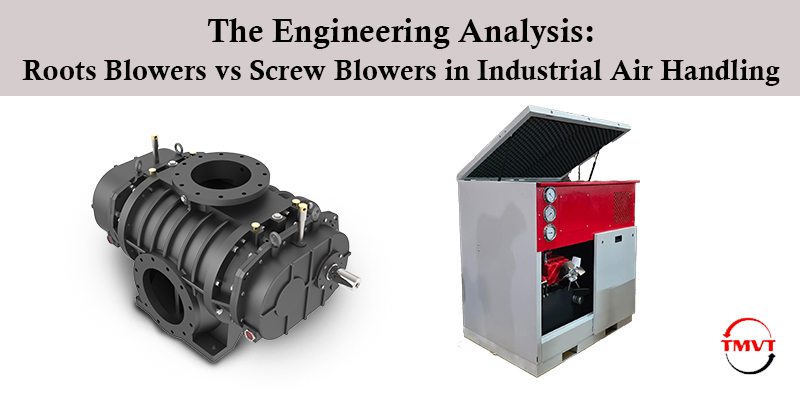
In the domain of industrial fluid dynamics and pneumatic conveyance, the selection of positive displacement air movers is a foundational decision that dictates process stability, energy efficiency, and long-term operational expenditure (OPEX). For decades, the debate has been polarized between the established, robust technology of Roots Blowers and the more recently aggressive market positioning of Screw Blowers.
As a global manufacturer of industrial air solutions, TMVT Industries believes in making decisions based on engineering reality, not just marketing hype. While screw blowers have their place in high-pressure applications, the modern Roots blower remains the superior choice for the vast majority of low-to-medium pressure industrial needs.
In this guide, we break down the mechanics, the economics, and the operational reality of Roots Blower vs. Screw Blower to help you make the right choice for your facility.
1. The Core Difference: How They Work
To understand the comparison, we must first look at the mechanics. Both machines are Positive Displacement blowers, meaning they move a specific amount of air with every rotation. However, the way they compress that air is fundamentally different.
The Roots Blower (External Compression)
The Roots blower operates on a simple, robust principle. The lobed rotors spin in opposite directions. They trap air from the inlet and carry it around the outside of the casing to the outlet.
- The Key: Compression happens at the discharge. The blower pushes air into the pipe, and the resistance of the system (e.g., water depth or pipe friction) creates the pressure.
- Why it matters: This makes Roots blowers incredibly versatile. They automatically adjust to changes in your system. If your system resistance drops, the power consumption drops instantly.
The Screw Blower (Internal Compression)
A Screw blower uses one male and one female rotor that mesh together. As they turn, the space between them gets smaller, squeezing the air inside the machine before it even reaches the outlet.
- The Key: It is designed for a specific built-in pressure.
The Downside: If your process needs less pressure than the screw is designed for (which happens often in variable industrial processes), the machine over-compresses the air, wasting significant energy and negating its efficiency claims.
2. Engineering Anatomy: The TMVT Advantage
Understanding why TMVT Roots blowers are preferred requires an analysis of their construction. TMVT has evolved the Roots design from a simple air mover to a precision instrument, addressing the historical weaknesses of the technology (noise and pulsation) while reinforcing its strengths (durability and simplicity).
Metallurgy and Structural Integrity
The longevity of a blower is dictated by its materials. TMVT employs a rigorous metallurgical standard for its 3MTL,MTLK, MP, and ETP series.
Stress-Relieved Castings
A critical differentiator in TMVT’s manufacturing process is Stress Relieving. By stress-relieving components, TMVT ensures dimensional stability at elevated temperatures. This allows the blower to maintain the precise internal clearances required for volumetric efficiency without the risk of rotor-to-casing contact, even during thermal spikes.
Precision Machining
TMVT components are machined to extremely tight tolerances. This guarantees interchangeability. If a side plate needs replacement after 15 years, a new spare from the factory will fit perfectly without requiring extensive field machining. This modularity is central to the “Right to Repair” philosophy that supports industrial continuity.
Rotor Dynamics: The Evolution from Twin to Tri-Lobe
TMVT offers both Twin Lobe and Three Lobe (Tri-Lobe) rotors, allowing engineers to select the exact profile needed for their application.
Twin Lobe (MTLK/MP Series)
- Flow Capacity: These models cover a vast range, tested rigorously under IS-10431 standards. They are the workhorses for bulk air movement where maximum volumetric displacement per revolution is required.
- Economics: Twin lobe rotors are simpler to machine, offering a lower CAPEX entry point for applications where noise constraints are less critical or can be managed with external silencing.
Three Lobe (3MTL Series) – The Technological Leap
The 3MTL Series represents the pinnacle of Roots technology.
- Pulse Frequency: A twin-lobe blower generates 4 large pressure pulses per revolution. A tri-lobe blower generates 6 smaller, smoother pulses.
- Vibration Reduction: The geometry of the three-lobe rotor inherently balances the dynamic forces. TMVT data indicates approximately 20% less vibration transmitted to the bearings compared to twin-lobe equivalents.
- Bearing Life Extension: Reduced vibration translates directly to reduced radial load on the bearings. This results in a roughly 20% longer bearing life, significantly extending the Mean Time Between Failures.
- Noise Attenuation: The smoother airflow reduces the amplitude of the pressure waves, resulting in a native noise reduction of approximately 5 dB before any acoustic enclosure is even applied.
Lubrication and Sealing: The Oil-Free Guarantee
For industries like food processing and aquaculture, oil contamination is catastrophic.
Splash Lubrication
TMVT utilizes Splash Lubrication for gears and bearings.
- Mechanism: Oil discs or the gears themselves dip into an oil sump, flinging lubricant onto the bearings.
- Reliability: This system is passive and fail-safe. Unlike screw blowers that often require forced lubrication pumps, oil coolers, and filters (all of which can fail), the splash system works as long as the gears are turning. It eliminates auxiliary failure points.
100% Oil-Free Air
TMVT designs feature a physical separation between the oil chambers (bearing housings) and the main compression chamber. Specialized oil throwers and intricate sealing arrangements ensure that zero lubricant enters the airstream. This design integrity is critical for applications like Pneumatic Conveying of Food Stuffs or Medical Waste Incineration, where hydrocarbon contamination is strictly prohibited.
3. The Screw Blower Critique: Complexity vs. Efficiency
To understand why the industry is rightfully cautious of screw blowers, one must look beyond the brochure efficiency numbers to the operational reality of these complex machines.
The Coating Vulnerability
Screw blower rotors must maintain microscopic clearances to achieve their efficiency. Because the rotors have a complex 3D helical profile, they cannot touch. To seal the gaps, manufacturers often apply sacrificial coatings (such as Teflon, Graphite, or Polymer composites).
- The Failure Mode: In dusty environments like cement plants or fly ash conveying, sub-micron dust particles inevitably bypass intake filters. These particles act as an abrasive grit.
The Result: The coating strips off. Once the coating is gone, the internal clearances open up, and the efficiency of the screw blower plummets, often dropping below that of a standard Roots blower. Worse, the debris from the coating contaminates the downstream process. TMVT Roots blowers, relying on precision metal-to-metal clearances without fragile coatings, maintain their efficiency curve for decades.
High RPM and Bearing Stress
Screw blowers rely on high rotational speeds (often 4,000 to 6,500 RPM) to achieve compression. This high speed imposes immense thermal and centrifugal loads on the bearings. A minor imbalance in lubrication quality at higher than 5,500 RPM leads to catastrophic failure much faster than at the 1,500 RPM of a TMVT Roots blower. The maintenance-free claim of screw blowers often refers to the impossibility of field maintenance, not the absence of wear.
The Black Box Maintenance Model
Perhaps the most significant disadvantage of the screw blower is its non-serviceability.
- Screw Repair: If a screw airend fails, it cannot be repaired on-site. The complex rotor profiles require factory re-profiling. The unit must be shipped to the manufacturer, often involving weeks of downtime. The cost of a replacement airend is frequently 60-70% of the cost of a new machine.
- Roots Repair: A TMVT blower is designed to be serviced by plant mechanics. Bearings, seals, and timing gears can be replaced on the shop floor using standard tools. This open architecture empowers the facility owner and drastically reduces the cost of unplanned outages.
4. Economic Analysis: Total Cost of Ownership (TCO)
The procurement decision often hinges on the trade-off between Capital Expenditure (CAPEX) and Operating Expenditure (OPEX). A detailed TCO analysis reveals the financial strength of the TMVT Roots option.
5. Strategic Application Analysis
Different industries impose unique demands on air blowers. Here, we analyse why TMVT Roots technology is the preferred engineering solution for specific sectors.
Wastewater Treatment (ETP/STP)
Biological processes need oxygen, but the demand fluctuates based on the water level and biological load.
- Why Roots Wins: TMVT blowers are true “load-following” machines. When paired with a Variable Frequency Drive (VFD), they offer linear control over airflow. If the water level drops, the power consumption drops automatically. Screw blowers, with their fixed internal compression, struggle to adapt efficiently to these pressure changes.
Pneumatic Conveying (Powder & Bulk Solids)
Moving cement, fly ash, or grain involves turbulent pressure spikes.
- Why Roots Wins: A TMVT Twin Lobe blower acts like a bulldozer. It has the torque and rotor strength to push through line blockages without damage. A high-speed screw blower is too sensitive for this rugged duty; a sudden pressure spike can cause rotor deflection and catastrophic failure.
Zero Liquid Discharge (ZLD) & MVR
In Mechanical Vapor Recompression (MVR), blowers re-compress steam.
- Why Roots Wins: Our blowers can handle water droplets and thermal fluctuations that would hydro-lock or seize a screw compressor. The wide clearances and robust cast iron construction make TMVT the preferred choice for ZLD systems globally.
Oil & Gas and Petrochemicals (ATEX)
Safety is the non-negotiable metric in hazardous environments.
- Why Roots Wins: TMVT manufactures blowers compliant with ATEX Directive 2014/34/EU.
- Spark Prevention: The 3MTL Tri-lobe design reduces vibration, minimizing the risk of mechanical contact and spark generation.
- Direct Drive: TMVT avoids belt drives in hazardous areas to prevent static electricity build-up, utilizing direct coupling.
- Chemical Resistance: The isolation of the bearing housing protects the lubrication oil from chemical attack by corrosive process gases (like Sour Gas), preventing oil degradation and bearing failure.
Vacuum Applications
- Range: TMVT Roots blowers are not just compressors; they are powerful vacuum pumps, capable of reaching -0.5 bar (and up to 600 mbar vacuum duty).
- Use Cases: Industrial vacuum cleaning, paper de-watering, and vacuum impregnation. The positive displacement action provides a stiff vacuum that maintains suction even when the system has minor leaks.
6. Detailed Product Breakdown: Acoustic Hood Solution
Recognizing that noise pollution is a primary concern, TMVT provides state-of-the-art Acoustic Hoods.
- Performance: These enclosures reduce noise levels by 10 to 12 dB(A) at a 1-meter distance.
- Design: Unlike generic boxes, these are engineered for ventilation (preventing motor overheating) and accessibility (easy-open panels for maintenance), ensuring that the blower remains serviceable even when enclosed.
Conclusion: The Strategic Choice for Industry
While Screw blowers have a niche in high-pressure (>1.5 bar) baseload applications, they bring with them a burden of complexity, fragility, and high TCO that is often unjustifiable in standard industrial contexts. For the plant manager who values reliability over hype and long-term value over short-term theoretical efficiency, the TMVT Roots Blower remains the undisputed champion of industrial air movement.
Secure Your Process with Proven Reliability.
Do not let the complexity of unproven technologies compromise your plant’s uptime. Whether you are engineering a new Zero Liquid Discharge (ZLD) facility, upgrading a municipal Wastewater Treatment Plant, or optimizing a Cement Pneumatic Conveying line, TMVT has the engineered air solution tailored to your specific needs.
Partner with a Global Leader. With a legacy of engineering excellence, TMVT Industries is ready to support your operations. Contact our Engineering Team Today for a TCO Analysis.

TMVT Team
Serving as the Editorial Lead at TMVT, I am a digital content expert passionate about manufacturing innovation and industrial efficiency, committed to delivering high-quality updates and technical guides on machinery trends for our global client base.