Aeration Control: Integrating VFDs and Smart Sensors with Multistage Blowers
Imagine a single system in your facility devouring up to 60% of your total energy budget. For most industrial engineers and wastewater treatment plant owners, this is not a hypothetical, it’s the reality of traditional aeration processes.
In an era of rising operational costs and strict environmental mandates, constant speed is no longer a viable strategy. The most effective way to reclaim your bottom line is by transforming your aeration system into an intelligent, responsive asset. For a global leader like TMVT, which has been engineering high-end air and gas handling solutions since 1991, we specialize in integrating Variable Frequency Drives and smart sensors with our world-class multistage centrifugal blowers to deliver precise, on-demand airflow that slashes energy consumption while stabilizing your process.
The Engineering Foundation of Multistage Centrifugal Blowers
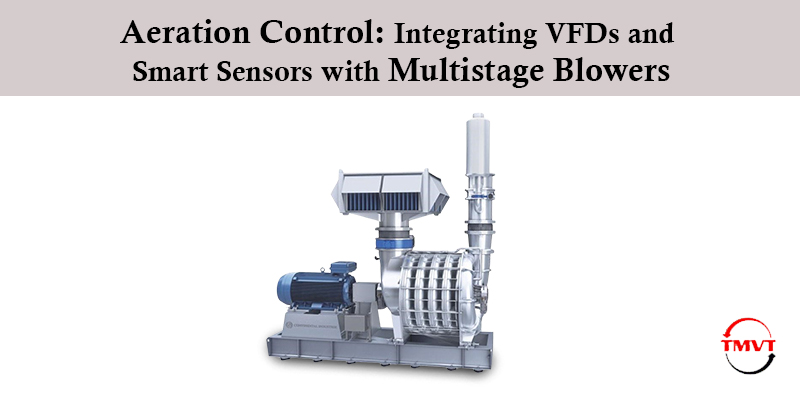
To understand the impact of advanced control systems, one must first examine the robust mechanical architecture of the multistage centrifugal blower. To achieve precision control, you need a machine engineered for responsiveness. TMVT’s multistage centrifugal blowers and exhausters are the workhorses of large-scale industrial aeration.
Engineered for the Long Haul
Our blowers are dynamic radial compressors that build pressure incrementally through a series of precision-engineered stages.
- Modular Architecture: Typically configured with 7 to 10 stages, allowing us to stack pressure to meet your exact discharge setpoint (up to 1.8 bar).
- Superior Materials: We use precisely machined cast aluminium for the housing and high-strength SAE 1045 steel for the blower shaft, ensuring thermal stability and structural integrity.
- 100% Oil-Free Air: Critical for biological processes and sensitive gas handling, our design guarantees an oil-free discharge, protecting your biosecurity and downstream equipment.
| Technical Specification | TMVT Multistage Centrifugal Range Details |
| Flow Capacity | 100 to 70,000 m³/hr |
| Maximum Pressure | Up to 1.8 bar |
| Maximum Vacuum | Up to 6700 mm H2O (WG) |
| Standard Configuration | 7 to 10 Stages (Customizable) |
Performance Characteristics and Gas Handling
The performance curve of a TMVT multistage centrifugal blower is typically flatter than that of turbo-style blowers. This characteristic allows the flow rate to change significantly with relatively small changes in pressure, which is particularly advantageous in ventilation systems where system resistance might vary dynamically. Furthermore, TMVT engineers these systems for extreme durability; a properly maintained unit can have a functional lifespan of 10 to 15 years, even in severe industrial environments.
For specialized applications involving aggressive, toxic, or explosive gases, TMVT incorporates double mechanical seals to achieve airtight containment. This capability extends the utility of multistage blowers into the petrochemical and oil and gas sectors, where they serve as gas movers for large volumetric flows at moderate differential pressures.
The Mechanism of Advanced Aeration Control
The integration of VFDs and smart sensors transforms a traditional blower into an intelligent, responsive system. The core of this strategy is a closed-loop control system, typically managed by a central Programmable Logic Controller (PLC) featuring a user-friendly Human Machine Interface.
- Smart Sensing (The Input)
Dissolved Oxygen sensors, air flow meters, and pressure transmitters act as the eyes and ears of the system. In a wastewater environment, they monitor oxygen levels in real-time. If the organic load drops, the oxygen demand decreases.
- PLC Logic (The Decision)
The PLC receives this data and compares it to your optimal setpoint (typically 2.0 to 4.5 ppm for DO). Instead of just throttling the air, which wastes energy through mechanical resistance, the PLC calculates the exact speed adjustment needed.
- VFD Speed Control (The Action)
The VFD receives the signal and adjusts the electrical frequency supplied to the motor, changing the blower’s rotational speed. By slowing the motor down to meet lower demand, you eliminate the need for inefficient mechanical throttling valves.
Operational Stability and Process Benefits
Beyond energy savings, the integration of VFDs and smart sensors with TMVT blowers provides a suite of operational benefits that enhance process stability and reduce long-term maintenance costs.
Soft Start Capability and Mechanical Longevity
Traditional fixed-speed motors utilize across-the-line starters that cause a massive inrush of current during startup, often 600% to 800% of the motor’s full-load current. This hard start creates significant electrical stress on the plant’s power system and mechanical shock to the blower’s drive train, including the shaft, gears, and bearings.
TMVT systems equipped with VFDs utilize a soft start feature, gradually ramping the motor speed from zero to the required operating point. This eliminates inrush current spikes and minimizes mechanical torque stress, which directly translates to an extended lifespan for the motor and the blower unit.3 Furthermore, because the blower often operates at lower average speeds compared to a fixed-speed unit, the overall wear and tear on components like the Type C3 ball bearings or hydrodynamic bearings is significantly reduced.
Precision Dissolved Oxygen (DO) Control
In biological wastewater treatment, maintaining a stable DO level is paramount. Over-aeration is not only a waste of energy but can also lead to the shearing of biological flocs, negatively impacting the settling process in secondary clarifiers. Under-aeration, conversely, can lead to the death of aerobic bacteria and the failure of the treatment process.
The responsiveness of a VFD-controlled TMVT blower allows for much tighter control of DO levels than mechanical throttling. While traditional systems might “hunt” or cycle around a setpoint, the electronic control loop provides a smooth, accurate response to variable influent conditions, ensuring that the microbial community in the aeration basin remains healthy and productive.
Reduced Noise and Vibration
Noise pollution is a significant concern in industrial environments. Multistage centrifugal blowers, by their nature, provide a quieter, more stable airflow compared to positive displacement technologies. However, operating a blower at a lower speed via a VFD further decreases noise levels significantly. TMVT’s multistage designs inherently reduce pulsations, and when paired with optional sound-insulating acoustic hoods, noise levels can be reduced by 10 to 12 dBA, creating a safer and more comfortable work environment for plant personnel.
Advanced Control Philosophies: MOV and ABAC
For larger facilities with multiple aeration zones and blowers, TMVT integrates even more sophisticated control strategies to maximize system-wide efficiency.
Most Open Valve (MOV) Logic
In systems with multiple aeration basins fed by a common air header, the pressure in the header must be high enough to overcome the resistance of the most restrictive path. MOV logic, managed by the TMVT PLC system, focuses on keeping the system pressure at the lowest possible level. The system monitors the positions of all individual basin valves; if a valve is closing too much, it indicates excessive header pressure. The PLC then signals the VFDs to slow down the blowers, allowing the valves to open wider to meet the flow demand at a lower pressure. This minimizes the work required by the blowers and significantly boosts energy efficiency.
Ammonia-Based Aeration Control
While DO control is the standard, many modern plants are moving toward Ammonia-Based Aeration Control. By placing an ammonia sensor at the effluent of the aeration zone, the system can determine the actual nutrient load being treated. Since the oxidation of ammonia is a primary consumer of oxygen, the PLC can adjust the DO setpoint dynamically based on ammonia levels. This prevented over-aeration during periods of low ammonia loading, leading to additional energy savings of up to 45% compared to fixed DO setpoint control.
Specialized Applications and Global Engineering Standards
TMVT’s ability to supply machines globally is supported by a commitment to meeting diverse international standards and handling specialized industrial challenges.
ATEX Certification for Hazardous Environments
In sectors like biogas, petrochemicals, and offshore oil and gas, blowers often operate in hazardous zones where explosive gases are present. TMVT manufactures ATEX-certified blowers designed to eliminate all potential ignition sources. These units are built to meet ATEX 2014/34/EU standards for Zone 1 areas, featuring flameproof enclosures, specialized non-sparking internal clearances, and 100% oil-free gas paths.
In biogas plants, for instance, TMVT’s multistage blowers are used to move gas containing hydrogen sulphide and moisture. The robust cast iron construction is stress-relieved after pre-machining to prevent warping at high operating temperatures, ensuring reliability in corrosive settings.
Zero Liquid Discharge (ZLD) Systems
Zero Liquid Discharge is an increasingly common requirement in water-intensive industries. TMVT blowers play a critical role in ZLD variants that involve mechanical vapor recompression (MVR). In these systems, the blower compresses the process vapor, raising its temperature and pressure so it can be reused as a heating medium. The integration of VFDs is vital here to match the compression work exactly to the evaporation rate, maximizing the thermal efficiency of the entire ZLD plant.
| Application Area | Role of TMVT Blower with VFD/Sensors | Key Benefit |
| Wastewater (ASP/SBR) | DO-based speed control of aeration air | 20-40% energy savings; process stability |
| Biogas Recovery | ATEX-certified movement of methane/H2S | Explosion safety; oil-free gas stream |
| Petrochemical | Boosting hydrocarbon gases to process pressure | Leak-proof sealing; high-volume reliability |
| ZLD (MVR) | Recompression of process vapours | Thermal efficiency; 70% steam reduction |
| Pneumatic Conveying | Adjusting air volume to solid loading ratio | Reduced material attrition; energy efficiency |
Maintenance, Remote Monitoring, and Predictive Analytics
The transition to VFD-integrated blowers also marks a shift toward data-driven maintenance strategies. Modern TMVT systems can be fully integrated with Supervisory Control and Data Acquisition systems and IoT platforms.
Real-Time Monitoring and Diagnostic Alarms
The HMI on a TMVT control panel provides operators with instant visibility into critical performance metrics. Parameters like motor winding temperature, bearing vibration, discharge pressure, and current draw are monitored continuously. If any parameter deviates from safe operating limits, the PLC triggers automated alarms or initiates safety shutdown procedures to prevent catastrophic failure.
Predictive Maintenance and TCO
By logging historical data, engineers can identify wear patterns before they lead to downtime. For example, a gradual increase in motor current at a constant speed might indicate fouled filters or increasing internal clearances. This predictive approach allows maintenance to be scheduled during planned outages, significantly reducing the Total Cost of Ownership compared to traditional run-to-fail models.
Because VFDs reduce the mechanical stress on the blower, maintenance intervals for lubrication and seal inspections are often extended. TMVT’s oil-free design further simplifies maintenance by eliminating the need for complex oil filtration and cooling systems in the gas path.
Why TMVT – A Global Leader in Blower Engineering
With a legacy dating back to 1948 and operating as TMVT since 1991, we have evolved into one of India’s leading manufacturers of high-end air and gas handling solutions.
- Global Benchmarks: We serve a global clientele of over 1000+ customers, meeting international standards like API and ISO.
- Tailor-Made Engineering: We don’t just sell blowers; we design systems. Whether you need specialized metallurgy for corrosive gases or a fully integrated PLC control package, our in-house R&D delivers.
- Quality Assurance: Every TMVT unit is individually tested for capacity, power, noise, and vibration on our performance benches before shipment.
Conclusion
The integration of VFDs and smart sensors with TMVT multistage blowers is the gold standard for modern aeration. It is a shift from running machines to managing processes. By leveraging the physical laws of efficiency and TMVT’s robust engineering, your facility can achieve lower OPEX, higher stability, and a reduced environmental footprint.
TMVT Industries Pvt. Ltd. continues to lead the way in this field, combining robust Indian manufacturing with global engineering standards. Whether the application is the aeration of organic waste in a municipal plant, the recompression of vapours in a ZLD system, or the safe handling of explosive gases in a refinery, the combination of TMVT’s superior blower design and integrated control intelligence delivers the performance today’s industry demands.
Ready to Optimize Your Aeration Process?
Drive your facility towards higher productivity and lower operational costs with TMVT’s engineered blower solutions. Our team of experts is ready to help you design a system tailored to your specific flow and pressure requirements.
Discover TMVT’s Advanced Multi-stage Centrifugal Blower & Exhauster Range.

TMVT Team
Serving as the Editorial Lead at TMVT, I am a digital content expert passionate about manufacturing innovation and industrial efficiency, committed to delivering high-quality updates and technical guides on machinery trends for our global client base.